
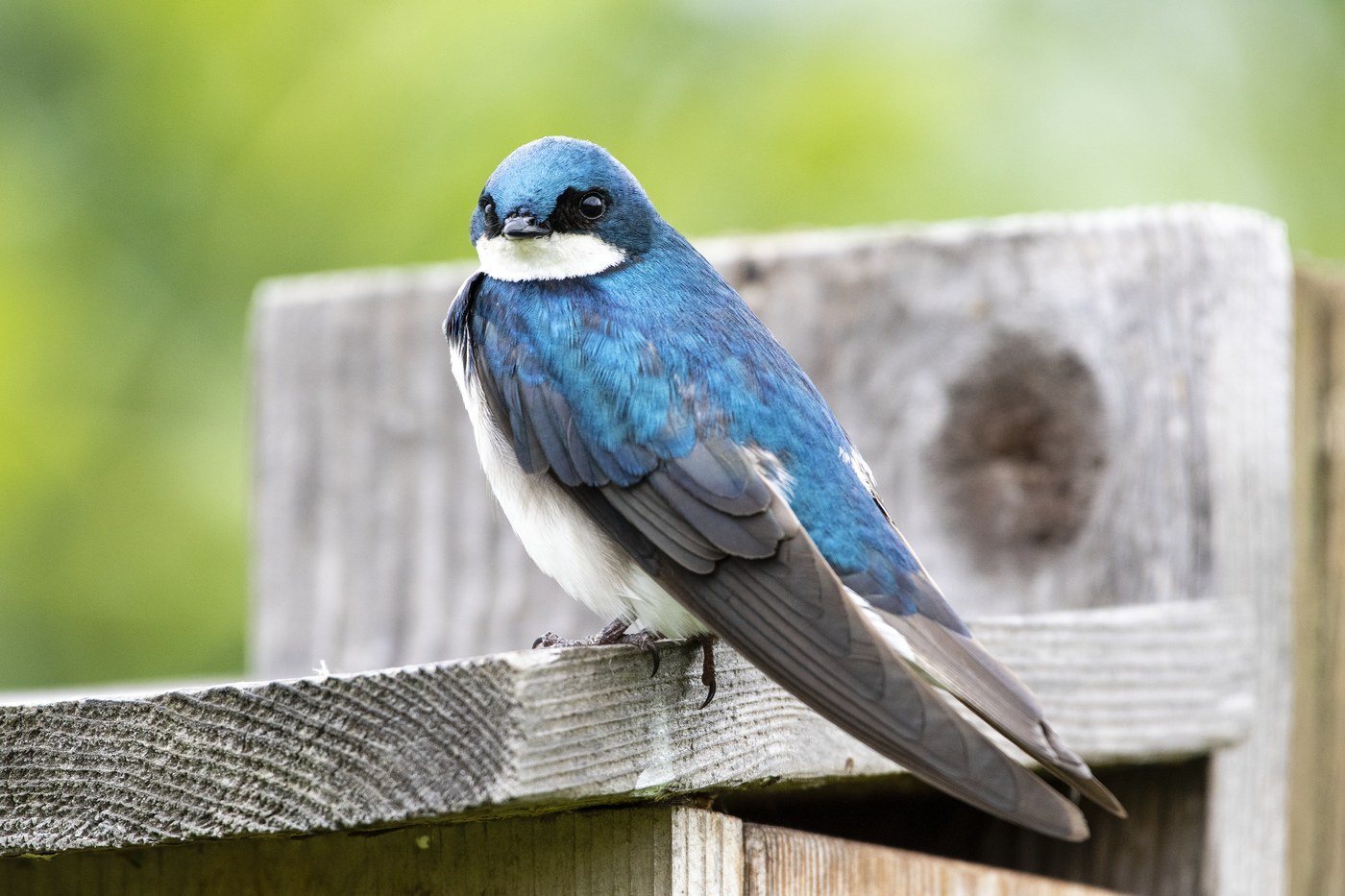
Tree Swallow
Tachycineta bicolor
A gleaming blue-green and white cavity-nesting swallow, one of the earliest swallows to arrive each spring and among the most cold-hardy.
- Size
- 13-16 cm (5.1-6.3 in) long, 30-35 cm (11.8-13.8 in) wingspan
- Habitat
- open areas near water with nearby tree cavities or nest boxes
- Type
- songbird
Spotted a bird like this?
Identify any bird from a photo, free.
Overview
The Tree Swallow is a strikingly clean-cut swallow with an iridescent blue-green back and crisp white underparts, common across much of North America. Males show the brightest, most saturated iridescence; females and immatures can appear duller, sometimes brownish above, especially in their first year.
Unlike most swallows, which nest on cliffs, banks, or structures, Tree Swallows are cavity nesters, relying on old woodpecker holes and natural tree cavities — and readily adopting nest boxes, which has made them a favorite of backyard birders and a model species for nest-box research.
How to identify it
Key field marks
- Glossy blue-green (sometimes appearing steel-blue) upperparts
- Sharp white underparts extending up to the chin
- Slightly notched tail (not deeply forked)
- Small black eye set against the clean white face
Similar species
Violet-green Swallow (western range overlap) shows white patches that wrap around the face above and behind the eye and white flank patches visible from above; Tree Swallow's white stops cleanly at the eye. Barn Swallow has a deeply forked tail and orange throat, quite different from Tree Swallow's clean white underparts.
Habitat & range
Habitat
Breeds in open or semi-open areas near water — marshes, wet meadows, lakeshores, and beaver ponds — with access to standing dead trees, old woodpecker cavities, or nest boxes for nesting.
Range
Breeds across most of Canada and the northern two-thirds of the United States. Because it can switch to eating berries when insects are scarce, Tree Swallow is one of the earliest swallows to arrive in spring and among the last to depart in fall, and some winter as far north as the southern United States.
Behavior & voice
Behavior
Highly gregarious outside the breeding season, Tree Swallows form large flocks that can number in the hundreds of thousands during migration and winter, often roosting communally in marshes.
Voice
Gives a cheerful, liquid, chattering series of notes, often rendered as a bubbly "weet, weet, weet-trit," sung frequently around the nest site.
Feeding and nesting
Feeds mainly on flying insects caught over water and fields, switching to bayberries and other fruit during cold snaps when insects are unavailable — a key adaptation allowing early spring arrival and late fall departure. Nests in a cavity lined with grass and, distinctively, large white feathers, which the birds actively collect and carry, sometimes from far away.
Frequently asked questions
How do you identify a Tree Swallow?
Look for glossy blue-green upperparts, clean white underparts up to the chin, and a slightly notched tail, often seen near water with tree cavities or nest boxes.
Where do Tree Swallows nest?
In cavities: old woodpecker holes, natural tree hollows, or nest boxes, which they readily accept, making them popular subjects for backyard nest-box programs.
What do Tree Swallows eat?
Mainly flying insects, but they can switch to eating berries, especially bayberries, during cold weather when insects are scarce.
Why do Tree Swallows arrive so early in spring?
Their ability to eat berries when insects aren't yet flying allows them to tolerate cold snaps, so they can arrive earlier and depart later than most other swallow species.
Why do Tree Swallows collect white feathers?
They line their nest cavities with large feathers, often held aloft and caught in flight as a form of play or practice; the function may relate to insulation or nest defense.
Tree Swallow guides
In-depth guides for identifying, finding, and understanding Tree Swallow.
Other birds you may enjoy

Black Redstart
13-14.5 cm (5.1-5.7 in) long, 23-26 cm wingspan

Black-throated Sparrow
12-14 cm (4.7-5.5 in) long, about 19-20 cm (7.5-8 in) wingspan

Greater Bird-of-paradise
Body about 43 cm; males with additional flank plumes up to 50 cm and long tail wires

Blue Tit
11-12 cm (4.3-4.7 in) long, 17-20 cm wingspan

Red-billed Quelea
11.5–13 cm long, wingspan about 20–22 cm
White-plumed Antbird
13-14 cm (5-5.5 in) long

Pyrrhuloxia
19-22 cm (7.5-8.7 in) long, 30 cm wingspan

Blue-gray Tanager
16-18 cm (6-7 in) long

Blackburnian Warbler
11-13 cm (4.3-5.1 in) long, 20-22 cm wingspan

Bluethroat
13-14 cm (5.1-5.5 in) long, 20-22 cm wingspan

Eurasian Nuthatch
12-14.5 cm (4.7-5.7 in) long, 22.5-27 cm wingspan

Wood Thrush
19-21 cm (7.5-8.3 in) long, about 33 cm (13 in) wingspan