
Tree Swallow Identification Guide
A common North American cavity-nesting swallow with iridescent blue-green upperparts and crisp white underparts, easily told from similar swallows by its clean white face and shallowly notched tail.
Read the full Tree Swallow encyclopedia entry →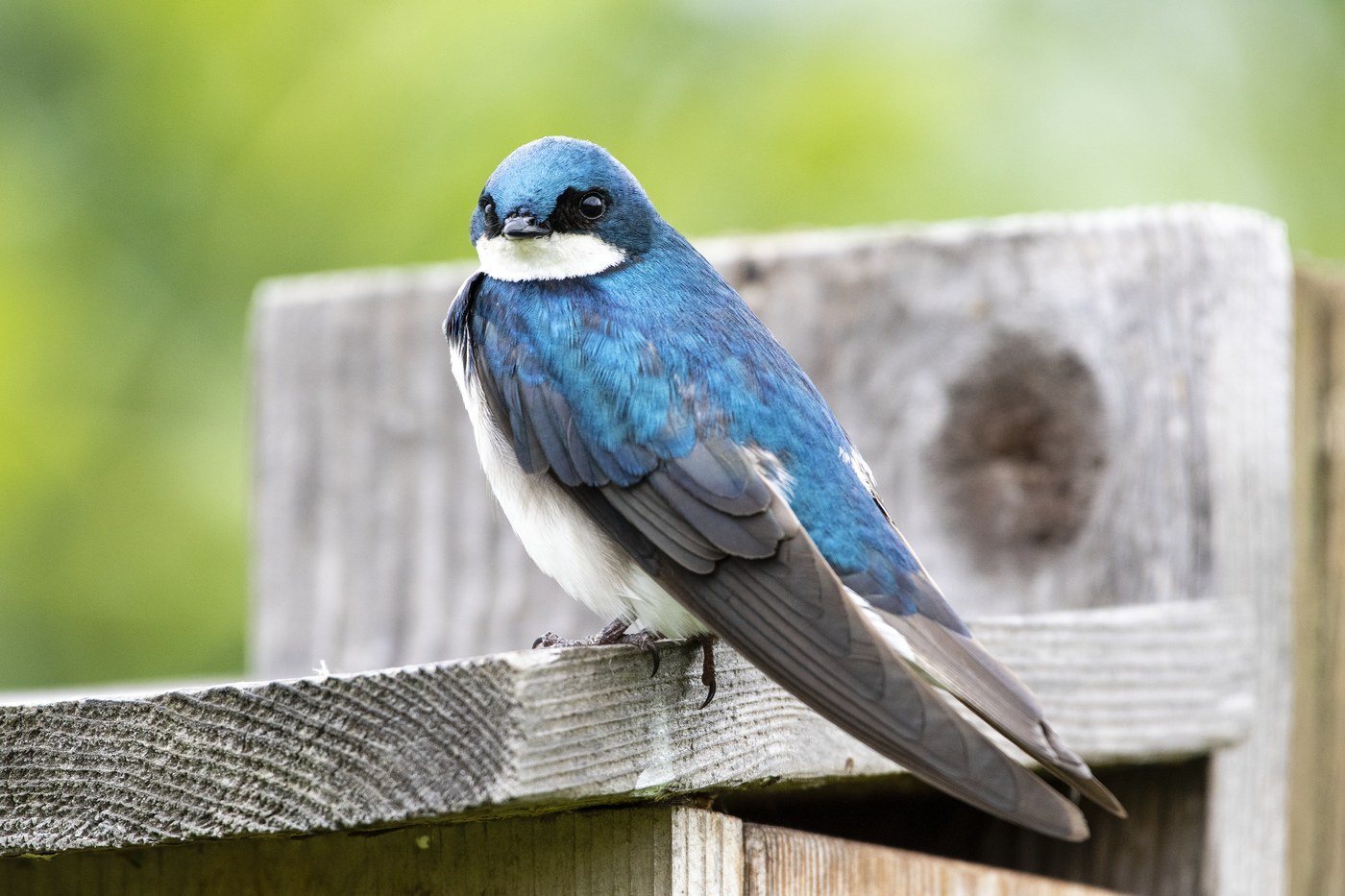
Key Field Marks
- Size & shape: A small, compact swallow with fairly broad-based, pointed wings and a short, only shallowly notched tail (not deeply forked like Barn Swallow).
- Plumage: Adults show glossy blue-green (can look almost teal or bottle-green in different light) upperparts contrasting sharply with immaculate white underparts, including a clean white face and throat with no dark mask.
- Sexes: Males are brighter, more uniformly iridescent blue-green; females and first-year birds are duller, browner above, sometimes with a faint breast band suggestion, but always white below.
- Behavior: Highly aerial, feeding on flying insects with quick, buoyant wingbeats and long glides low over water, fields, and marshes. Often seen in large flocks, especially during migration, swirling over wetlands or gathering by the thousands on wires in late summer/fall.
- Nesting: A secondary cavity nester, using old woodpecker holes and readily taking to nest boxes — often seen carrying white feathers, which it uses to line the nest.
Separating Tree Swallow from Similar Species
- Violet-green Swallow (western species): Shows white patches on the face that extend above and around the eye and onto the rump sides (visible as white flank patches nearly meeting over the rump), whereas Tree Swallow has a solid dark cap down to the eye and no white rump patches.
- Barn Swallow: Has a deeply forked "swallow tail," rusty-buff underparts and throat, and a dark chestnut forehead/throat — very different from Tree Swallow's clean white underparts and shallow tail notch.
- Bank Swallow / Northern Rough-winged Swallow: Both are brown above (not iridescent blue-green) with a distinct brown breast band (Bank Swallow) or dingy brown throat wash (Rough-winged) — Tree Swallow never shows brown upperparts or a breast band.
- Female/juvenile Tree Swallow vs. Rough-winged Swallow: Can look superficially similar (dull brown-ish above), but Tree Swallow retains a clean white underside without the smudgy brown throat wash of Rough-winged.
Where & When to See It
Breeds widely across Canada and the northern-to-mid United States, especially near open water, wetlands, and fields with nearby dead trees or nest boxes. Highly migratory; one of the earliest swallows to return in spring and among the latest to depart in fall because it can subsist on berries (notably wax myrtle/bayberry) when insects are scarce, allowing it to winter farther north than other swallows — from the southern U.S. and Mexico south to Central America.
Voice
Gives a liquid, cheerful chattering song and calls of bright, twittering "chi-veet" or "silip" notes, often delivered in a cascading series from a perch or in flight; flocks produce a constant twittering chorus, especially around nest boxes and staging areas.
Frequently asked questions
How do I tell a Tree Swallow from a Violet-green Swallow?
Check the face and rump: Violet-green Swallow shows white extending above and behind the eye and white patches on the sides of the rump, while Tree Swallow has a solid dark cap reaching down to the eye and a completely dark rump with no white flank patches.
Why are Tree Swallows often seen so early in spring and late in fall?
Unlike most swallows, Tree Swallows can switch to eating berries (especially bayberry/wax myrtle) when flying insects aren't available, letting them arrive earlier and linger later than strictly insectivorous swallows.
Are Tree Swallows cavity nesters?
Yes, they nest in natural cavities and old woodpecker holes and readily use human-provided nest boxes, which has made them one of the best-studied songbirds in North America.
What does a female or young Tree Swallow look like compared to a male?
Females and first-year birds are duller and browner above rather than bright iridescent blue-green, but they still show the same clean white underparts and face pattern that separate Tree Swallow from other brown-backed swallows.