
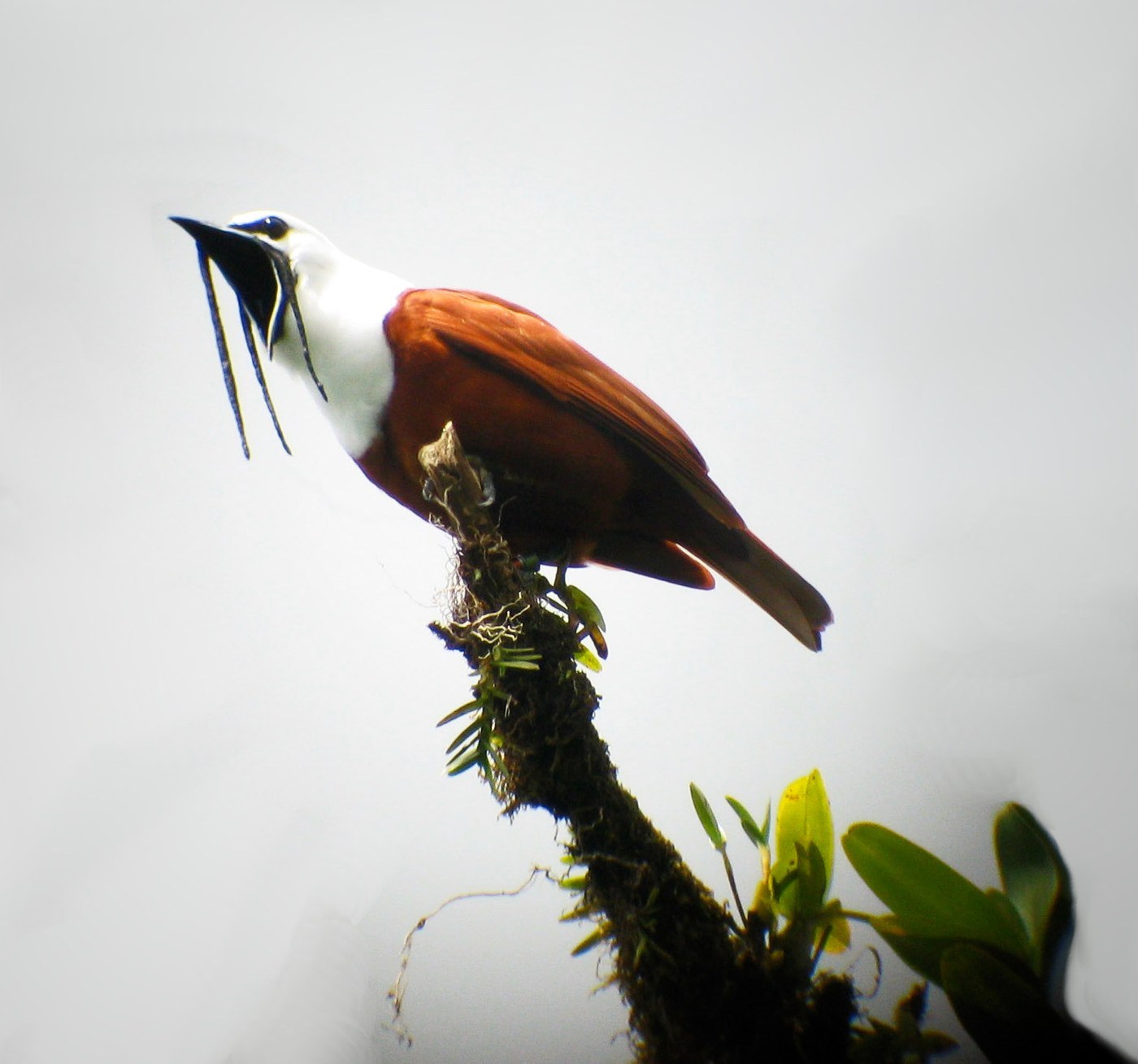
Three-wattled Bellbird
Procnias tricarunculatus
A Central American cotinga whose male sports three long, worm-like black wattles dangling from the base of the bill and delivers an explosive, far-carrying call.
- Size
- 25-30 cm (10-12 in) long
- Habitat
- montane cloud forest (breeding) and lowland forest (non-breeding)
- Type
- songbird
Spotted a bird like this?
Identify any bird from a photo, free.
Overview
The Three-wattled Bellbird is a large, unmistakable cotinga of Central American cloud forest, named for the male's three long, thin, worm-like black wattles that hang from the base of the bill, one from each side of the gape and one from the center, swinging and twisting as the bird moves or calls. Males have a rich chestnut-brown body with a contrasting white head and throat, while females are plain olive-green with yellowish, faintly streaked underparts and lack any wattles.
The species is an altitudinal migrant, breeding in mid- to high-elevation cloud forest and moving to lower elevations, including the Caribbean lowlands, outside the breeding season in search of fruiting trees. Males deliver one of the most explosive and startling calls in the Neotropics, a loud, sharp "BONK" that can be heard ringing through the forest from a considerable distance.
How to identify it
Key field marks
- Males: chestnut-brown body, white head and throat, three long black wattles hanging from the base of the bill
- Females: plain olive-green above, yellowish streaked underparts, no wattles
- Stocky cotinga build
- Extremely loud, explosive "BONK" call, often heard before the bird is seen
Similar species
- Bearded Bellbird has a single curtain-like beard of wattles rather than three distinct wattles, and occurs in South America rather than Central America.
- No other Central American bird shows the male's combination of chestnut body, white head, and triple wattles.
Habitat & range
Habitat
Breeds in montane cloud forest, typically 1,000-2,500 m elevation; moves to lowland and foothill forest outside the breeding season.
Range
Found from Honduras south through Costa Rica and Panama, with the largest populations centered on Costa Rica's Monteverde and Talamanca regions.
Migration
An altitudinal migrant, breeding in highland cloud forest and descending to lowland forest, including Caribbean-slope lowlands, for the non-breeding season, tracking the fruiting of favored tree species.
Behavior & voice
Behavior
Males perch prominently and call persistently from exposed canopy perches to attract mates, often returning to the same favored calling perches across seasons; otherwise inconspicuous and often solitary.
Voice
An extraordinarily loud, explosive "BONK" call, one of the loudest sounds produced by any bird, along with sharper accompanying notes during display.
Feeding
Feeds almost entirely on fruit, particularly wild avocados and other lipid-rich fruits, and is an important seed disperser for many cloud forest trees.
Nesting
Males do not participate in nesting; females build a flimsy platform nest and raise the single chick alone.
Frequently asked questions
Why is the Three-wattled Bellbird considered Vulnerable?
Its dependence on both intact highland cloud forest for breeding and lowland forest for the non-breeding season makes it especially vulnerable to habitat loss and fragmentation at multiple elevations, which has driven population declines.
How do you identify a Three-wattled Bellbird?
Adult males are chestnut-brown with a white head and throat and three long, thin black wattles dangling from the base of the bill; females are plain olive-green without wattles.
Why does the Three-wattled Bellbird migrate between elevations?
It breeds in mid- to high-elevation cloud forest but moves to lower-elevation forest outside the breeding season to follow the availability of fruiting trees, particularly wild avocados.
What does a Three-wattled Bellbird eat?
Almost exclusively fruit, especially wild avocados and other lipid-rich fruits from forest trees.
Three-wattled Bellbird guides
In-depth guides for identifying, finding, and understanding Three-wattled Bellbird.
Other birds you may enjoy
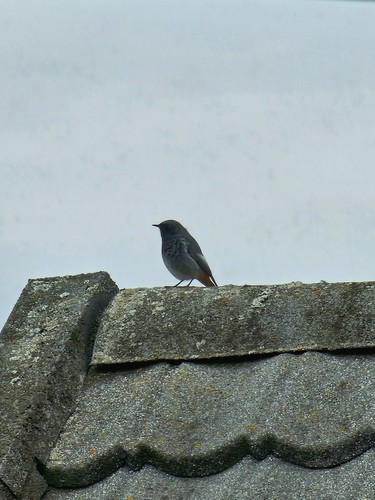
Black Redstart
13-14.5 cm (5.1-5.7 in) long, 23-26 cm wingspan
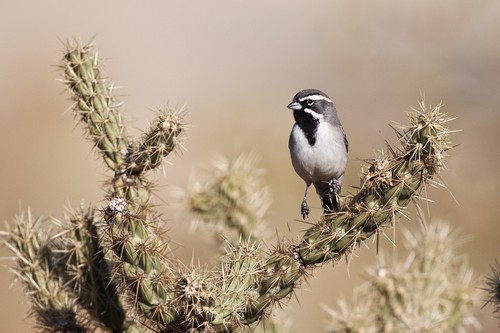
Black-throated Sparrow
12-14 cm (4.7-5.5 in) long, about 19-20 cm (7.5-8 in) wingspan
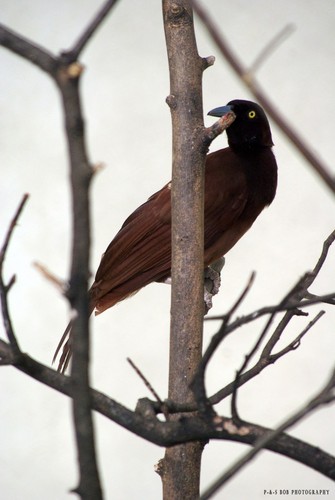
Greater Bird-of-paradise
Body about 43 cm; males with additional flank plumes up to 50 cm and long tail wires
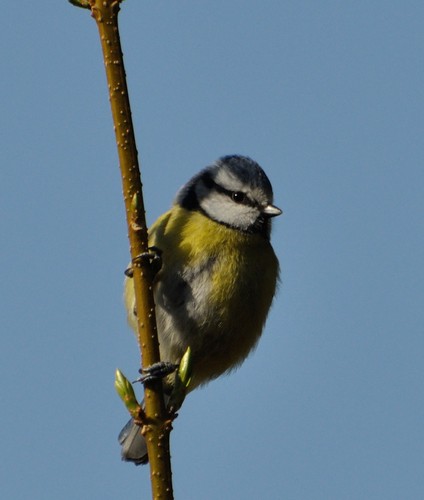
Blue Tit
11-12 cm (4.3-4.7 in) long, 17-20 cm wingspan
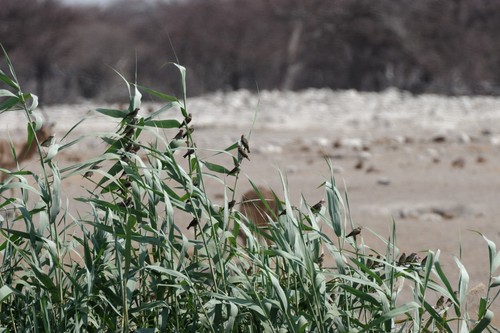
Red-billed Quelea
11.5–13 cm long, wingspan about 20–22 cm
White-plumed Antbird
13-14 cm (5-5.5 in) long
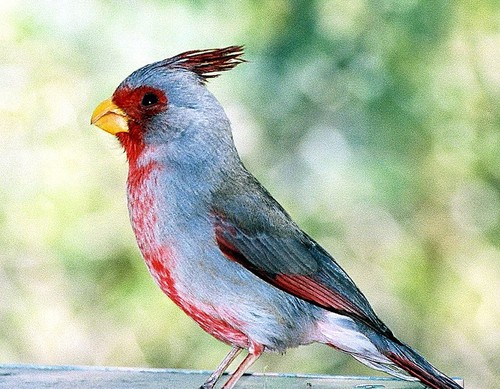
Pyrrhuloxia
19-22 cm (7.5-8.7 in) long, 30 cm wingspan
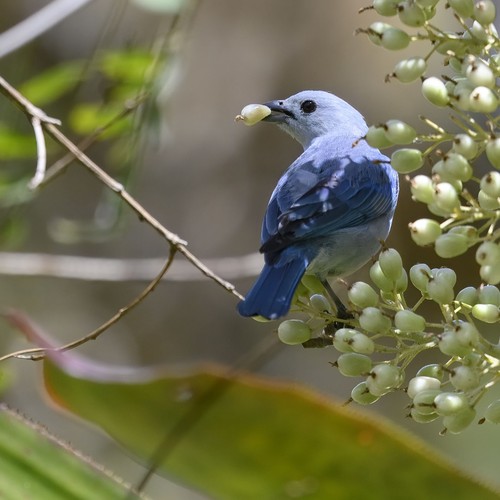
Blue-gray Tanager
16-18 cm (6-7 in) long
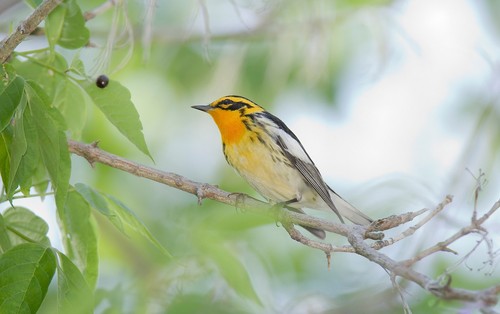
Blackburnian Warbler
11-13 cm (4.3-5.1 in) long, 20-22 cm wingspan
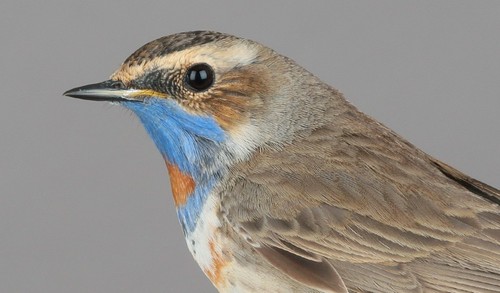
Bluethroat
13-14 cm (5.1-5.5 in) long, 20-22 cm wingspan
Eurasian Nuthatch
12-14.5 cm (4.7-5.7 in) long, 22.5-27 cm wingspan
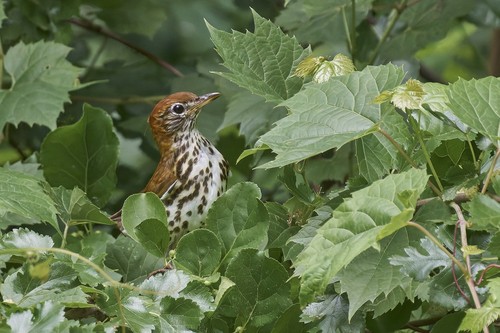
Wood Thrush
19-21 cm (7.5-8.3 in) long, about 33 cm (13 in) wingspan