
Three-wattled Bellbird Identification Guide
The Three-wattled Bellbird is a Central American cloud-forest cotinga whose chestnut-and-white male, adorned with three dangling black wattles, produces one of the loudest and most explosive calls of any bird.
Read the full Three-wattled Bellbird encyclopedia entry →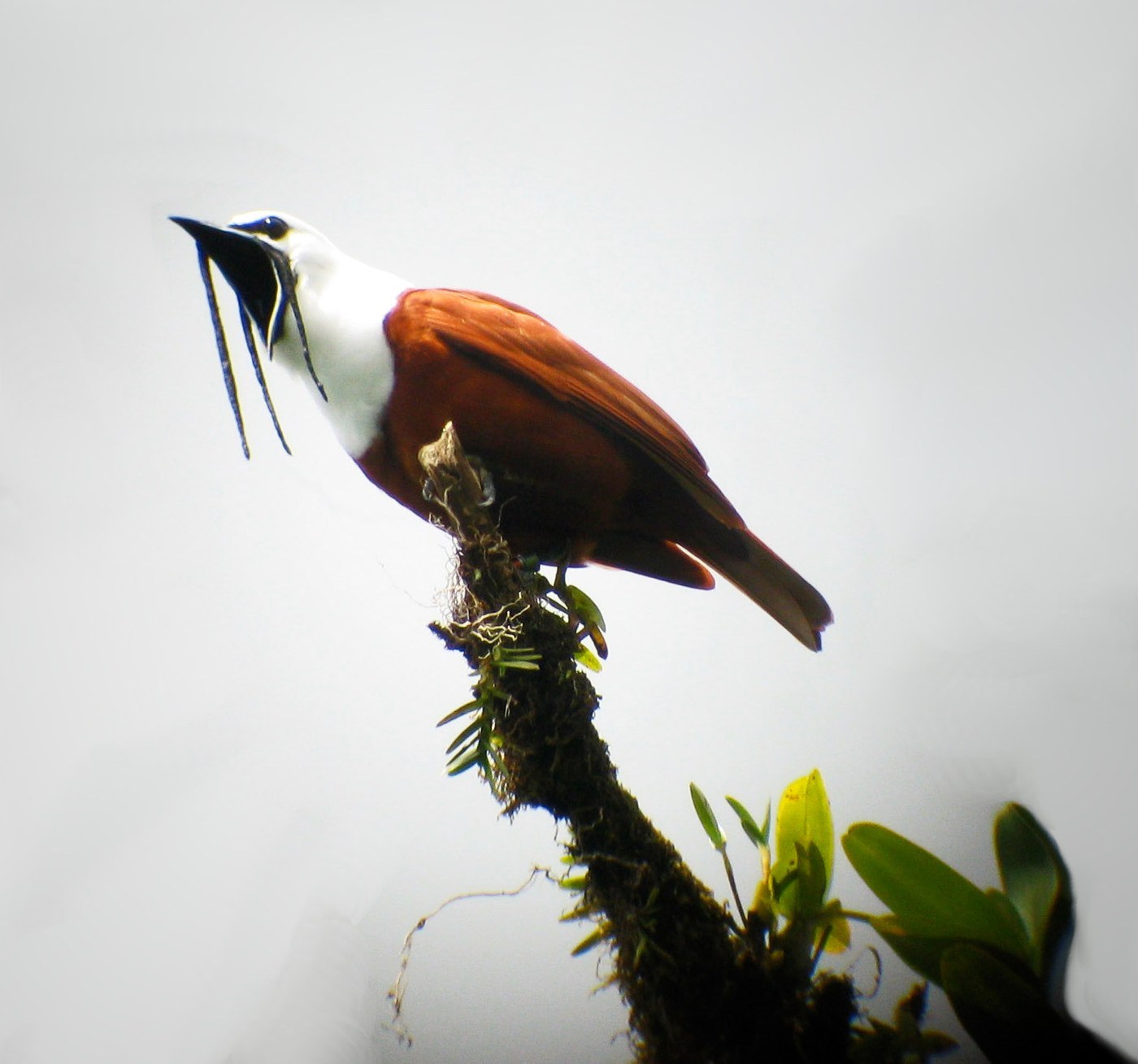
Key Field Marks
- Size & shape: A stocky, robin-plus-sized cotinga, 25–30 cm, with a fairly large head and short tail relative to body bulk.
- Adult male: Unmistakable — rich chestnut-brown body with a contrasting white head and neck, and three long, thin, worm-like black wattles hanging from the base of the bill that swing and wriggle during calling.
- Female and immature: Entirely different in appearance — olive-green above with yellow-streaked underparts and no wattles, easily mistaken for another species entirely if the male is not also present.
- Behavior: Males occupy exposed display perches high in the canopy, calling loudly and periodically gaping the bill wide while wattles swing; the species is an altitudinal migrant, shifting elevation to track fruiting trees.
Separating Three-wattled Bellbird from Similar Species
- Male: No other Central American bird combines a white head/neck with a chestnut body and dangling facial wattles — identification is straightforward once seen well.
- Female: Much harder — plain olive above with yellow-streaked underparts recalls female tanagers or other cotingas; best confirmed by association with a calling male nearby, habitat (cloud forest canopy), and voice.
- Older immature males show a patchwork of chestnut and olive as they molt into adult plumage, which can look odd but is diagnostic of this transitional stage.
Where and When to See One
- Range: Endemic to Central American highlands — Costa Rica, western Panama, and locally into Nicaragua and Honduras.
- Habitat: Humid montane and cloud forest; the species migrates altitudinally, breeding at higher elevations (around 1,000–2,000 m, e.g., Monteverde, Costa Rica) in the wet season and dropping to lower-elevation Pacific slope forest and even Caribbean lowlands outside the breeding season.
- Season: Males call most persistently during the breeding season (roughly March–September in Costa Rica's Monteverde area), making this the best window to hear and locate them at traditional display sites.
Voice
- One of the loudest bird vocalizations in the world: an explosive, metallic "BONK!" that carries for hundreds of meters through the forest, likened to a hammer striking an anvil, interspersed with softer whistled and buzzy notes during extended display bouts.
Frequently asked questions
Why does the male Three-wattled Bellbird have wattles?
The three fleshy black wattles are used in visual display during calling, swinging and wriggling to attract females and signal to rival males.
Why do female and male Three-wattled Bellbirds look so different?
Like many cotingas, the species shows strong sexual dimorphism driven by sexual selection — showy males compete for female attention while cryptic olive females handle nesting duties alone.
Where is the best place to see a Three-wattled Bellbird?
The Monteverde Cloud Forest region of Costa Rica is the classic site, especially during the breeding season when males hold traditional calling perches.
What makes the Three-wattled Bellbird's call so notable?
Its explosive metallic 'bonk' is among the loudest vocalizations of any bird species, audible from a great distance through dense forest.