
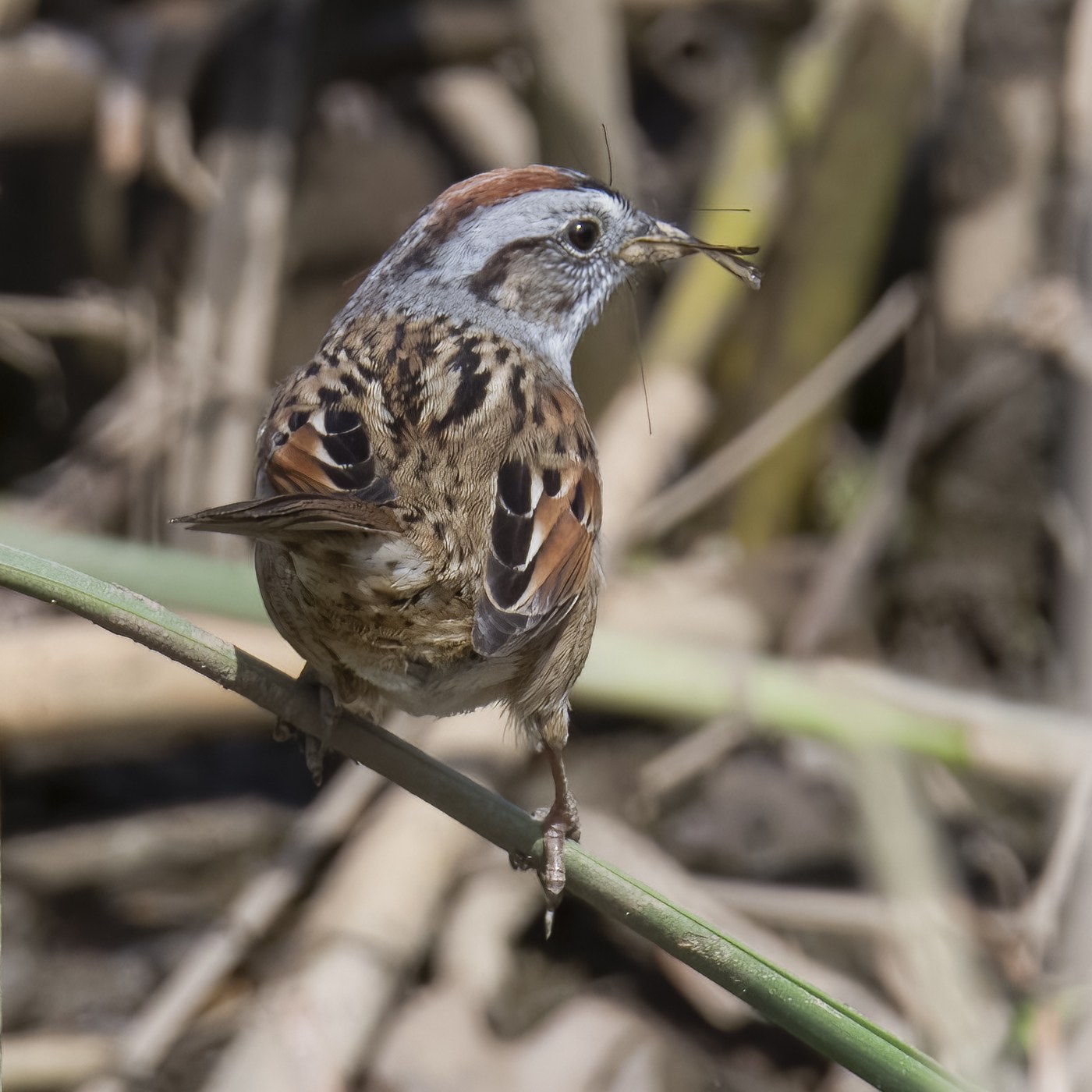
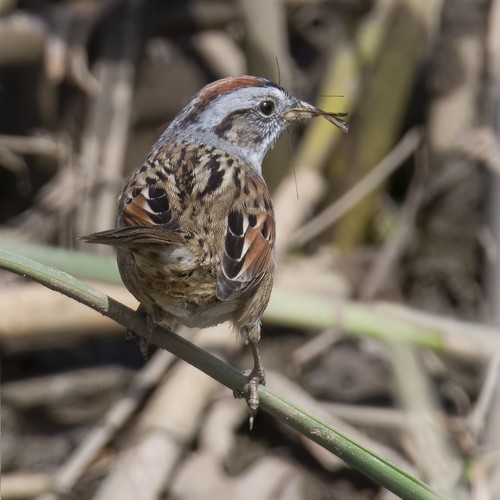
Swamp Sparrow
Melospiza georgiana
A rusty-winged, gray-breasted sparrow closely tied to marshes and wetlands, with a slow, musical trill.
- Size
- 12-15 cm (4.7-5.9 in) long, 18-19 cm wingspan
- Habitat
- freshwater and brackish marshes, wet meadows, and boggy thickets
- Type
- songbird
Spotted a bird like this?
Identify any bird from a photo, free.
Overview
The Swamp Sparrow is a chunky, marsh-loving sparrow with rich rufous-brown wings contrasting against a gray face and breast, and a streaked brown back. Breeding adults show a neat rusty cap, while non-breeding and immature birds have a more streaked crown with a paler central stripe.
The throat is whitish and unmarked, and the overall look is warmer and richer in tone than many other streaked brown sparrows, with the rufous wing color being especially noticeable in flight or when the bird flicks its wings while foraging.
How to identify it
Key field marks
- Rich rufous-brown wings contrasting with a gray breast and face
- Rusty cap (breeding adults) or streaked crown (immatures/non-breeding)
- Plain whitish, unstreaked throat
- Long legs suited to wading in shallow water and mud, and a habit of pumping its tail
Similar species
- Song Sparrow is larger with heavy dark streaking across the breast, unlike the Swamp Sparrow's plainer gray breast.
- Lincoln's Sparrow has fine dark streaking on a buffy breast band, quite different from the Swamp Sparrow's plain gray underparts and rustier wings.
Habitat & range
Swamp Sparrows breed across a broad band of Canada and the northern United States, particularly the Great Lakes region and the Northeast, in freshwater marshes, wet meadows, bogs, and areas with cattails, sedges, or shrubby wetland vegetation. A separate coastal saltmarsh-breeding population occurs along parts of the mid-Atlantic coast.
In winter, the species moves to the southeastern and south-central United States, again favoring marshes, wet fields, and brushy wetland edges, and is less commonly found away from wet habitats at any season.
Behavior & voice
Swamp Sparrows forage low in marsh vegetation and at the water's edge, often wading into shallow water to pick insects and other invertebrates from the mud or water surface, a habit shared by few other sparrows. They tend to skulk in dense marsh vegetation, often more easily heard than seen.
The song is a slow, sweet, monotone trill, all on one pitch, distinguishing it from the more variable songs of other Melospiza sparrows; the call is a hard, sharp "chip." Diet shifts seasonally from mostly insects and aquatic invertebrates in the breeding season to more seeds in winter. Nests are well hidden low in marsh vegetation, often just above the water, with typical clutches of three to five eggs.
Frequently asked questions
How do you identify a Swamp Sparrow?
Look for a chunky sparrow with rich rufous-brown wings, a gray breast and face, a rusty cap, and a plain whitish throat, usually found in or near marshy vegetation.
What does a Swamp Sparrow sound like?
A slow, sweet trill given all on one pitch, more monotone than the songs of related sparrows like the Song Sparrow.
Where do Swamp Sparrows live?
In freshwater marshes, wet meadows, and boggy wetlands across Canada and the northern US in summer, moving to marshes and wet fields of the southeastern US in winter.
What is the difference between a Swamp Sparrow and a Song Sparrow?
Swamp Sparrows have plainer gray, unstreaked underparts and richer rufous wings, while Song Sparrows show heavy dark streaking across the breast, often converging into a central spot.
What do Swamp Sparrows eat?
Mostly insects and aquatic invertebrates gleaned from marsh vegetation, mud, or shallow water during the breeding season, shifting to more seeds in winter.
Swamp Sparrow guides
In-depth guides for identifying, finding, and understanding Swamp Sparrow.
Other birds you may enjoy

Black Redstart
13-14.5 cm (5.1-5.7 in) long, 23-26 cm wingspan

Black-throated Sparrow
12-14 cm (4.7-5.5 in) long, about 19-20 cm (7.5-8 in) wingspan

Greater Bird-of-paradise
Body about 43 cm; males with additional flank plumes up to 50 cm and long tail wires

Blue Tit
11-12 cm (4.3-4.7 in) long, 17-20 cm wingspan

Red-billed Quelea
11.5–13 cm long, wingspan about 20–22 cm
White-plumed Antbird
13-14 cm (5-5.5 in) long

Pyrrhuloxia
19-22 cm (7.5-8.7 in) long, 30 cm wingspan

Blue-gray Tanager
16-18 cm (6-7 in) long

Blackburnian Warbler
11-13 cm (4.3-5.1 in) long, 20-22 cm wingspan

Bluethroat
13-14 cm (5.1-5.5 in) long, 20-22 cm wingspan

Eurasian Nuthatch
12-14.5 cm (4.7-5.7 in) long, 22.5-27 cm wingspan

Wood Thrush
19-21 cm (7.5-8.3 in) long, about 33 cm (13 in) wingspan