
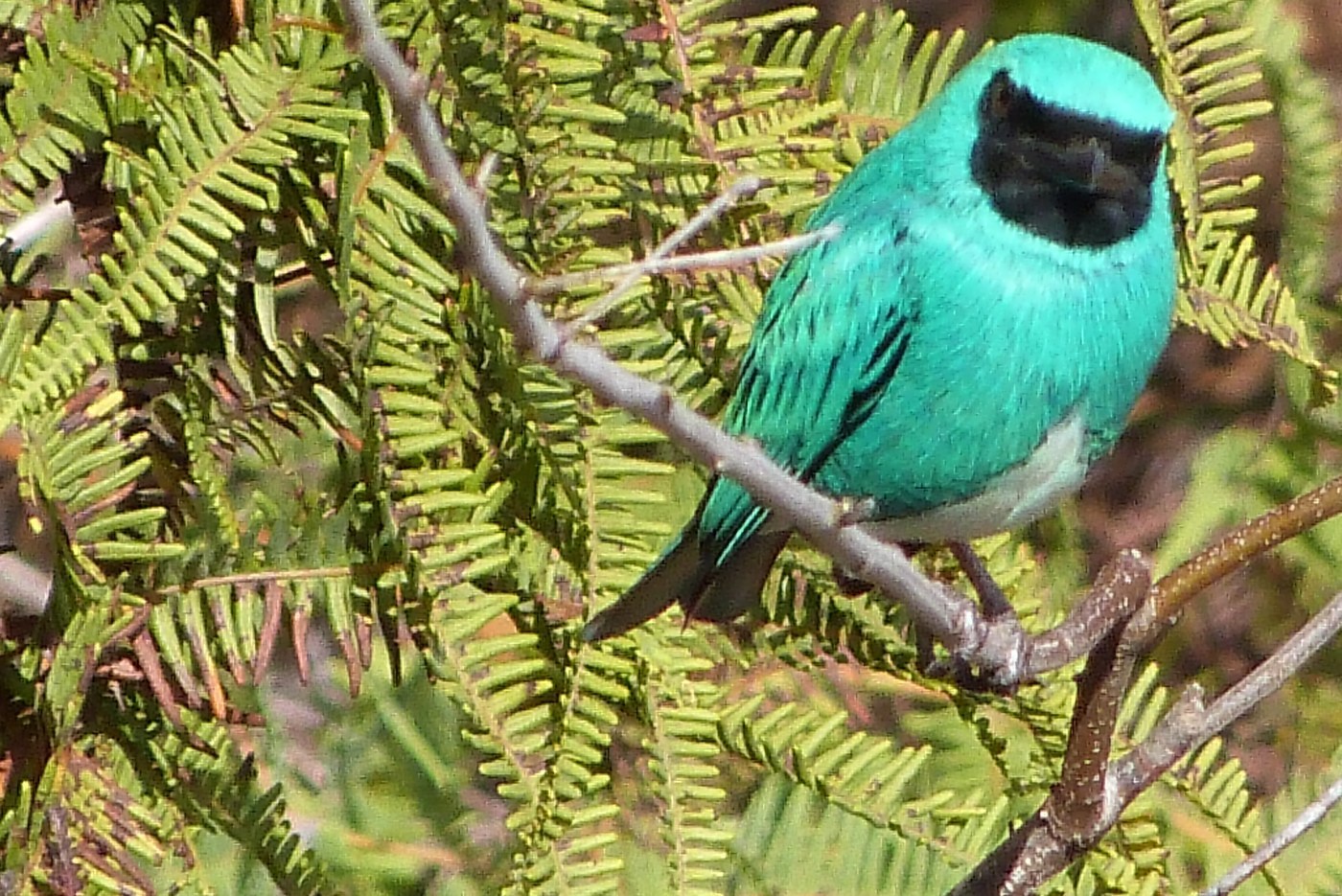
Swallow Tanager
Tersina viridis
A short-billed, swallow-shaped tanager, with turquoise-blue males and grass-green females, that hawks insects on the wing and nests in burrows.
- Size
- 13-14 cm (5-5.5 in) long
- Habitat
- forest edge, riverine woodland, savanna woodland, and clearings, mostly in the lowlands and foothills
- Type
- songbird
Spotted a bird like this?
Identify any bird from a photo, free.
Overview
The Swallow Tanager is an unusual member of the tanager family, distinctive enough to be placed in its own genus, Tersina. The male is a striking, brilliant turquoise-blue overall, with a black face, throat, and upper breast, black flight feathers, and clean white patches on the flanks and belly. The female and immature birds are entirely different, being bright grass-green above with a paler, sometimes yellowish-white, belly.
Both sexes share a distinctive body shape: a short, broad, slightly flattened bill and relatively long, pointed wings that give it an unusually streamlined, swallow-like profile compared to other tanagers, which is reflected in its common name.
This shape reflects its habit of catching insects in flight, a behavior less common among tanagers, most of which glean food from foliage rather than hawking insects aerially like a flycatcher or swallow.
How to identify it
Key field marks
- Male: brilliant turquoise-blue body, black face/throat/breast, white flank patches
- Female/immature: grass-green above, pale below
- Short, broad bill and relatively long, pointed wings
- Often seen perched on high bare branches or wires, or hawking insects in flight
Similar species
No other tanager shares the male's turquoise-and-black pattern combined with a swallow-like body shape. Female Swallow Tanagers can be confused with various green female tanagers or honeycreepers, but the short broad bill and streamlined wing shape help distinguish it.
Habitat & range
Habitat
Swallow Tanagers favor forest edge, riverine woodland, gallery forest, savanna woodland, and clearings with scattered tall trees, rather than dense forest interior.
Range
The species is broadly distributed across tropical South America, from Colombia, Venezuela, and the Guianas south through the Amazon basin to Bolivia, Paraguay, and northern Argentina, with some populations undertaking seasonal movements.
Migration
Some southern and Amazonian populations are migratory or make substantial seasonal movements tied to breeding and food availability, unlike most tanagers which are largely sedentary.
Behavior & voice
Behavior
Swallow Tanagers often perch conspicuously on high exposed branches, dead snags, or wires, from which they sally out to catch flying insects, a foraging style unusual for a tanager and reminiscent of flycatchers or swallows.
Voice
The voice includes thin, buzzy, high-pitched notes and chattering calls, generally unremarkable and given in flight or from perches.
Feeding
It feeds on a combination of fruit, taken from trees and shrubs, and flying insects caught in aerial sallies, giving it a broader foraging repertoire than most tanagers.
Nesting and breeding
Unusually for a tanager, the Swallow Tanager nests in burrows or cavities, often digging its own tunnel into an earthen bank, streamside cutbank, or using natural cavities and crevices, where the female lays and incubates the eggs.
Frequently asked questions
Why is it called the Swallow Tanager?
Its streamlined body, short broad bill, and habit of catching flying insects on the wing give it a shape and foraging style reminiscent of swallows, unusual among tanagers.
What does a male Swallow Tanager look like compared to a female?
Males are brilliant turquoise-blue with a black face and throat, while females and immatures are grass-green above and paler below.
Where does the Swallow Tanager nest?
Unusually for a tanager, it nests in burrows dug into earthen banks or in natural cavities and crevices.
What does the Swallow Tanager eat?
It eats both fruit and flying insects, the latter caught in aerial sallies from an exposed perch.
Is the Swallow Tanager migratory?
Some populations, especially in the southern part of its range, make seasonal movements, unlike most other tanager species.
Swallow Tanager guides
In-depth guides for identifying, finding, and understanding Swallow Tanager.
Other birds you may enjoy

Black Redstart
13-14.5 cm (5.1-5.7 in) long, 23-26 cm wingspan

Black-throated Sparrow
12-14 cm (4.7-5.5 in) long, about 19-20 cm (7.5-8 in) wingspan

Greater Bird-of-paradise
Body about 43 cm; males with additional flank plumes up to 50 cm and long tail wires

Blue Tit
11-12 cm (4.3-4.7 in) long, 17-20 cm wingspan

Red-billed Quelea
11.5–13 cm long, wingspan about 20–22 cm
White-plumed Antbird
13-14 cm (5-5.5 in) long

Pyrrhuloxia
19-22 cm (7.5-8.7 in) long, 30 cm wingspan

Blue-gray Tanager
16-18 cm (6-7 in) long

Blackburnian Warbler
11-13 cm (4.3-5.1 in) long, 20-22 cm wingspan

Bluethroat
13-14 cm (5.1-5.5 in) long, 20-22 cm wingspan

Eurasian Nuthatch
12-14.5 cm (4.7-5.7 in) long, 22.5-27 cm wingspan

Wood Thrush
19-21 cm (7.5-8.3 in) long, about 33 cm (13 in) wingspan