
Swallow Tanager Identification Guide
A striking South American tanager with an unusually broad, flattened bill and swallow-like foraging flight, males a shimmering turquoise-blue and females bright green, both with a distinctive black throat/face patch.
Read the full Swallow Tanager encyclopedia entry →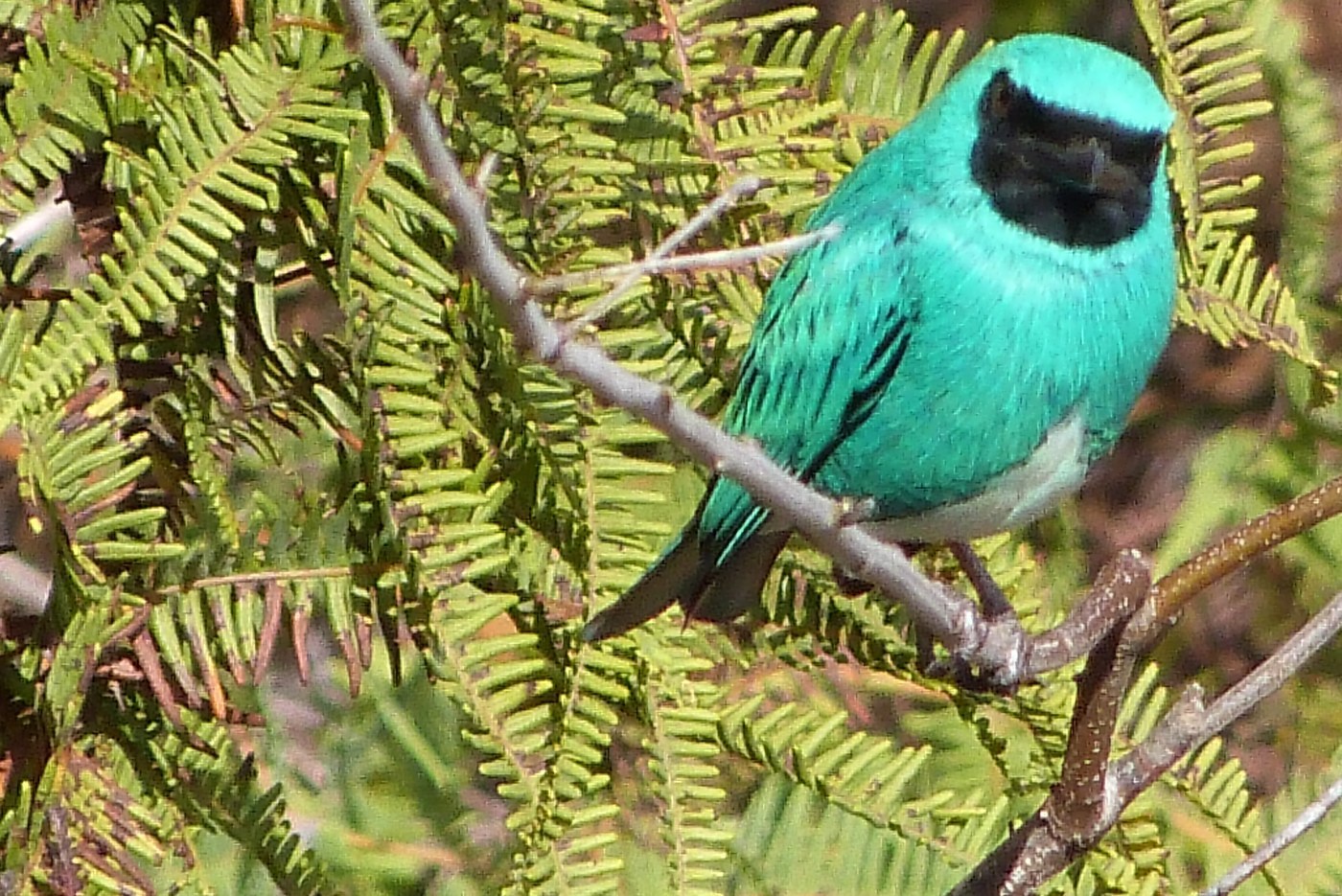
Size & Shape
The Swallow Tanager is a small, compact tanager, about 13-14 cm (5-5.5 in) long, notable for its unusually wide, flattened, slightly hooked bill — quite different from the narrower bills of most tanagers — and relatively short, slightly forked tail suited to aerial foraging.
Plumage & Key Field Marks
- Adult males are a brilliant, shimmering turquoise-blue overall, with a contrasting black face, throat, and upper back patch, and white on the flanks/undertail area visible in flight or when perched.
- Adult females and immatures are bright grass-green above with paler, somewhat yellowish-green underparts, and typically show a duskier gray-green throat patch rather than the male's solid black.
- The unusually broad, flattened bill (an adaptation for catching flying insects) is a useful mark distinguishing it from other similarly colored tanagers.
Behavior
Unlike most tanagers, which glean fruit and insects from foliage, Swallow Tanagers frequently hawk flying insects on the wing in swallow-like sallies from an exposed perch, in addition to eating fruit. They often perch on bare branches or wires at forest edges and are found singly, in pairs, or in small mixed groups, sometimes joining other tanager flocks.
Similar Species
- Male Swallow Tanager could suggest other blue tanagers such as Blue Dacnis, but the black face/throat patch, broader flattened bill, and larger size distinguish it; Blue Dacnis males lack the black throat patch and have a more slender bill.
- Female Swallow Tanager resembles various green tanagers, but the combination of a flattened bill and a duller gray-green throat patch, plus swallow-like flycatching behavior, helps separate it.
Voice
Calls include short, sharp, buzzy or metallic chip notes given in flight or while perched; the song is a simple, thin, high-pitched series of notes, not especially musical or loud compared to some tanager relatives.
Habitat, Range & Season
Widespread across much of tropical South America, including the Amazon Basin, the Guianas, parts of the Andean foothills, and eastern Brazil, generally in forest canopy, edges, clearings, and river-edge vegetation. It is resident across much of its range but shows local movements/altitudinal shifts in some Andean areas, and can be seen year-round where present, often perched conspicuously on high bare branches between insect-hawking sallies.
Frequently asked questions
What is the key field mark for a male Swallow Tanager?
Brilliant turquoise-blue overall plumage with a contrasting black face and throat patch, plus an unusually broad, flattened bill.
How do I identify a female Swallow Tanager?
Bright green above, paler green-yellow below, with a duskier gray-green throat patch and the same distinctively broad, flattened bill as the male.
Why does Swallow Tanager have such a wide bill?
The broad, flattened bill is an adaptation for catching flying insects in swallow-like aerial sallies, a foraging style unusual among tanagers.
Where does the Swallow Tanager live?
Widely across tropical South America, including the Amazon Basin and Atlantic Forest of Brazil, typically at forest edges, clearings, and canopy openings.
Is Swallow Tanager related to true swallows?
No, it is a true tanager; the name refers only to its swallow-like habit of catching insects in flight, not to any close relationship with swallows.