
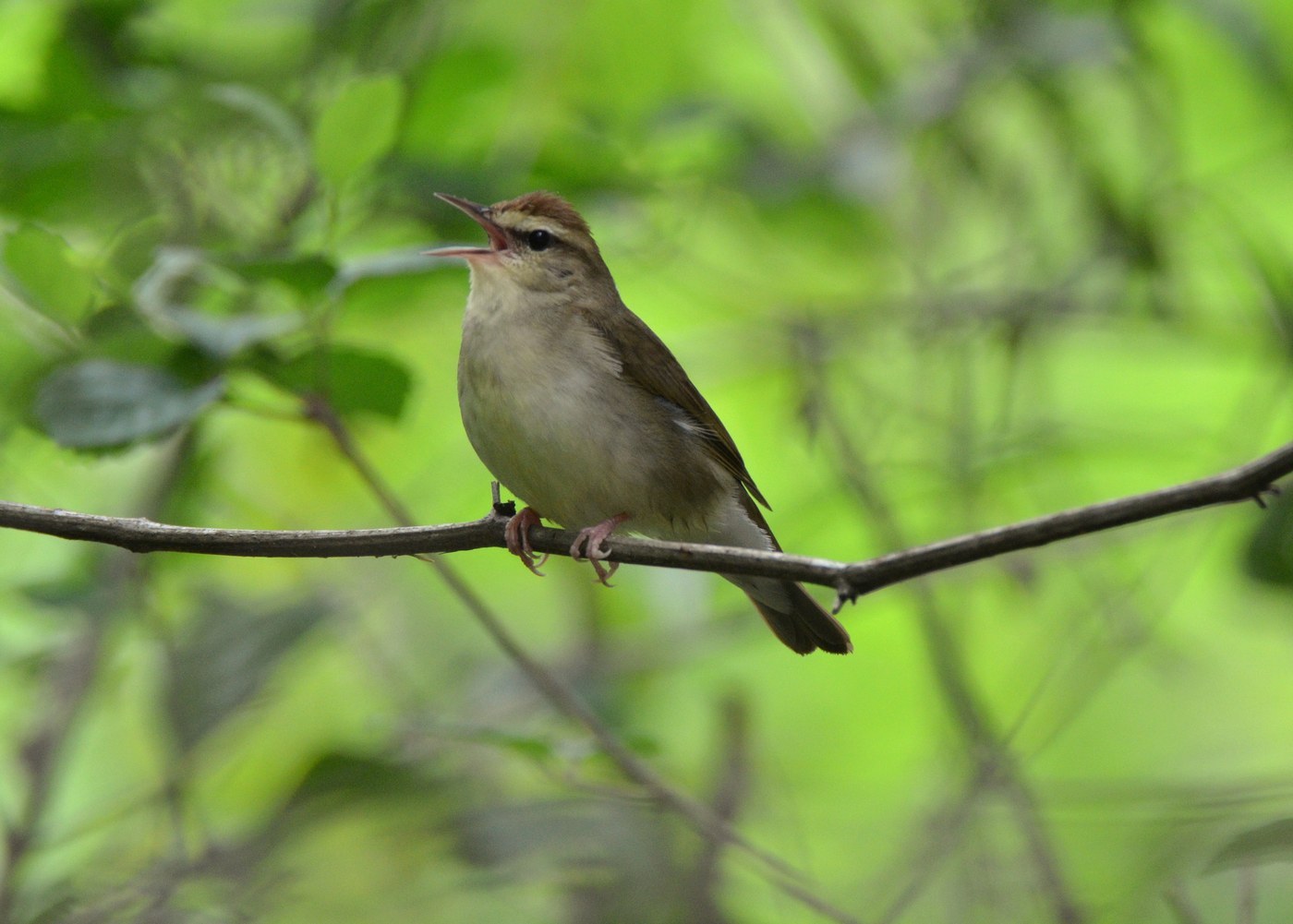
Swainson's Warbler
Limnothlypis swainsonii
A plain, secretive brown warbler of dense southeastern thickets, more often heard than seen thanks to its loud, ringing song.
- Size
- 13-15 cm (5-6 in) long
- Habitat
- dense canebrakes, rhododendron thickets, and wet bottomland forest undergrowth
- Type
- songbird
Spotted a bird like this?
Identify any bird from a photo, free.
Overview
Swainson's Warbler is one of the plainest but most sought-after warblers in North America, prized by birders not for bright colors but for its extreme secretiveness and loud, memorable voice. It lives in some of the densest, most impenetrable understory habitat in the southeastern United States, from canebrakes to rhododendron thickets, where it can be maddeningly hard to see well.
Plumage is understated: warm reddish-brown on the crown, plain olive-brown upperparts, and pale buffy-white underparts, with a whitish eyebrow stripe and a relatively long, heavy bill for a warbler.
How to identify it
Key field marks
- Reddish-brown cap contrasting slightly with a plain olive-brown back
- Whitish eyebrow stripe over a plain face
- Pale buffy-white underparts, unmarked
- Long, heavy bill for a warbler
- Ground-foraging habits in dense cover
Similar species
- Worm-eating Warbler: has bold black head stripes that Swainson's lacks entirely.
- Louisiana Waterthrush: streaked underparts and constant tail-bobbing distinguish it, though the two share similarly loud, ringing songs and overlapping habitat.
Habitat & range
Habitat
Swainson's Warblers require dense, often wet understory: canebrakes, rhododendron and mountain laurel thickets, and thick tangles in bottomland hardwood forest, almost always near water or in swampy ground.
Range
The species breeds across the southeastern United States, from the coastal plain and Piedmont north to parts of the mid-Atlantic, and in a separate population in the southern Appalachians. It winters in the Caribbean and eastern Mexico to Central America.
Migration
Swainson's Warblers are long-distance migrants, arriving on breeding grounds in April and departing by September to winter primarily in Cuba, Jamaica, and other parts of the Caribbean and Central America.
Behavior & voice
Behavior
This species forages almost entirely on or near the ground, flipping leaf litter with its bill to uncover insects and spiders, staying hidden in dense cover for most of its activity and rarely venturing into the open.
Voice
The song is loud, clear, and ringing, a series of whistled notes ending in a downslurred flourish, carrying remarkably far for such a small, hidden bird and often the only clue to its presence.
Nesting
Nests are bulky cups built low in dense cane, shrubs, or vine tangles, well concealed from view. Females lay 2-4 eggs, and both parents help provision the young once hatched.
Frequently asked questions
Why is Swainson's Warbler hard to see?
It lives and forages in extremely dense understory habitat like canebrakes and thickets and rarely comes into the open, so it is usually detected by its loud song rather than by sight.
What does Swainson's Warbler sound like?
Its song is loud and ringing, a series of clear whistles ending in a downslurred flourish, somewhat similar to a Louisiana Waterthrush.
Where does Swainson's Warbler live?
It breeds in dense, often wet thickets in the southeastern United States, including canebrakes and rhododendron tangles, and winters in the Caribbean and Central America.
What does Swainson's Warbler eat?
It eats insects and spiders found by foraging in leaf litter on the ground.
Swainson's Warbler guides
In-depth guides for identifying, finding, and understanding Swainson's Warbler.
Other birds you may enjoy

Black Redstart
13-14.5 cm (5.1-5.7 in) long, 23-26 cm wingspan

Black-throated Sparrow
12-14 cm (4.7-5.5 in) long, about 19-20 cm (7.5-8 in) wingspan

Greater Bird-of-paradise
Body about 43 cm; males with additional flank plumes up to 50 cm and long tail wires

Blue Tit
11-12 cm (4.3-4.7 in) long, 17-20 cm wingspan

Red-billed Quelea
11.5–13 cm long, wingspan about 20–22 cm
White-plumed Antbird
13-14 cm (5-5.5 in) long

Pyrrhuloxia
19-22 cm (7.5-8.7 in) long, 30 cm wingspan

Blue-gray Tanager
16-18 cm (6-7 in) long

Blackburnian Warbler
11-13 cm (4.3-5.1 in) long, 20-22 cm wingspan

Bluethroat
13-14 cm (5.1-5.5 in) long, 20-22 cm wingspan

Eurasian Nuthatch
12-14.5 cm (4.7-5.7 in) long, 22.5-27 cm wingspan

Wood Thrush
19-21 cm (7.5-8.3 in) long, about 33 cm (13 in) wingspan