
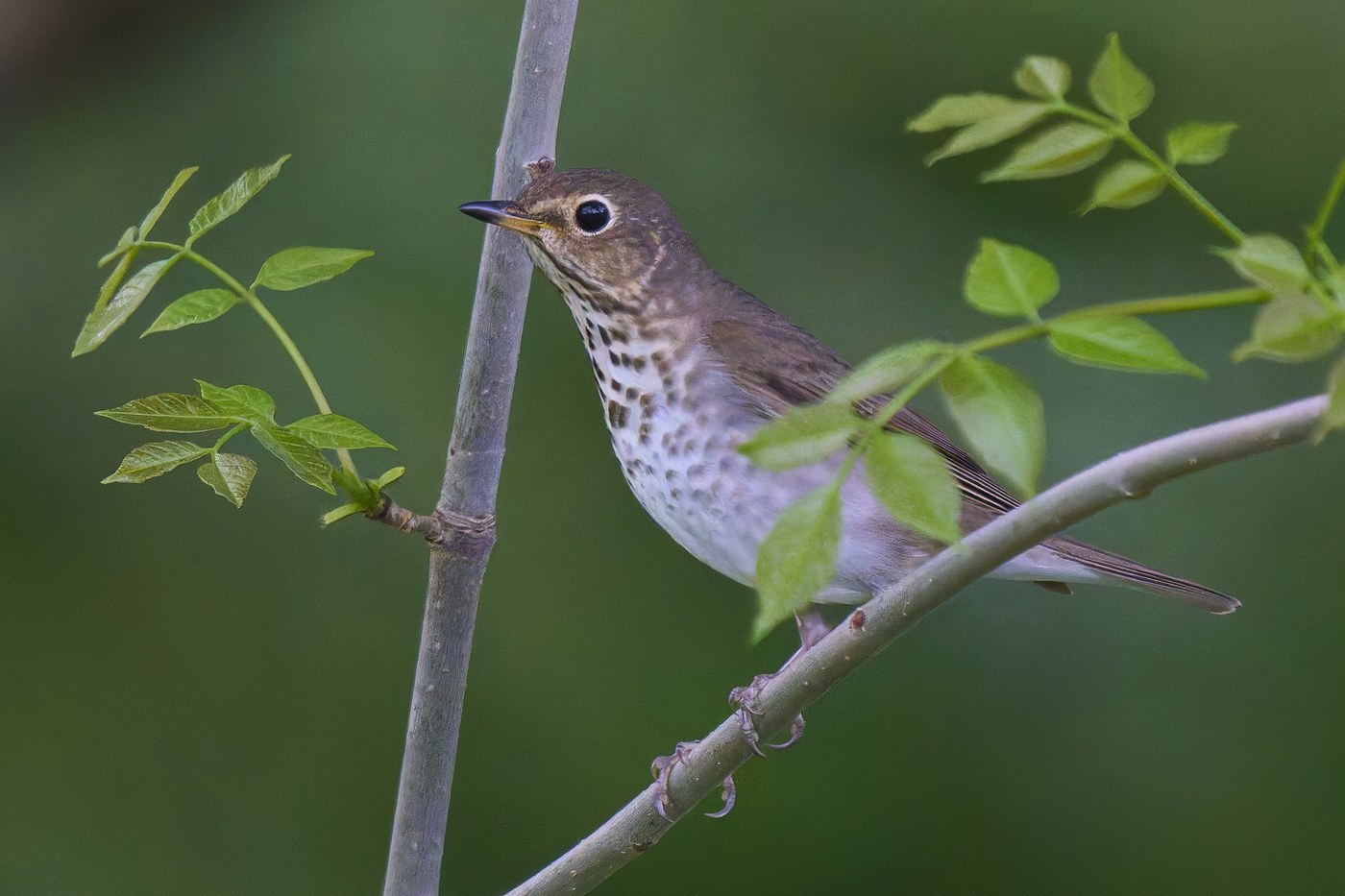
Swainson's Thrush
Catharus ustulatus
A buffy-faced forest thrush known for its upward-spiraling flute-like song and heavy nocturnal migration through much of North America.
- Size
- 16-19 cm (6.5-7.5 in) long
- Habitat
- coniferous and mixed forests for breeding; forest and woodland during migration
- Type
- songbird
Spotted a bird like this?
Identify any bird from a photo, free.
Overview
Swainson's Thrush is a widespread breeder across boreal and montane forests of North America, best known to many birders as a common but often invisible migrant, detected mainly by its distinctive nighttime flight calls as huge numbers pass overhead each spring and fall. It is an olive-brown to warm brown thrush with a buffy wash across the face and a bold buffy eyering.
Two main plumage forms exist: a grayer, olive-backed form breeding across most of the continent, and a warmer, russet-backed form along the Pacific coast, though both share the same buffy facial pattern that helps distinguish the species from its Catharus relatives.
How to identify it
Key field marks
- Buffy eyering and buffy wash on the lores and face
- Olive-brown to warm russet-brown upperparts (varies geographically)
- Spotted upper breast on a buffy background
- No strong contrast between tail and back (unlike Hermit Thrush)
Similar species
- Hermit Thrush: white (not buffy) eyering and a reddish tail that contrasts with the back.
- Gray-cheeked Thrush and Bicknell's Thrush: lack the warm buffy face and eyering, appearing colder gray overall with a faint, less distinct eyering.
- Veery: more uniformly tawny with much fainter spotting.
Habitat & range
Habitat
Swainson's Thrushes breed in coniferous and mixed forests, including boreal spruce forest across Canada and Alaska, and moist coastal and montane forests in the Pacific Northwest and western mountains.
Range
The species breeds broadly across Canada, Alaska, the Pacific Northwest, and higher-elevation forests of the western United States and northern New England. It winters primarily in Central America and South America.
Migration
Swainson's Thrush is a long-distance, mostly nocturnal migrant, passing through the rest of the United States in huge numbers during spring and fall, often detected overhead at night by its distinctive short, whistled flight call.
Behavior & voice
Behavior
Swainson's Thrushes forage on or near the ground in forest understory, taking insects and other invertebrates, and shift toward fruit as an important food source during migration and winter.
Voice
The song is a series of flute-like notes that spiral upward in pitch, quite different from the downward-spiraling song of the Veery; the flight call, a short, liquid "whit" or "queep," is frequently heard from migrating flocks passing overhead at night.
Nesting
Nests are built low in shrubs or small trees, generally within a few meters of the ground, constructed as a compact cup of twigs, moss, and grass. Females lay 3-4 pale blue eggs, typically marked with brown spots.
Frequently asked questions
How can you tell Swainson's Thrush from Hermit Thrush?
Swainson's has a buffy eyering and buffy face, with no contrast between the tail and back, while Hermit Thrush has a white eyering and a reddish tail that contrasts with an olive-brown back.
Why do people hear Swainson's Thrushes at night?
They migrate mostly at night in large numbers and give a distinctive short, liquid flight call that can be heard from the ground as flocks pass overhead.
What does a Swainson's Thrush song sound like?
It is a series of flute-like notes that spiral upward in pitch, unlike the downward-spiraling song of the closely related Veery.
Where does Swainson's Thrush spend the winter?
Most winter in Central America and South America, making it a long-distance migrant.
Swainson's Thrush guides
In-depth guides for identifying, finding, and understanding Swainson's Thrush.
Other birds you may enjoy

Black Redstart
13-14.5 cm (5.1-5.7 in) long, 23-26 cm wingspan

Black-throated Sparrow
12-14 cm (4.7-5.5 in) long, about 19-20 cm (7.5-8 in) wingspan

Greater Bird-of-paradise
Body about 43 cm; males with additional flank plumes up to 50 cm and long tail wires

Blue Tit
11-12 cm (4.3-4.7 in) long, 17-20 cm wingspan

Red-billed Quelea
11.5–13 cm long, wingspan about 20–22 cm
White-plumed Antbird
13-14 cm (5-5.5 in) long

Pyrrhuloxia
19-22 cm (7.5-8.7 in) long, 30 cm wingspan

Blue-gray Tanager
16-18 cm (6-7 in) long

Blackburnian Warbler
11-13 cm (4.3-5.1 in) long, 20-22 cm wingspan

Bluethroat
13-14 cm (5.1-5.5 in) long, 20-22 cm wingspan

Eurasian Nuthatch
12-14.5 cm (4.7-5.7 in) long, 22.5-27 cm wingspan

Wood Thrush
19-21 cm (7.5-8.3 in) long, about 33 cm (13 in) wingspan