
Swainson's Thrush Identification Guide
A quietly plumaged, spot-breasted forest thrush of North America best known for its buffy eye-ring and lores and its ethereal, upward-spiraling flute-like song.
Read the full Swainson's Thrush encyclopedia entry →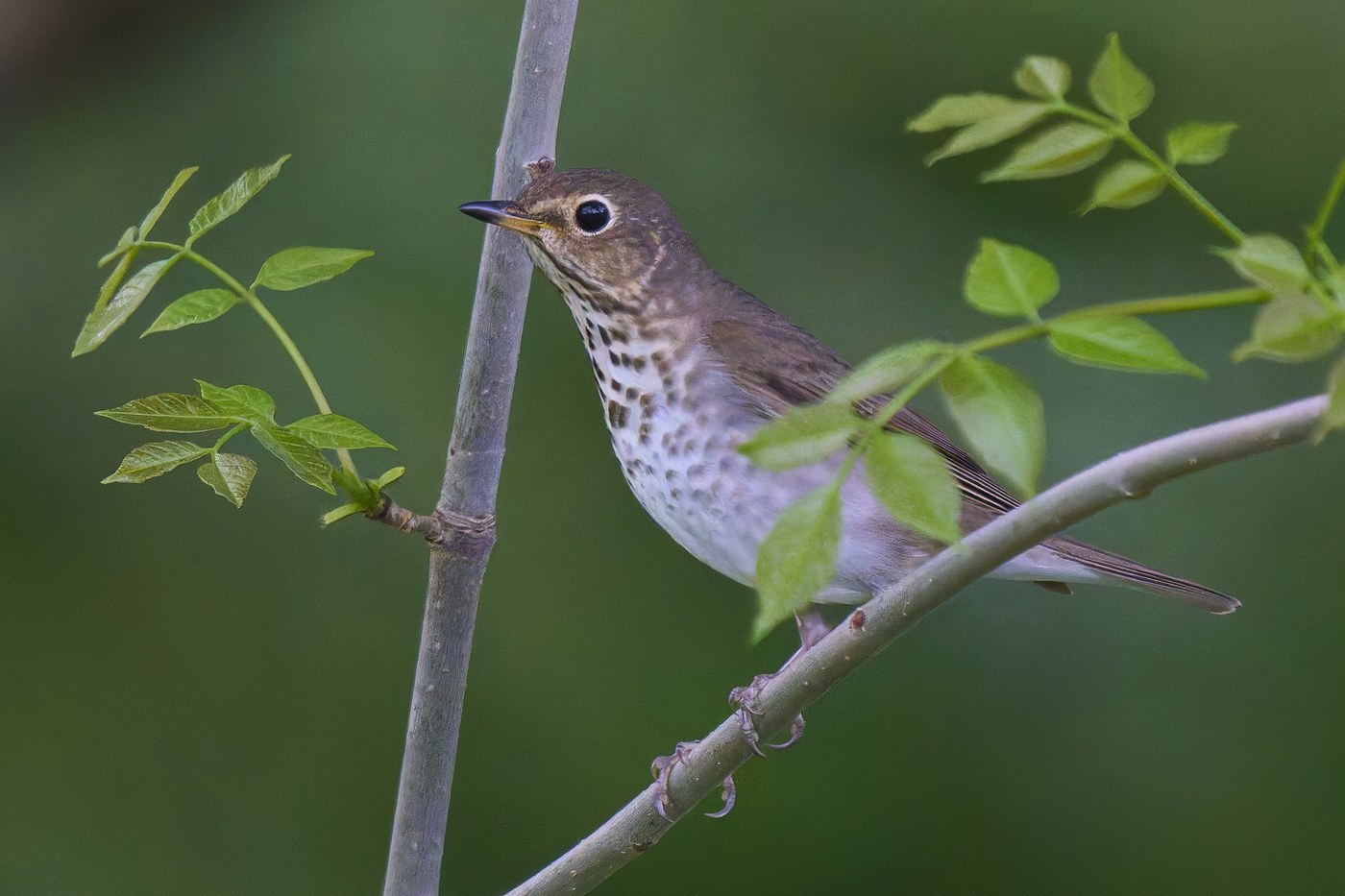
Size & Shape
Swainson's Thrush is a medium-small thrush, about 16-19 cm (6.5-7.5 in) long, with the classic rounded, compact body, moderately long legs, and thin straight bill typical of Catharus thrushes.
Plumage & Key Field Marks
- Upperparts are olive-brown to warm brown, fairly uniform from head to tail (unlike some relatives that show a contrasting reddish tail).
- The breast is buffy-tan with bold dark spotting that fades into a whitish, less-marked belly.
- The key diagnostic field mark is a bold, complete buffy eye-ring combined with buffy lores (the area between eye and bill), giving the face a distinctive "spectacled" look — this is the most reliable mark separating it from similar Catharus thrushes.
- Legs are pale pinkish, and the bill is mostly dark with a pale base to the lower mandible.
Behavior
Swainson's Thrush is a shy, mostly ground- and understory-foraging bird, often detected first by voice rather than sight. It forages on the forest floor and in low vegetation for insects and, later in the season, berries. It is a nocturnal migrant, and its distinctive flight calls are frequently recorded on nocturnal migration monitoring.
Similar Species
- Hermit Thrush shows a contrasting reddish-brown tail against a more olive-brown back and habitually pumps its tail up and slowly down — Swainson's Thrush lacks the contrasting tail and has the bold buffy eye-ring/lores that Hermit Thrush lacks.
- Gray-cheeked Thrush and Bicknell's Thrush lack the buffy eye-ring and lores, showing a grayer face and less contrast, and their breast spotting tends to be grayer/duskier rather than warm buffy.
- Veery is warmer, more uniformly reddish-brown above with faint, indistinct breast spotting and a very faint eye-ring, quite different from Swainson's crisper spotting and bold spectacled face.
Voice
The song is one of the most distinctive in North American woods: a series of flutey, whistled phrases that spiral upward in pitch, often described as ethereal or otherworldly, typically given at dawn or dusk (and sometimes through the night) from dense cover. The flight call, frequently heard overhead during nocturnal migration, is a sharp, liquid "queep" or "whit."
Habitat, Range & Season
Breeds across boreal and montane coniferous and mixed forest from Alaska and Canada south through the western mountains and parts of the northern/Appalachian United States. It winters primarily in Central and South America. Look for it as a common but often skulking migrant through wooded habitats across most of North America in spring (May) and fall (September-October), and on breeding territory in dense, moist coniferous forest with a shrubby understory in summer.
Frequently asked questions
What is the best field mark for Swainson's Thrush?
A bold, complete buffy eye-ring combined with buffy lores, giving it a distinctive spectacled facial appearance not shared by most similar thrushes.
How do I separate Swainson's Thrush from Hermit Thrush?
Hermit Thrush shows a reddish tail contrasting with a browner back and pumps its tail; Swainson's Thrush has a uniformly colored back and tail and lacks the tail-pumping habit, but has the bold buffy eye-ring Hermit Thrush lacks.
What does a Swainson's Thrush sound like?
Its song is a series of flute-like phrases that spiral upward in pitch, often heard at dawn or dusk in forest habitat; its flight call is a sharp 'queep' often heard overhead at night during migration.
Where does Swainson's Thrush breed?
In boreal and montane coniferous or mixed forest across Canada, Alaska, and parts of the western and northeastern United States.
Is Swainson's Thrush easy to see?
It is often more easily heard than seen, as it tends to forage and sing from dense understory and low branches in shaded forest.