
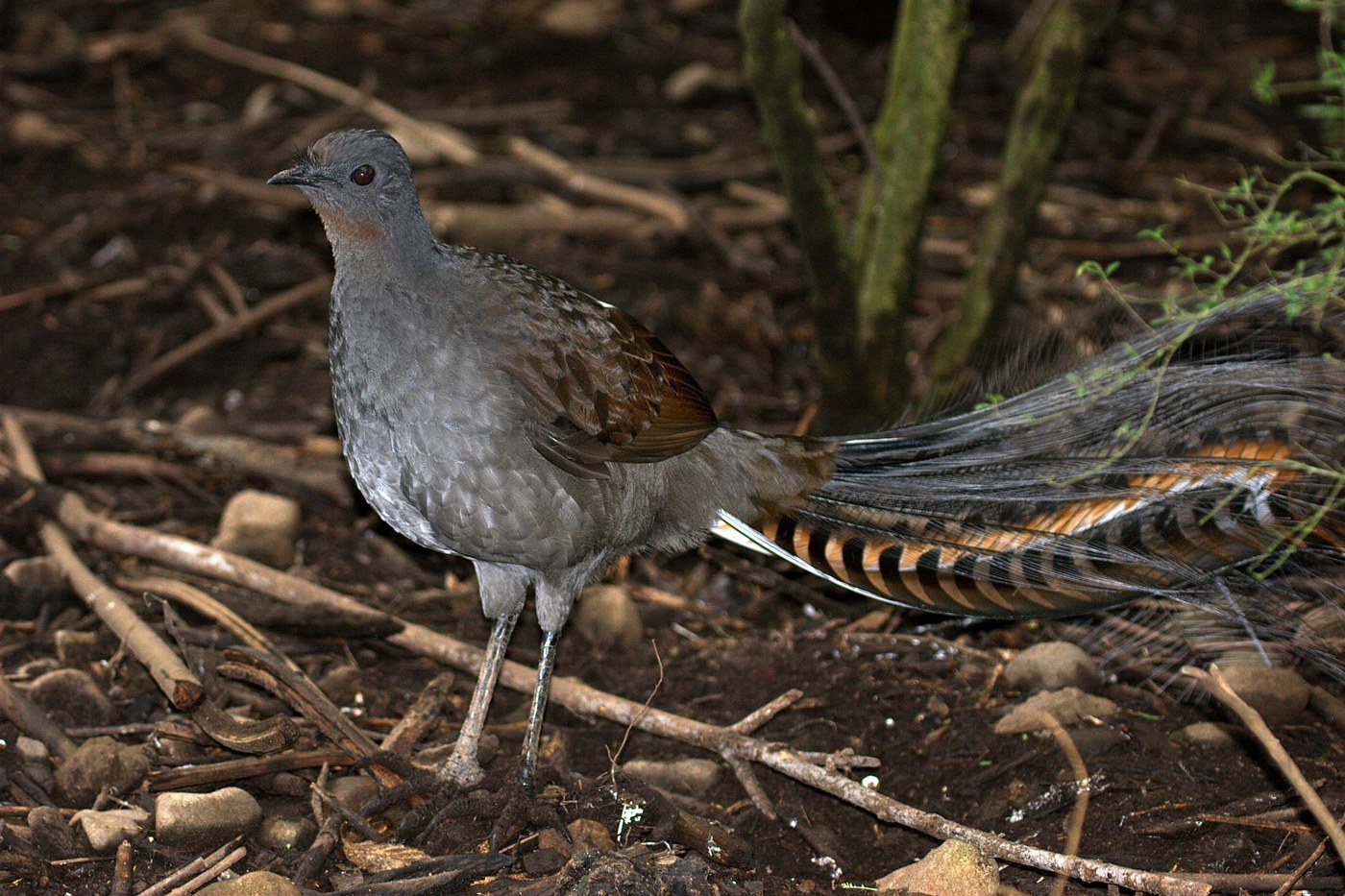
Superb Lyrebird
Menura novaehollandiae
Australia's celebrated rainforest songbird, famous for its extravagant tail and uncanny ability to mimic almost any sound it hears.
- Size
- 74-100 cm (29-39 in) total length including tail; body roughly pheasant-sized
- Habitat
- temperate rainforest, wet eucalypt forest, and gullies of southeastern Australia
- Type
- songbird
Spotted a bird like this?
Identify any bird from a photo, free.
Overview
The Superb Lyrebird is one of the world's most extraordinary songbirds, a large, pheasant-like ground dweller of southeastern Australia's cool, moist forests. It is best known for two things: the male's spectacular tail, which in full display fans out into a shimmering lyre-shaped silhouette of lacy plumes, and its unmatched talent for vocal mimicry.
Both sexes are mostly dull grey-brown above with a rufous throat and warm cinnamon wash on the wings, built low to the ground with strong legs for scratching through leaf litter. Females and young males lack the elaborate tail, carrying instead a long, plain brownish tail. The male's mature tail comprises sixteen feathers, including two outer lyrate feathers with dark bars, and delicate lace-like and filamentary plumes that are thrown up and forward over the body during courtship display, appearing as a silvery, quivering veil.
Despite its size and remarkable appearance, the Superb Lyrebird is a shy, ground-hugging bird that runs rather than flies when disturbed, and can be very difficult to see well even where common, though its loud song often gives its presence away.
How to identify it
Key field marks
- Large, dark brown-grey, chicken-sized ground bird with a long neck and small head
- Rufous-chestnut throat and undertail patch
- Male's tail, when folded, is long and drooping; in full courtship display it fans into an unmistakable lyre shape
- Strong grey legs and feet adapted for scratching in soil and leaf litter
- Moves with a crouched, quail-like gait, often flicking leaf litter aside while foraging
Similar species
No other Australian bird has a comparable tail or shape. Female and immature birds without the ornate tail can superficially resemble a large, dark ground-feeding bird such as a scrubwren or logrunner from a distance, but their much larger size and long tail carriage are distinctive. Albert's Lyrebird is similar but found only in a small area of subtropical rainforest on the NSW-Queensland border, is slightly smaller, more reddish-brown, and the male's tail lacks the paired lyrate outer feathers, instead forming a plumed arch when displayed.
Habitat & range
Habitat
Superb Lyrebirds favour the dim, damp understorey of temperate and cool rainforest, wet eucalypt forest, and fern-choked gullies, where deep leaf litter provides abundant invertebrate prey and dense cover for concealment.
Range
The species occurs along the Great Dividing Range and coastal forests of southeastern Australia, from southern Queensland through New South Wales and Victoria, with an introduced population established in Tasmania.
Migration
Superb Lyrebirds are sedentary and highly territorial, occupying the same home range year-round; they do not migrate, though some local movement to lower elevations may occur in severe winter weather.
Behavior & voice
Behavior
Lyrebirds spend most of their time on the ground, using their powerful feet to rake through leaf litter in search of food, and rarely fly except to reach a roost or display mound. Males build and maintain several earthen display mounds within their territory, visiting each in turn to sing and dance.
Voice
The Superb Lyrebird possesses one of the most complex voices of any bird. Its own song is a loud, ringing series of notes, but it is equally famous for near-perfect mimicry of other birds' calls, as well as mechanical and human-made sounds it has encountered in its environment. Males sing almost continuously through the cooler months, especially at dawn, to defend territory and attract mates.
Feeding
It forages by scratching through soil and leaf litter with alternating feet, uncovering worms, beetles, spiders, and other invertebrates.
Nesting and breeding
Breeding is polygynous; males display alone on their mounds while females build a large, domed nest of sticks and bark lined with feathers, usually in a sheltered site such as a rock ledge, tree fern, or bank. The female alone incubates a single egg and raises the chick with no help from the male.
Frequently asked questions
Why is the Superb Lyrebird famous?
It is renowned for the male's extraordinary lyre-shaped tail display and for being one of the most accomplished vocal mimics in the bird world, able to reproduce the calls of many other species as well as other environmental sounds.
Can Superb Lyrebirds fly?
They can fly short distances, mainly to reach roosts in trees, but they are primarily ground-dwelling and prefer to run or walk rather than fly.
Where do Superb Lyrebirds live?
They inhabit rainforest and wet eucalypt forest along the Great Dividing Range in southeastern Australia, with an introduced population in Tasmania.
What does a Superb Lyrebird eat?
It feeds on invertebrates such as worms, beetles, and spiders found by scratching through leaf litter and soil.
How is the Superb Lyrebird different from Albert's Lyrebird?
The Superb Lyrebird is larger, greyer, and the male's tail has paired lyre-shaped outer feathers, while Albert's Lyrebird is smaller, more reddish-brown, and restricted to a tiny rainforest range on the NSW-Queensland border.
Superb Lyrebird guides
In-depth guides for identifying, finding, and understanding Superb Lyrebird.
Other birds you may enjoy

Black Redstart
13-14.5 cm (5.1-5.7 in) long, 23-26 cm wingspan

Black-throated Sparrow
12-14 cm (4.7-5.5 in) long, about 19-20 cm (7.5-8 in) wingspan

Greater Bird-of-paradise
Body about 43 cm; males with additional flank plumes up to 50 cm and long tail wires

Blue Tit
11-12 cm (4.3-4.7 in) long, 17-20 cm wingspan

Red-billed Quelea
11.5–13 cm long, wingspan about 20–22 cm
White-plumed Antbird
13-14 cm (5-5.5 in) long

Pyrrhuloxia
19-22 cm (7.5-8.7 in) long, 30 cm wingspan

Blue-gray Tanager
16-18 cm (6-7 in) long

Blackburnian Warbler
11-13 cm (4.3-5.1 in) long, 20-22 cm wingspan

Bluethroat
13-14 cm (5.1-5.5 in) long, 20-22 cm wingspan

Eurasian Nuthatch
12-14.5 cm (4.7-5.7 in) long, 22.5-27 cm wingspan

Wood Thrush
19-21 cm (7.5-8.3 in) long, about 33 cm (13 in) wingspan