
Superb Lyrebird Identification Guide
A large, pheasant-like ground bird of southeastern Australian rainforests, best identified by its extraordinary lyre-shaped tail (in males) and its uncanny ability to mimic other birds and sounds.
Read the full Superb Lyrebird encyclopedia entry →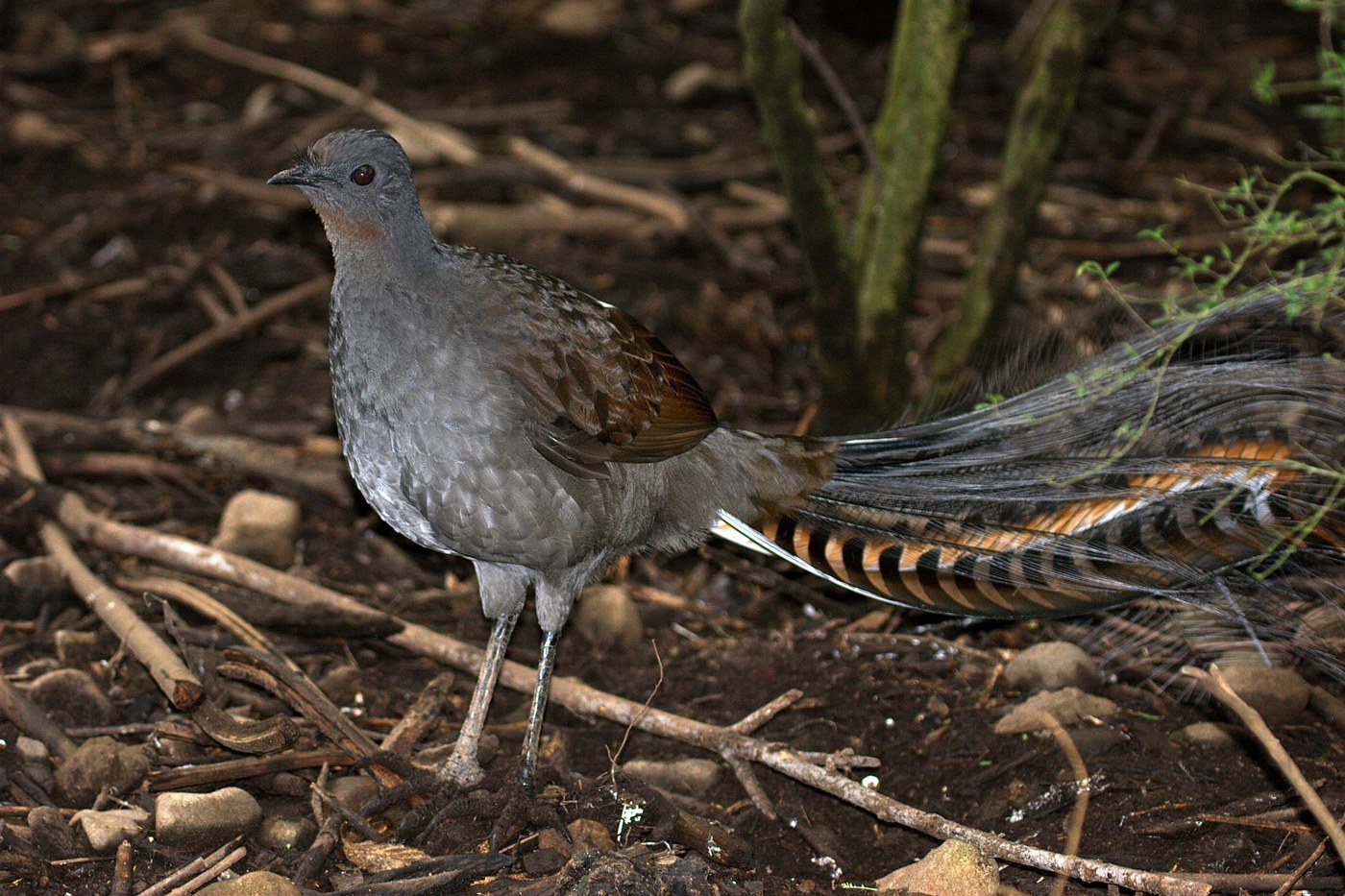
Size & Shape
The Superb Lyrebird is one of the largest songbirds in the world, roughly the size of a large pheasant. It has a plump, chicken-like body, a small head, and long, strong legs adapted for scratching through leaf litter. The body length (excluding tail) is about 40-50 cm (16-20 in), but adult males add another 55-70 cm (22-28 in) of elaborate tail plumes, bringing total length to nearly a meter.
Plumage & Key Field Marks
- Overall plumage is dull grayish-brown to rufous-brown above, paler gray-brown below — camouflage suited to the dim forest floor.
- The male's tail is the diagnostic feature: 16 modified feathers including two broad, lyre-curved outer feathers marked with pale scalloping, plus fine lace-like and wiry filamentary plumes. When displayed (mainly during the austral winter breeding season, June-August), the tail is thrown forward over the head in a shimmering silvery fan.
- Females and immature birds lack the ornate tail, having instead a long, plain brownish tail — this can cause confusion with other large ground birds, but the lyrebird's overall shape, thick legs, and habitat give it away.
- The bill is fairly long, dark, and slightly downcurved, used for probing and raking leaf litter.
Behavior
Superb Lyrebirds are shy, ground-dwelling, and reluctant fliers — they run rather than fly when startled, though they can fly short distances and often roost in trees at night. They spend most of the day scratching through leaf litter for invertebrates. Males build and maintain multiple earthen display mounds within a territory and sing and dance on these mounds through the breeding season, making the species easiest to detect by ear.
Similar Species
- Albert's Lyrebird (a close relative found in a much smaller range in the Border Ranges of NSW/Queensland) is similar but slightly smaller, with a reddish-brown tail lacking the lyre-shaped outer feathers, and a distinct, less musical song. Range essentially does not overlap with Superb Lyrebird.
- Female/immature lyrebirds can superficially resemble large ground-dwelling birds such as scrubfowl or bush-turkeys, but lyrebirds are more slender-necked, have a longer plain tail, and forage by vigorous bilateral scratching rather than mound-building or pecking.
Voice
The Superb Lyrebird is renowned as one of the most accomplished vocal mimics on Earth. Its own song is a loud, ringing series of notes, but a singing male typically weaves in near-perfect imitations of dozens of other bird species (kookaburras, currawongs, whipbirds, rosellas) as well as non-avian sounds like camera shutters, chainsaws, and car alarms in areas near human activity. Listen for an unusually varied, rapid-fire medley of different bird calls coming from one spot — that's often a lyrebird rather than a chorus of different species.
Habitat, Range & Season
Endemic to southeastern Australia, from southern Queensland through New South Wales and Victoria into southeastern South Australia (introduced to Tasmania). It favors wet eucalypt forest and cool temperate or subtropical rainforest with dense understory and deep leaf litter. Present year-round; the best time to observe display and song is during the austral autumn and winter (April-August), when males are most vocally active on their mounds. Early morning is the best time of day.
Frequently asked questions
How can I tell a male from a female Superb Lyrebird?
Adult males have the famous long, lyre-shaped tail with broad curved outer feathers and lacy filamentary plumes; females and immatures have a much shorter, plain brownish tail without these ornate feathers.
What is the easiest way to find a Superb Lyrebird?
Listen for their loud, varied, mimicking song, often delivered from a display mound in dense forest during the cooler months (autumn-winter), then approach quietly and scan the leaf litter and understory.
Can Superb Lyrebirds fly?
They can fly short distances and glide down from roost trees, but they are primarily ground birds that run to escape danger rather than taking sustained flight.
How do I distinguish Superb Lyrebird from Albert's Lyrebird?
Range is the best clue since they barely overlap; structurally, Albert's Lyrebird has a reddish, less elaborate tail without the broad lyre-curved outer feathers seen in male Superb Lyrebirds.
What sounds does a Superb Lyrebird mimic?
It mimics other local birds (kookaburras, currawongs, rosellas, whipbirds) as well as human-made sounds like camera shutters and chainsaws where it lives near people.