
Stitchbird
Notiomystis cincta
A small, striking New Zealand honeyeater-like bird, the male boldly patterned in black, yellow, and white, now surviving only on predator-free islands and in reintroduced mainland sanctuaries.
- Size
- 18 cm (7 in) long
- Habitat
- native forest, mainly on predator-free islands and fenced sanctuaries in New Zealand
- Type
- songbird
Spotted a bird like this?
Identify any bird from a photo, free.
Overview
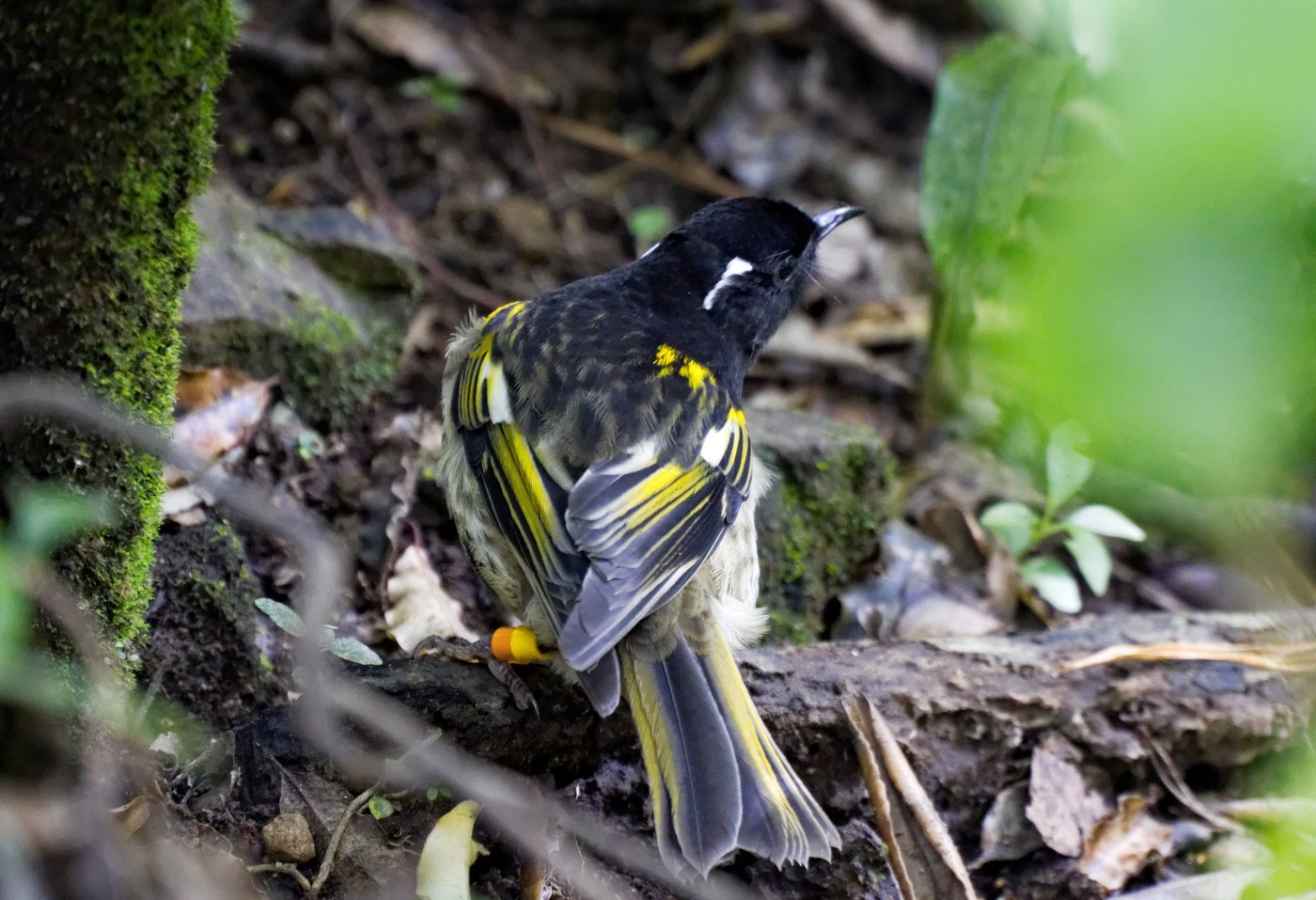
The Stitchbird, known in Maori as hihi, is a small forest bird unique enough in its biology to be placed in its own family, Notiomystidae, found nowhere else in the world. Males are strikingly patterned with a black head and upper breast, a bright yellow band across the shoulders and breast, white wing patches, and small white tufts behind the eye that erect during display; females are far duller, olive-brown with a paler wing bar.
Once found across the North Island, the Stitchbird had by the late 1800s been reduced to a single surviving population on Hauturu/Little Barrier Island, escaping extinction only through the persistence of that one refuge. Decades of careful conservation work have since reestablished breeding populations on several other predator-free islands and fenced mainland sanctuaries.
How to identify it
Key field marks
- Male: black head and upper breast, bright yellow band across shoulders/breast, white wing patch, small erectile white ear tufts
- Female: duller olive-brown overall with a pale wing bar, lacking the male's bold pattern
- Fairly short tail, often held cocked
- Distinctive whirring wingbeat in flight
Similar species
- New Zealand Bellbird, which shares some habitat, is plain olive-green in both sexes and lacks the male Stitchbird's black-and-yellow pattern.
- Tui is much larger, glossy black-green with a white throat tuft, quite different from the smaller, more boldly patterned Stitchbird.
Habitat & range
Range
Historically found across the North Island of New Zealand; today established on Hauturu/Little Barrier Island (its last natural refuge) and reintroduced to several other predator-free islands and fenced mainland sanctuaries such as Zealandia and Tiritiri Matangi.
Habitat
Requires mature native forest with abundant flowering and fruiting plants, and, unusually among New Zealand birds, readily nests in cavities and artificial nest boxes provided at sanctuary sites.
Migration
Sedentary, confined to the forested extent of its island or sanctuary habitat.
Behavior & voice
Behavior
Active and agile, foraging through the canopy and understorey, with males performing a distinctive face-to-face display in which they fan their white ear tufts.
Voice
Gives a range of calls including a sharp "stitch" or "tzit" contact note (source of the English name), along with more complex songs from males.
Feeding
Feeds on nectar taken from native flowers, along with fruit and insects; it is notable among New Zealand birds for occasionally mating face-to-face rather than the more typical bird mating position.
Nesting
Nests in tree cavities or nest boxes, an unusual trait among New Zealand's native forest birds; the female incubates the eggs, and both parents help feed the chicks, though nest sites and food are actively supplemented by conservation managers at many sanctuaries.
Frequently asked questions
Why is the Stitchbird called hihi?
Hihi is its Maori name; the English name "Stitchbird" comes from one of its sharp contact calls, which sounds like "stitch."
Why did the Stitchbird nearly go extinct?
Introduced predators and habitat loss eliminated it from the mainland by the late 1800s, leaving only a single population on predator-free Hauturu/Little Barrier Island until later reintroductions expanded its range.
Where can you see Stitchbirds today?
On Hauturu/Little Barrier Island and several other predator-free islands and fenced sanctuaries, including Tiritiri Matangi and Zealandia, where reintroduced populations are managed and monitored.
How is the Stitchbird related to other New Zealand honeyeaters?
Despite superficially resembling honeyeaters like the Tui and Bellbird, the Stitchbird is not closely related to them and is instead the sole member of its own unique family, Notiomystidae.
Stitchbird guides
In-depth guides for identifying, finding, and understanding Stitchbird.
Other birds you may enjoy

Black Redstart
13-14.5 cm (5.1-5.7 in) long, 23-26 cm wingspan

Black-throated Sparrow
12-14 cm (4.7-5.5 in) long, about 19-20 cm (7.5-8 in) wingspan

Greater Bird-of-paradise
Body about 43 cm; males with additional flank plumes up to 50 cm and long tail wires

Blue Tit
11-12 cm (4.3-4.7 in) long, 17-20 cm wingspan

Red-billed Quelea
11.5–13 cm long, wingspan about 20–22 cm
White-plumed Antbird
13-14 cm (5-5.5 in) long

Pyrrhuloxia
19-22 cm (7.5-8.7 in) long, 30 cm wingspan

Blue-gray Tanager
16-18 cm (6-7 in) long

Blackburnian Warbler
11-13 cm (4.3-5.1 in) long, 20-22 cm wingspan

Bluethroat
13-14 cm (5.1-5.5 in) long, 20-22 cm wingspan

Eurasian Nuthatch
12-14.5 cm (4.7-5.7 in) long, 22.5-27 cm wingspan

Wood Thrush
19-21 cm (7.5-8.3 in) long, about 33 cm (13 in) wingspan