
Stitchbird Identification Guide
A rare New Zealand honeyeater relative (also called Hihi) with a velvety black head and bold yellow shoulder patches in males, now surviving mainly on predator-free offshore islands and fenced sanctuaries.
Read the full Stitchbird encyclopedia entry →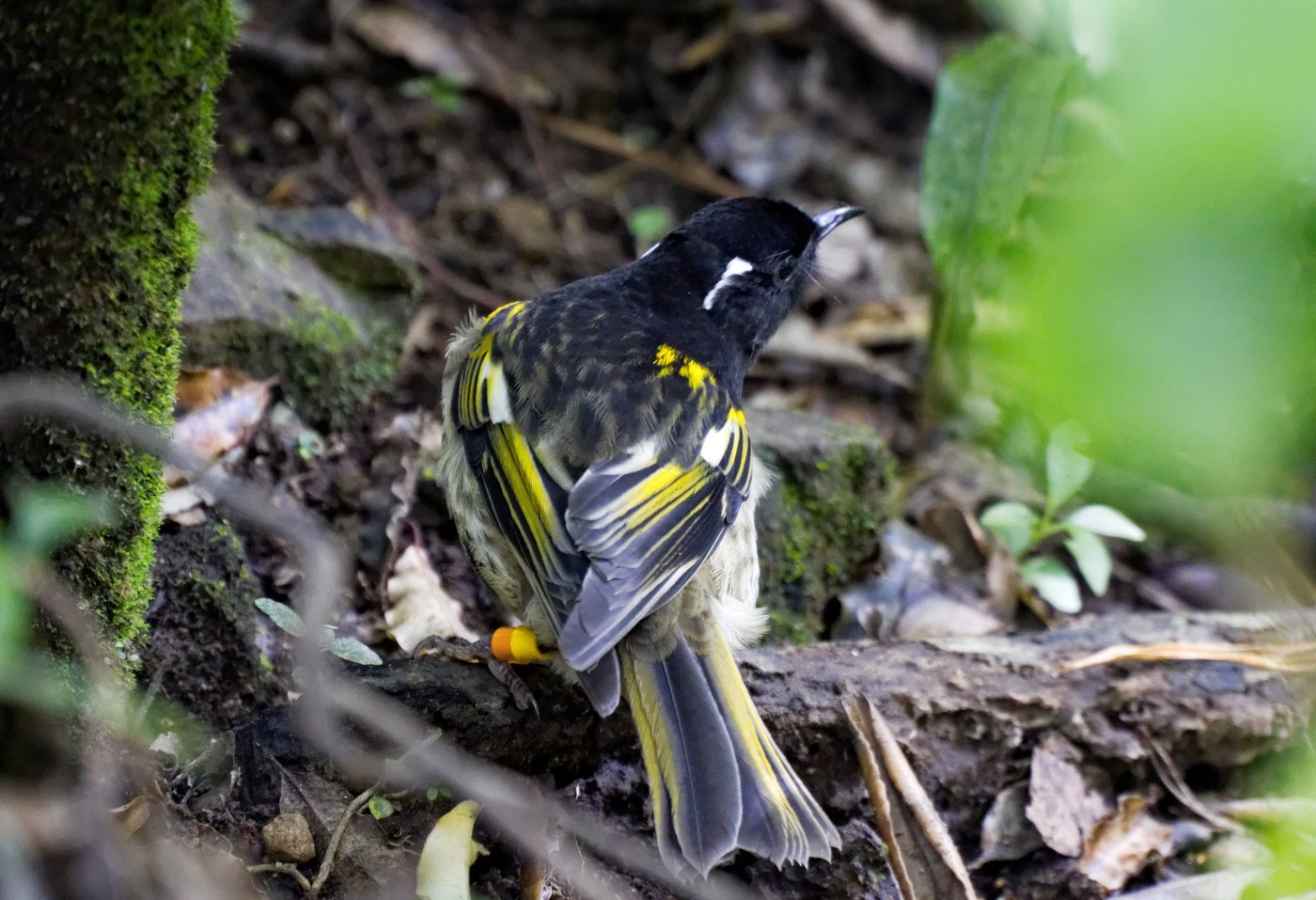
Key Field Marks
- Size & shape: A small, plump songbird, about 18 cm, with a fairly short tail, slim slightly downcurved bill adapted for nectar feeding, and an upright, alert posture.
- Male plumage: Velvety black head, throat, and upper breast, a bold yellow band across the shoulders and upper back, white wing patches, and greyish-brown lower underparts; small white "ear" tufts are sometimes raised behind the eye.
- Female plumage: Much duller olive-grey-brown overall with a plain face, lacking the male's black head and yellow band, but showing a similar small white wing patch.
- Bill: Slim, slightly downcurved bill suited to feeding on nectar, fruit, and insects.
- Distinctive posture: Often perches and forages with a distinctively upright, cocked-tail stance, and is unusual among songbirds for sometimes mating face-to-face.
Separating It From Similar Species
- Bellbird (Korimako): Overall olive-green rather than black-and-yellow in males, with a different, more slender bill shape and no bold yellow shoulder band.
- Tui: Much larger, glossy black-green with a distinctive white throat tuft, easily separated by size and the absence of any yellow shoulder patch.
- Female Stitchbird vs. female Bellbird: Both are dull olive-brown, but Stitchbird shows a small white wing patch and a more compact, short-tailed shape compared to the more slender Bellbird.
- Male Stitchbird's black head and yellow shoulder band are unique and unmistakable among New Zealand's native honeyeater-like birds.
Where & When to See It
- Habitat: Native forest with a diverse understory providing nectar, fruit, and insects; historically widespread on the North Island but now restricted to predator-free environments.
- Range: Endemic to New Zealand; naturally survives only on Te Hauturu-o-Toi/Little Barrier Island, with additional populations successfully translocated to other predator-free offshore islands (such as Tiritiri Matangi and Kapiti Island) and fenced mainland sanctuaries (such as Zealandia in Wellington and Karori-type reserves) as part of conservation recovery efforts.
- Season: Resident year-round at all sites; most active and vocal during the breeding season (roughly spring through summer, September-February in the Southern Hemisphere).
- Conservation note: Classified as vulnerable/endangered; entirely dependent on predator-free island or fenced sanctuary environments due to vulnerability to introduced mammalian predators.
Voice & Song Cues
- Song is a distinctive, whistled series of notes, often described as clear and warbling, quite different from the bell-like tones of the related Bellbird.
- The common contact/alarm call is a sharp, repeated "stitch" or "tzit" sound, which gave rise to the English name Stitchbird.
- Vocalizations are an important detection tool in dense forest understory where the birds can be hard to spot visually.
Frequently asked questions
Why is the Stitchbird also called Hihi?
Hihi is the Maori name for the species and is commonly used alongside or instead of 'Stitchbird' in New Zealand, especially in conservation contexts.
Where can you see a Stitchbird today?
Only on predator-free environments: naturally on Te Hauturu-o-Toi/Little Barrier Island, plus translocated populations on other predator-free islands and fenced mainland sanctuaries such as Zealandia in Wellington.
How do you tell a male from a female Stitchbird?
Males have a velvety black head and throat with a bold yellow band across the shoulders, while females are uniformly dull olive-brown with only a small white wing patch.
Why did the Stitchbird's range shrink so drastically?
It is highly vulnerable to introduced mammalian predators (like rats and stoats) that arrived in New Zealand, wiping it out from the mainland and most islands except predator-free refuges.