
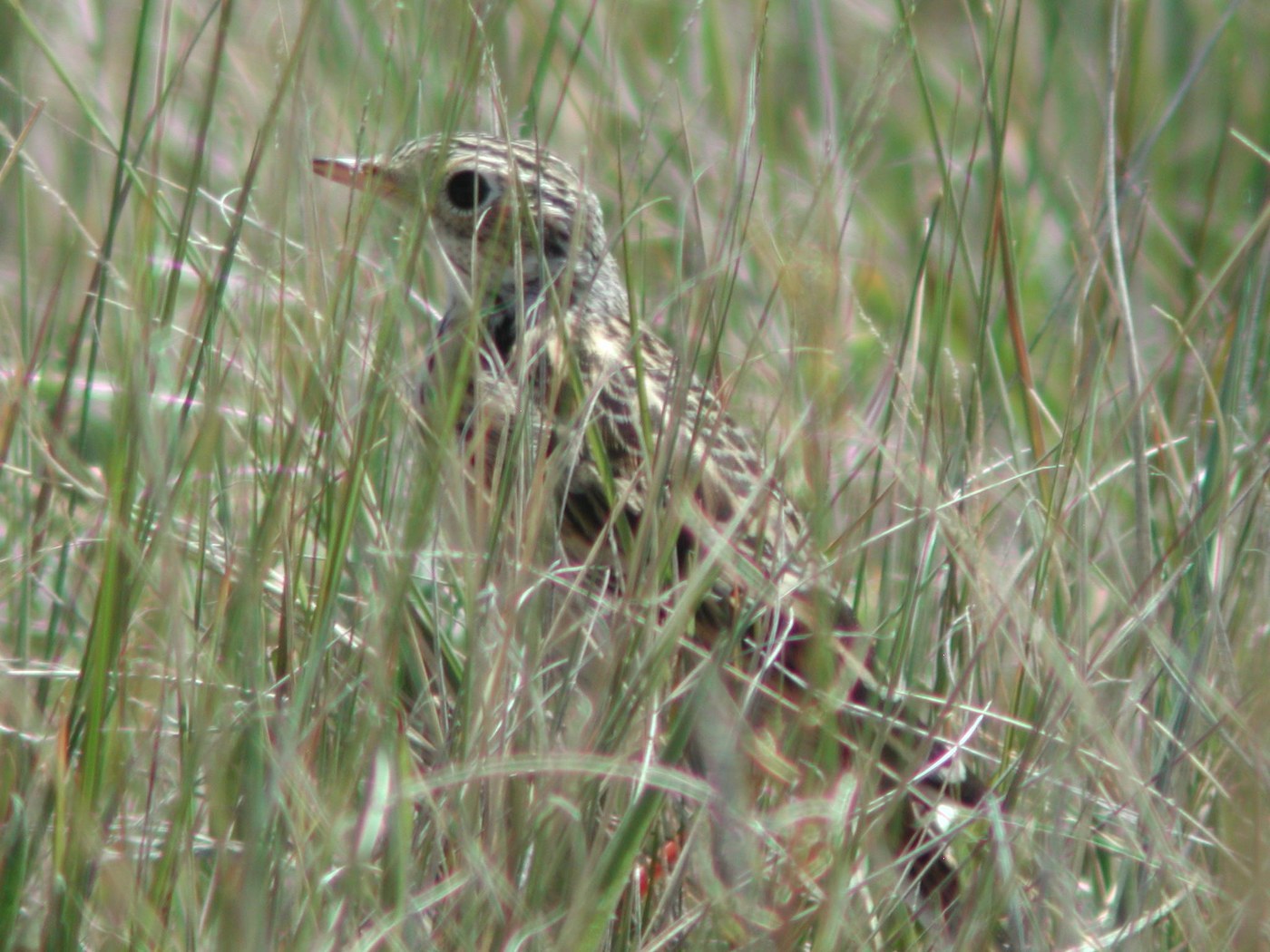
Sprague's Pipit
Anthus spragueii
A secretive, pale grassland songbird of the northern Great Plains, best known for its extraordinary high, circling flight song.
- Size
- 15-17 cm (6-6.7 in) long, 24-26 cm (9.4-10.2 in) wingspan
- Habitat
- native short- and mixed-grass prairie
- Type
- songbird
Spotted a bird like this?
Identify any bird from a photo, free.
Overview
Sprague's Pipit is a shy, superbly camouflaged songbird of native North American prairie. Pale buffy-brown and finely streaked above with a plain, unmarked face, it is far more often heard than seen, spending most of its time walking unobtrusively through dense grass.
Compared to the American Pipit, Sprague's Pipit is paler overall, with crisp, fine streaking on the back, a plain buffy face lacking strong markings, pale legs, and a shorter, less obvious tail-bobbing habit. It is famous among birders for its habit of flushing almost underfoot and flying off low, only to disappear again into the grass.
How to identify it
Key field marks
- Pale, buffy-brown plumage with crisp streaking on the back and crown
- Plain, unpatterned face without a strong eyebrow or mask
- Pale pinkish legs
- Streaked breast, whitish belly
- Extremely secretive, walking through dense grass rather than out in the open
Similar species
American Pipit is darker, more heavily streaked below, has darker legs, more actively bobs its tail, and readily walks on bare open ground rather than staying hidden in grass. Vesper Sparrow and other grassland sparrows have thicker, conical bills rather than the pipit's thin, pointed bill.
Habitat & range
Habitat
A true grassland specialist, Sprague's Pipit requires large expanses of native, relatively undisturbed short- and mixed-grass prairie with moderate grass height; it avoids cropland, heavily grazed pasture, and areas with woody encroachment.
Range
Breeds on the northern Great Plains of the United States and the prairie provinces of Canada. Winters in grasslands of the southern United States (especially Texas) and Mexico. Its restriction to native prairie has made it one of the most range-limited grassland songbirds in North America.
Behavior & voice
Behavior
Sprague's Pipit is notoriously difficult to observe on the ground, walking quietly through grass and flushing reluctantly, then dropping back down some distance away. It is best detected by its remarkable song flight.
Voice
The male sings while circling extremely high overhead, sometimes several hundred feet up, for minutes at a time — a thin, descending, jingling series of notes that seems to fall from the sky, one of the most distinctive sounds of the northern prairie.
Feeding and nesting
Feeds on insects and other invertebrates picked from the ground and low vegetation, with seeds taken more often outside the breeding season. The nest is a well-hidden grass cup built on the ground, often domed or partly covered by overhanging grass, making it extremely hard to find.
Frequently asked questions
Why is Sprague's Pipit hard to see?
It walks quietly through dense grass, flushes reluctantly, and is superbly camouflaged, so it is usually detected by its song rather than by sight.
What is special about Sprague's Pipit's song?
Males sing a thin, jingling, descending song while circling extremely high in the air, often for several minutes, a display unlike that of almost any other North American songbird.
Where does Sprague's Pipit live?
It breeds in native short- and mixed-grass prairie of the northern Great Plains and winters in grasslands of the southern U.S. and Mexico.
Is Sprague's Pipit endangered?
It is considered globally Vulnerable, with populations declining due to widespread loss and degradation of native prairie habitat.
How is Sprague's Pipit different from American Pipit?
Sprague's Pipit is paler, more finely streaked, has a plainer face and pinkish legs, and stays hidden in grass rather than walking on open ground like the American Pipit.
Sprague's Pipit guides
In-depth guides for identifying, finding, and understanding Sprague's Pipit.
Other birds you may enjoy

Black Redstart
13-14.5 cm (5.1-5.7 in) long, 23-26 cm wingspan

Black-throated Sparrow
12-14 cm (4.7-5.5 in) long, about 19-20 cm (7.5-8 in) wingspan

Greater Bird-of-paradise
Body about 43 cm; males with additional flank plumes up to 50 cm and long tail wires

Blue Tit
11-12 cm (4.3-4.7 in) long, 17-20 cm wingspan

Red-billed Quelea
11.5–13 cm long, wingspan about 20–22 cm
White-plumed Antbird
13-14 cm (5-5.5 in) long

Pyrrhuloxia
19-22 cm (7.5-8.7 in) long, 30 cm wingspan

Blue-gray Tanager
16-18 cm (6-7 in) long

Blackburnian Warbler
11-13 cm (4.3-5.1 in) long, 20-22 cm wingspan

Bluethroat
13-14 cm (5.1-5.5 in) long, 20-22 cm wingspan

Eurasian Nuthatch
12-14.5 cm (4.7-5.7 in) long, 22.5-27 cm wingspan

Wood Thrush
19-21 cm (7.5-8.3 in) long, about 33 cm (13 in) wingspan