
Sprague's Pipit Identification Guide
A secretive, cryptically streaked grassland songbird of the northern Great Plains, far more often heard — via its thin, descending flight song delivered from high overhead — than seen on the ground.
Read the full Sprague's Pipit encyclopedia entry →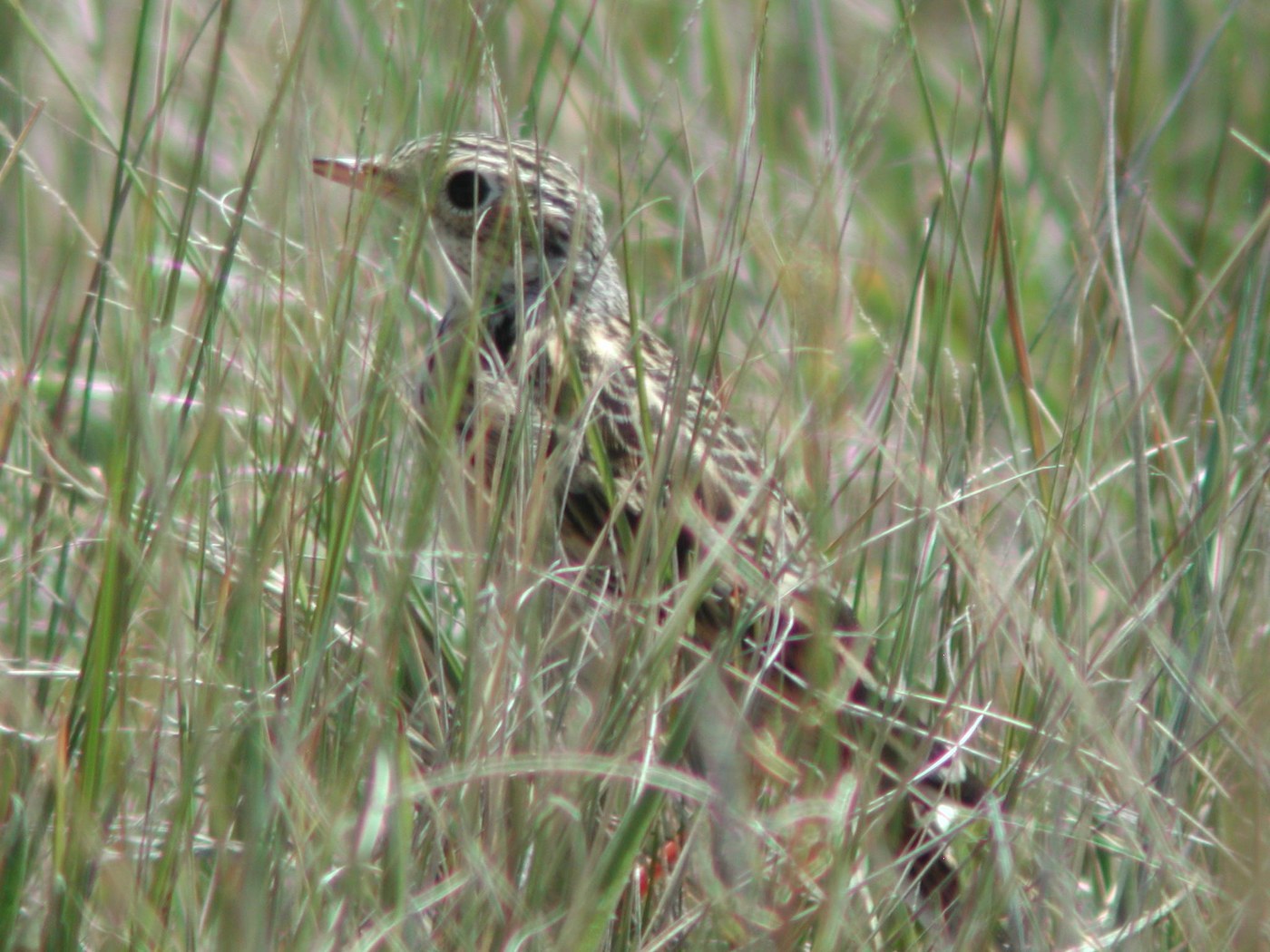
Key Field Marks
- Size & shape: A slender, medium-small songbird, about 15-17 cm, with a slim body, fairly short thin bill, and a relatively short tail for a pipit.
- Plumage: Buffy overall with crisp dark streaking on the back and crown; underparts are pale buff with fine streaking confined mainly to the breast.
- Face: Plain, pale face with a large dark eye and faint pale eye-ring; lacks strong facial contrast compared to many other grassland sparrows.
- Legs: Pale pinkish-yellow legs with a notably long hind claw, typical of pipits, adapted for walking through grass.
- Tail: White outer tail feathers flash in flight, similar to other pipits, but the bird usually flushes reluctantly and low before dropping back into grass.
Separating It From Similar Species
- American Pipit: Darker and greyer overall with a more contrasting face pattern, bobs its tail while walking (Sprague's does not), and typically occurs in more open, often wetter or agricultural habitats rather than native prairie.
- Grassland sparrows (e.g., Baird's Sparrow, Savannah Sparrow): These have conical seed-eating bills rather than the thin, pointed pipit bill, and lack the pipit's distinctive long hind claw and walking gait.
- Behavior as an ID clue: Sprague's Pipit walks (rather than hops) through grass with a crouched, mouse-like gait and is extremely difficult to flush or see well on the ground — the famous skylarking flight song is often the only reliable way to confirm the species.
Where & When to See It
- Habitat: A true native-prairie specialist, strongly favoring extensive, undisturbed or lightly grazed short- to mixed-grass prairie; it avoids cropland, heavily grazed pasture, and areas with much shrub cover.
- Range: Breeds in the northern Great Plains of the United States and the Canadian prairie provinces; winters in the southern Great Plains, Texas, and northern Mexico.
- Season: Present on breeding grounds roughly May-August; a scarce and elusive migrant and winter visitor further south, generally October-March in winter range.
- Conservation note: A species of significant conservation concern due to widespread loss of native prairie habitat.
Voice & Song Cues
- The male performs a spectacular, sustained flight display, circling extremely high (often nearly out of sight) while delivering a thin, tinkling, descending series of paired notes, often likened to jingling bells.
- This flight song can last several minutes and is the most reliable way to detect and confirm the species, since the bird is otherwise silent and cryptic on the ground.
- Ground calls are simple, thin "chip" or "squeet" notes, rarely heard and not particularly distinctive.
Frequently asked questions
Why is Sprague's Pipit so hard to see?
It is cryptically colored, walks through dense grass with a low, mouse-like gait, and is very reluctant to flush, so it is usually detected by its high, circling flight song rather than by sight on the ground.
What does the Sprague's Pipit flight song sound like?
A thin, tinkling, descending series of paired notes delivered from extremely high altitude, often while the bird is nearly invisible, and can continue for several minutes.
How is Sprague's Pipit different from American Pipit?
Sprague's Pipit is paler and buffier with less facial contrast, does not bob its tail, and prefers native prairie, while American Pipit is darker, bobs its tail while walking, and favors open fields, shorelines, and agricultural land.
Where is the best place to find a Sprague's Pipit?
Extensive tracts of native, lightly grazed short- to mixed-grass prairie in the northern Great Plains and Canadian prairie provinces during the breeding season.