
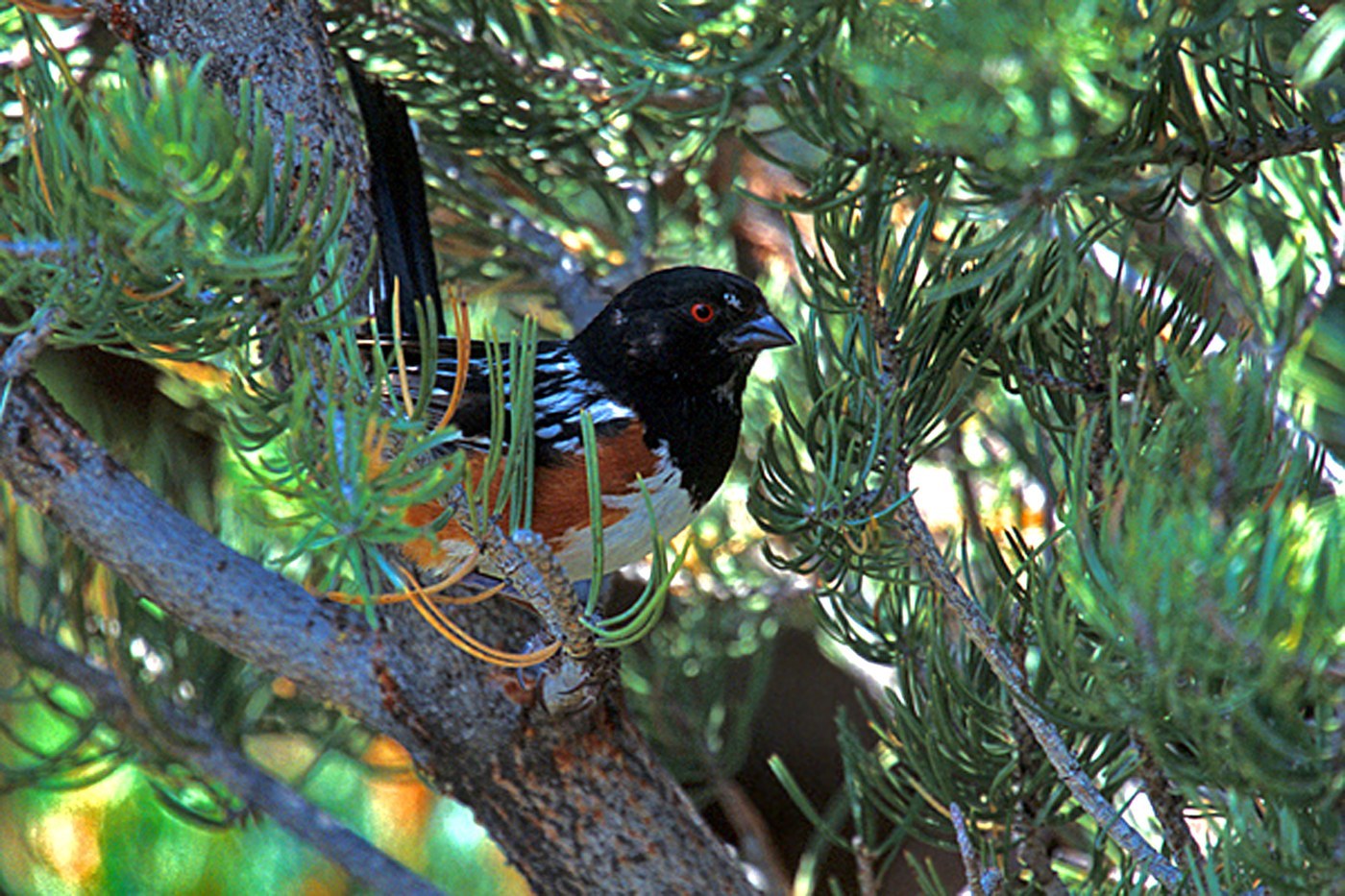
Spotted Towhee
Pipilo maculatus
The western counterpart to the Eastern Towhee, distinguished by bold white spotting on its black back and wings.
- Size
- 17-21 cm (6.7-8.3 in) long, 26-30 cm wingspan
- Habitat
- chaparral, brushy woodland edges, and dense shrub thickets in western North America
- Type
- songbird
Spotted a bird like this?
Identify any bird from a photo, free.
Overview
The Spotted Towhee is a striking, large sparrow relative closely related to the Eastern Towhee, sharing the same basic black-hood, rufous-flank, white-belly pattern but distinguished by rows of bold white spots across the black back, scapulars, and wing coverts. Males have solid black upperparts spangled with these white spots, while females show the same pattern in dark brownish-gray.
Red eyes, a heavy conical bill, and a long tail with white corners round out the field marks, and the species is a familiar, vocal presence in brushy habitats across the West.
How to identify it
Key field marks
- Bold white spots on an otherwise black (male) or dark brownish-gray (female) back and wings
- Rufous-orange flanks and a clean white belly
- Red eyes and a heavy, conical bill
- Long black tail with white corners, visible in flight
Similar species
- Eastern Towhee lacks the white spotting on the back, showing a plain black back instead; the two species meet and hybridize in a narrow contact zone on the Great Plains.
- No other western songbird shares this combination of a spotted black back, rufous flanks, and white belly.
Habitat & range
Spotted Towhees are widespread across western North America, from southern British Columbia and the Pacific Northwest south through California and the interior West into Mexico, favoring chaparral, brushy woodland edges, riparian thickets, and dense shrub understory. They are absent from open grassland and dense unbroken forest, preferring tangled edge habitats.
Most populations are resident or short-distance migrants, though birds breeding at higher elevations or in the northern part of the range may move to lower elevations or slightly south for winter.
Behavior & voice
Like its eastern counterpart, the Spotted Towhee forages mainly on the ground, using a vigorous double-footed scratching motion to kick through leaf litter and expose insects and seeds, often audible before the bird is seen.
The song is a variable buzzy trill, sometimes preceded by a few sharp introductory notes, and the call is a nasal, rising "mew" or "chwEE," distinct from the Eastern Towhee's "chewink." Diet includes insects, seeds, and berries gleaned mostly from the ground and low shrubs. Nests are built on or near the ground in dense cover, with typical clutches of three to five eggs.
Frequently asked questions
How do you identify a Spotted Towhee?
Look for a large sparrow relative with a black back and wings covered in bold white spots, rufous-orange flanks, a white belly, and red eyes.
What does a Spotted Towhee sound like?
A variable buzzy trill, sometimes with a few sharp introductory notes, plus a nasal, rising 'mew' or 'chwEE' call.
What is the difference between a Spotted Towhee and an Eastern Towhee?
The Spotted Towhee shows bold white spots across its black back and wings, while the Eastern Towhee has a plain, unspotted black back; their ranges meet on the Great Plains, where hybrids occur.
Where do Spotted Towhees live?
In chaparral, brushy woodland edges, and dense shrub thickets across western North America, from the Pacific Northwest through California and the interior West into Mexico.
Do Spotted Towhees migrate?
Most are resident or short-distance migrants, though birds from higher elevations or the northern edge of the range may move to lower ground or slightly south in winter.
Spotted Towhee guides
In-depth guides for identifying, finding, and understanding Spotted Towhee.
Other birds you may enjoy

Black Redstart
13-14.5 cm (5.1-5.7 in) long, 23-26 cm wingspan

Black-throated Sparrow
12-14 cm (4.7-5.5 in) long, about 19-20 cm (7.5-8 in) wingspan

Greater Bird-of-paradise
Body about 43 cm; males with additional flank plumes up to 50 cm and long tail wires

Blue Tit
11-12 cm (4.3-4.7 in) long, 17-20 cm wingspan

Red-billed Quelea
11.5–13 cm long, wingspan about 20–22 cm
White-plumed Antbird
13-14 cm (5-5.5 in) long

Pyrrhuloxia
19-22 cm (7.5-8.7 in) long, 30 cm wingspan

Blue-gray Tanager
16-18 cm (6-7 in) long

Blackburnian Warbler
11-13 cm (4.3-5.1 in) long, 20-22 cm wingspan

Bluethroat
13-14 cm (5.1-5.5 in) long, 20-22 cm wingspan

Eurasian Nuthatch
12-14.5 cm (4.7-5.7 in) long, 22.5-27 cm wingspan

Wood Thrush
19-21 cm (7.5-8.3 in) long, about 33 cm (13 in) wingspan