
Spotted Towhee Identification Guide
A striking black, white, and rufous sparrow relative of western North America, best known for its two-footed backward 'kick-scratch' in leaf litter and its buzzy, drawn-out song.
Read the full Spotted Towhee encyclopedia entry →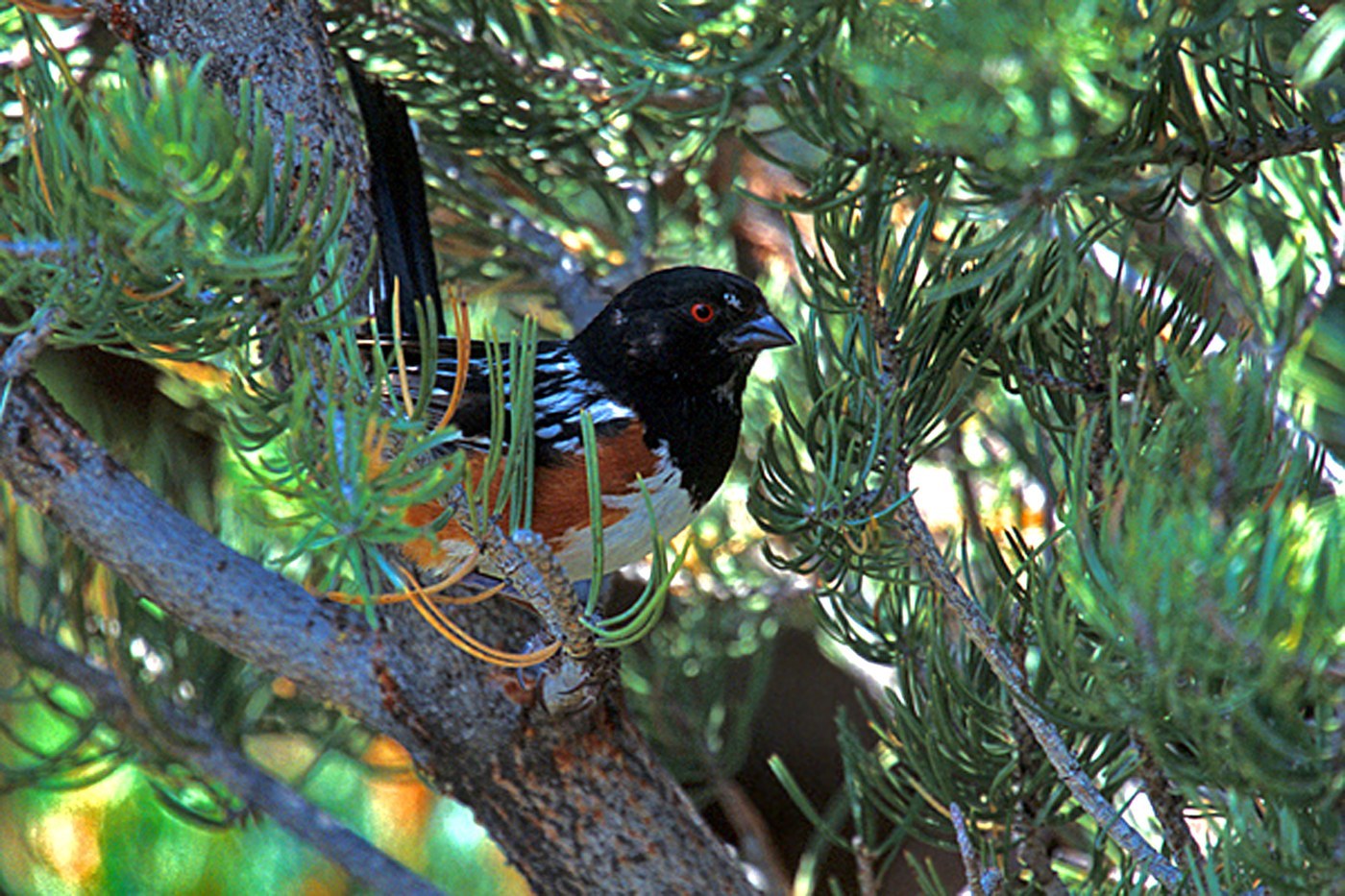
Key Field Marks
- Size & shape: A large, chunky sparrow relative, about 18-21 cm, with a long tail, stout conical bill, and a somewhat hunched, ground-hugging posture.
- Head & upperparts: Male has a solid black hood, back, and tail; female is a softer sooty brown in the same pattern.
- Wings: Black (or brown in females) with bold white spotting on the wing coverts and scapulars — the source of the name.
- Underparts: Rich rufous-orange flanks contrasting with a clean white belly and white-cornered black tail tip visible in flight.
- Eyes: Bright red iris, visible at close range and useful for confirming adults.
Separating It From Similar Species
- Eastern Towhee: Very similar overall pattern but with little to no white spotting on the back and wings (mostly limited to primary edges); ranges barely overlap, mainly in the Great Plains, where hybrids occur.
- Female vs. male Spotted Towhee: Females show the identical spotted pattern but in warm brown/grey tones instead of black — never confuse a dull female for a different species.
- California Towhee / Canyon Towhee: Both are plain, uniformly brown towhees with no black-and-white pattern or rufous flanks, easily separated by their drab, unmarked plumage.
Where & When to See It
- Habitat: Dense brushy thickets, chaparral, forest edges, overgrown gardens, and shrubby understory — almost always near low, tangled cover it can retreat into.
- Range: Resident across most of the western United States, southwestern Canada, and Mexico; some northern and high-elevation populations move short distances or altitudinally in winter.
- Season: Present year-round through most of its range, making it a reliable target in any season within suitable brushy habitat.
- Behavior: Forages on the ground with a distinctive two-footed backward "kick-scratch" hop, throwing leaf litter aside to expose insects and seeds, then often retreats to low cover.
Voice & Song Cues
- Song is a buzzy, often two-part phrase, typically a few clear introductory notes followed by a fast trill: "chup chup chup zeeeeeee."
- Call note is a nasal, rising, cat-like "mew" or upslurred "chweee," frequently given from cover and often the first sign of the bird's presence.
- Both song and call show regional variation across its wide range, but the buzzy trilled ending is consistently useful for identification.
Frequently asked questions
How is Spotted Towhee different from Eastern Towhee?
Spotted Towhee has bold white spotting across the back and wing coverts, while Eastern Towhee has little to no white spotting on the back; their ranges mostly don't overlap except in a narrow zone on the Great Plains.
What does the 'kick-scratch' foraging behavior look like?
The towhee hops forward and kicks both feet backward simultaneously to flip leaf litter aside, exposing seeds and insects — a distinctive ground-foraging technique shared with Eastern Towhee.
Are female Spotted Towhees a different color from males?
Yes, females show the same spotted pattern as males but in brown and grey tones instead of solid black, so the pattern shape is the more reliable ID feature than color alone.
What habitat is best for finding a Spotted Towhee?
Dense, brushy thickets and chaparral with low tangled cover are ideal; listen for its buzzy trilled song or catlike mewing call near shrubby edges.