
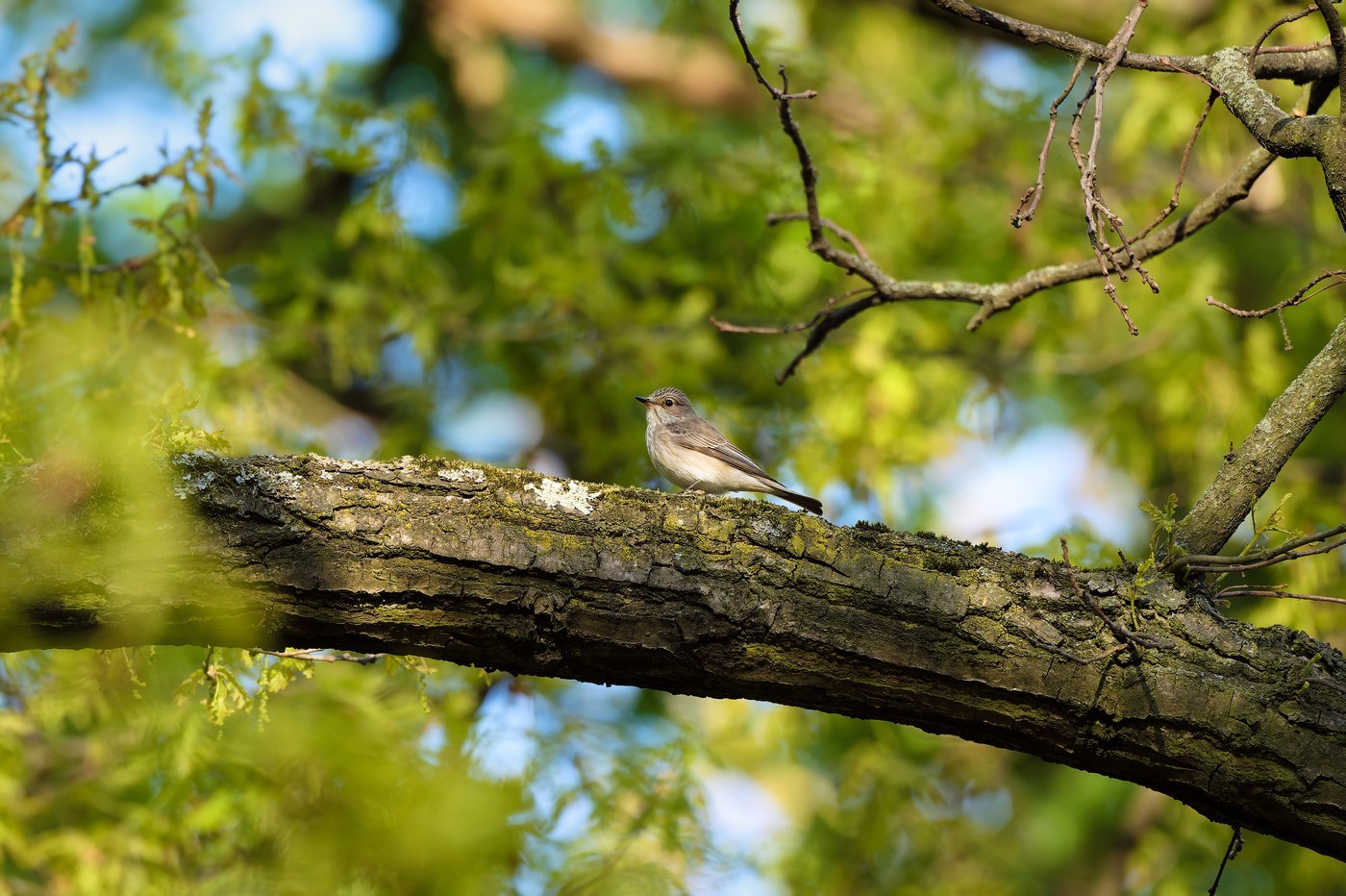
Spotted Flycatcher
Muscicapa striata
An unassuming grey-brown songbird best known for its habit of darting from an exposed perch to snap up flying insects and returning to the same spot.
- Size
- 13.5-15 cm (5.3-6 in) long, 23-25.5 cm wingspan
- Habitat
- open woodland edges, orchards, parks, and gardens with mature trees
- Type
- songbird
Spotted a bird like this?
Identify any bird from a photo, free.
Overview
The Spotted Flycatcher is a slim, upright, grey-brown bird that is easy to overlook until it reveals its distinctive feeding behaviour. Rather than being boldly patterned, it relies on a subtle, streaky camouflage: soft grey-brown upperparts, a faintly streaked forehead and crown, and off-white underparts with light dusky streaking across the breast.
Its most recognisable feature is not its plumage but its posture and behaviour. Perched upright on a dead twig, fence, or garden wire, it watches for passing insects, then sallies out in a quick looping flight to snatch its prey in mid-air before returning, often to the exact same perch.
Once a familiar sight in gardens and orchards across Europe, the species has undergone steep declines in parts of its breeding range, making sightings increasingly special.
How to identify it
Key field marks
- Grey-brown upperparts with a subtly streaked crown and forehead
- Whitish underparts with fine, diffuse streaking on the breast and flanks
- Large, dark eye set in a plain face
- Thin, flat bill suited to catching insects in flight
- Upright, alert posture on an exposed perch
- Long wings that extend well down the tail at rest
Similar species
- Pied Flycatcher (female/juvenile): shows a small white wing patch and white outer tail feathers, which Spotted Flycatcher lacks.
- Whitethroat and other warblers: lack the flycatcher's habit of sallying out from a fixed perch and returning to it, and have finer bills.
- European Robin (juvenile): also spotted, but rounder-bodied with a shorter tail and does not hawk insects in the same repeated looping flights.
The single best clue is behaviour: a plain streaky bird making repeated short aerial sallies from the same perch is almost always this species.
Habitat & range
Spotted Flycatchers breed across most of Europe and western Asia, favouring open woodland edges, parkland, orchards, churchyards, and large gardens with mature trees that provide both nesting cover and open airspace for hunting insects.
They are long-distance migrants, wintering in sub-Saharan Africa and arriving back on European breeding grounds later than most other migrants, typically not until mid-to-late May, after most flying insects have become abundant.
The species has declined significantly in Britain and other parts of northwestern Europe, likely linked to reduced insect abundance and habitat changes both on the breeding grounds and along migration routes.
Behavior & voice
Voice
The song is quiet, thin, and easily overlooked: a scratchy, irregular series of squeaky notes with little musical structure. The call is a sharp, high-pitched "tzee" or "tzee-tuk-tuk," often the first clue to its presence.
Feeding
Spotted Flycatchers feed almost entirely by "hawking": watching from a prominent perch, then flying out in a short looping sortie to catch a flying insect before returning to the same or a nearby perch. This repeated pattern makes them relatively easy to locate once noticed.
Nesting and breeding
Nests are open cups of grass, moss, and cobwebs, tucked into a tree crevice, ivy-covered wall, or open-fronted nest box. Clutches typically number four to five eggs, and pairs may raise two broods where the season allows.
Frequently asked questions
How do you identify a Spotted Flycatcher?
Look for a plain grey-brown bird with a faintly streaked crown and lightly streaked breast, sitting upright on an exposed perch and making repeated short flights to snatch flying insects before returning to the same spot.
What does a Spotted Flycatcher eat?
It feeds almost exclusively on flying insects such as flies, bees, wasps, and moths, caught in mid-air during short sallying flights from a perch.
Where do Spotted Flycatchers go in winter?
They migrate long distances to spend the winter in sub-Saharan Africa, returning to European breeding grounds relatively late in spring.
Why have Spotted Flycatcher numbers declined?
Populations have fallen sharply in parts of northwestern Europe, likely due to reduced flying-insect abundance on breeding grounds and pressures encountered along migration routes.
Will Spotted Flycatchers use a nest box?
Yes, they readily use open-fronted nest boxes fixed to walls or tree trunks, as well as natural crevices and ivy-covered ledges.
Spotted Flycatcher guides
In-depth guides for identifying, finding, and understanding Spotted Flycatcher.
Other birds you may enjoy

Black Redstart
13-14.5 cm (5.1-5.7 in) long, 23-26 cm wingspan

Black-throated Sparrow
12-14 cm (4.7-5.5 in) long, about 19-20 cm (7.5-8 in) wingspan

Greater Bird-of-paradise
Body about 43 cm; males with additional flank plumes up to 50 cm and long tail wires

Blue Tit
11-12 cm (4.3-4.7 in) long, 17-20 cm wingspan

Red-billed Quelea
11.5–13 cm long, wingspan about 20–22 cm
White-plumed Antbird
13-14 cm (5-5.5 in) long

Pyrrhuloxia
19-22 cm (7.5-8.7 in) long, 30 cm wingspan

Blue-gray Tanager
16-18 cm (6-7 in) long

Blackburnian Warbler
11-13 cm (4.3-5.1 in) long, 20-22 cm wingspan

Bluethroat
13-14 cm (5.1-5.5 in) long, 20-22 cm wingspan

Eurasian Nuthatch
12-14.5 cm (4.7-5.7 in) long, 22.5-27 cm wingspan

Wood Thrush
19-21 cm (7.5-8.3 in) long, about 33 cm (13 in) wingspan