
Spotted Flycatcher Identification Guide
A plain grayish-brown Eurasian migrant songbird best known for its upright, alert perching posture and habit of sallying out to snatch flying insects.
Read the full Spotted Flycatcher encyclopedia entry →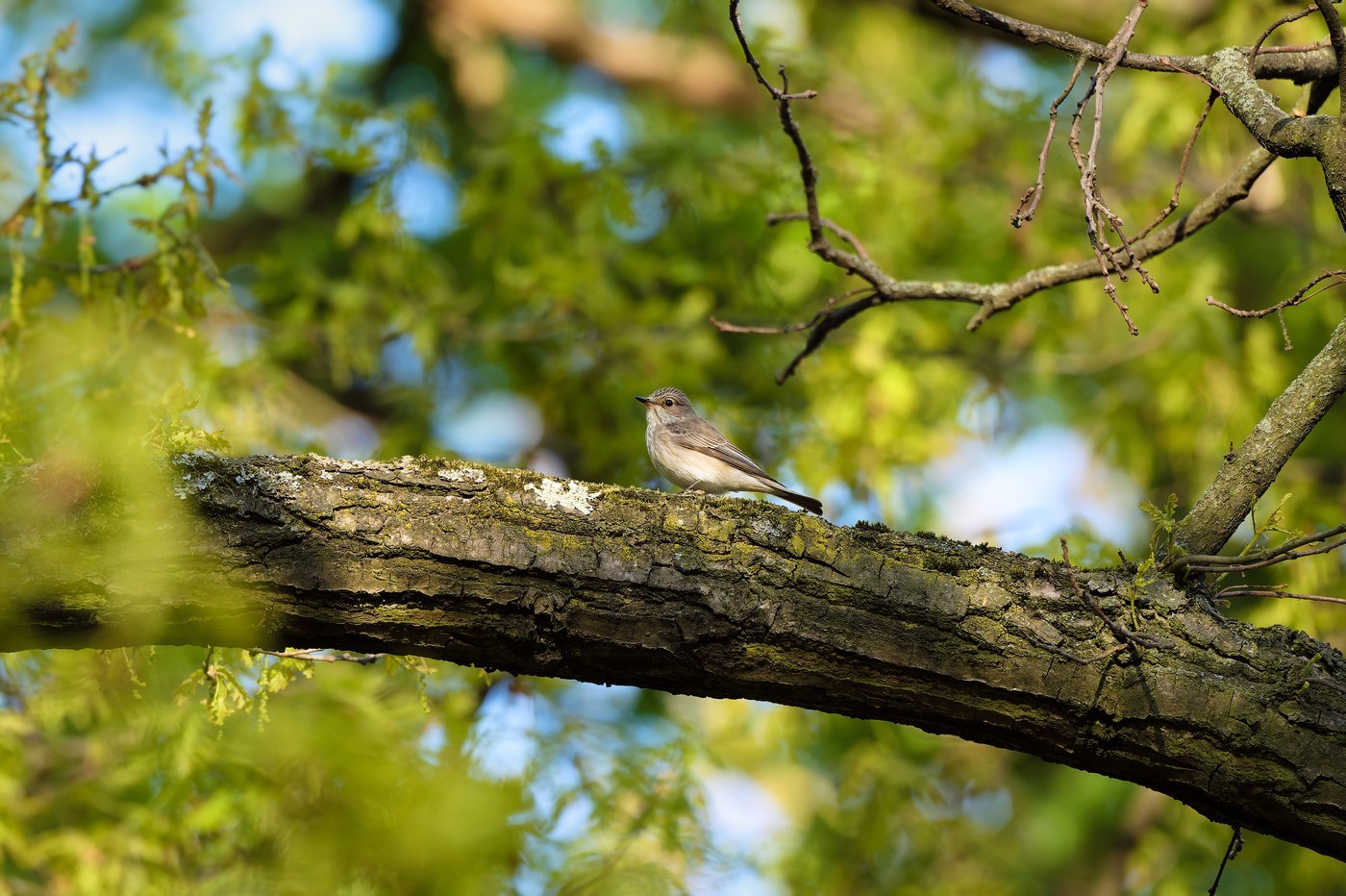
Key Field Marks
- Size & shape: A slim, medium-small songbird, about 5.5 inches (14 cm), with a fairly large head, broad flat bill, and an upright, alert perching stance.
- Plumage: Overall grayish-brown, with fine dark streaking on the crown and diffuse streaking on the breast and flanks against a whitish-buff background — plumage is subdued and nondescript, an important clue in itself.
- Wings: Show pale buffy fringes to the wing feathers when fresh, but no bold wing bars.
- Behavior: The signature field mark is behavioral — it perches upright on an exposed branch, fence, or wire, then makes short sallying flights to catch flying insects, often returning to the same or a nearby perch (classic "flycatching" or "hawking"); frequently flicks its wings and tail while perched.
Separating It From Similar Species
- Pied Flycatcher and Collared Flycatcher (females/non-breeding) — both show a bolder white wing patch/panel and a more compact shape; Spotted Flycatcher lacks any white wing patch and looks plainer and longer-tailed.
- Whinchat or other perching passerines — lack the flat, broad-based bill and the distinctive repeated sally-and-return flycatching behavior.
- Juveniles show spotting on the upperparts (hence some regional names), which can suggest a different species, but the flat bill, upright posture, and hawking behavior remain diagnostic.
- Overall, the plain streaky-breasted look combined with obvious aerial sallying from a fixed perch is the most reliable way to identify this species even when plumage detail is hard to see.
Habitat, Range & Season
Breeds across most of Europe and western Asia in open woodland, woodland edge, parks, gardens, orchards, and churchyards, favoring areas with open perches near foliage. A long-distance migrant, wintering in sub-Saharan Africa; present in breeding areas roughly May through August/September, arriving later in spring than most other migrants.
Voice
A weak, thin, scratchy "tzee" or "tzee-suk-suk" call; the song is an unremarkable, quiet series of thin squeaky notes, easily overlooked and not a strong identification feature compared to its distinctive foraging behavior.
Frequently asked questions
What is the easiest way to recognize a Spotted Flycatcher?
Its upright perching posture on an exposed twig or wire followed by short sallying flights to catch insects and a return to the same perch, combined with plain grayish-brown, lightly streaked plumage.
Does the Spotted Flycatcher have spots as an adult?
Not obviously — adults show only fine streaking on the crown and breast; it is juveniles that display more spotting on the upperparts, which gave rise to the name historically.
How do I separate it from Pied Flycatcher females?
Pied Flycatcher shows a distinct pale wing patch and a more compact build, while Spotted Flycatcher has plain wings without a white panel and a longer-tailed, slimmer look.
Where does the Spotted Flycatcher spend the winter?
It migrates to sub-Saharan Africa for the non-breeding season, returning to Europe and western Asia to breed in late spring.