
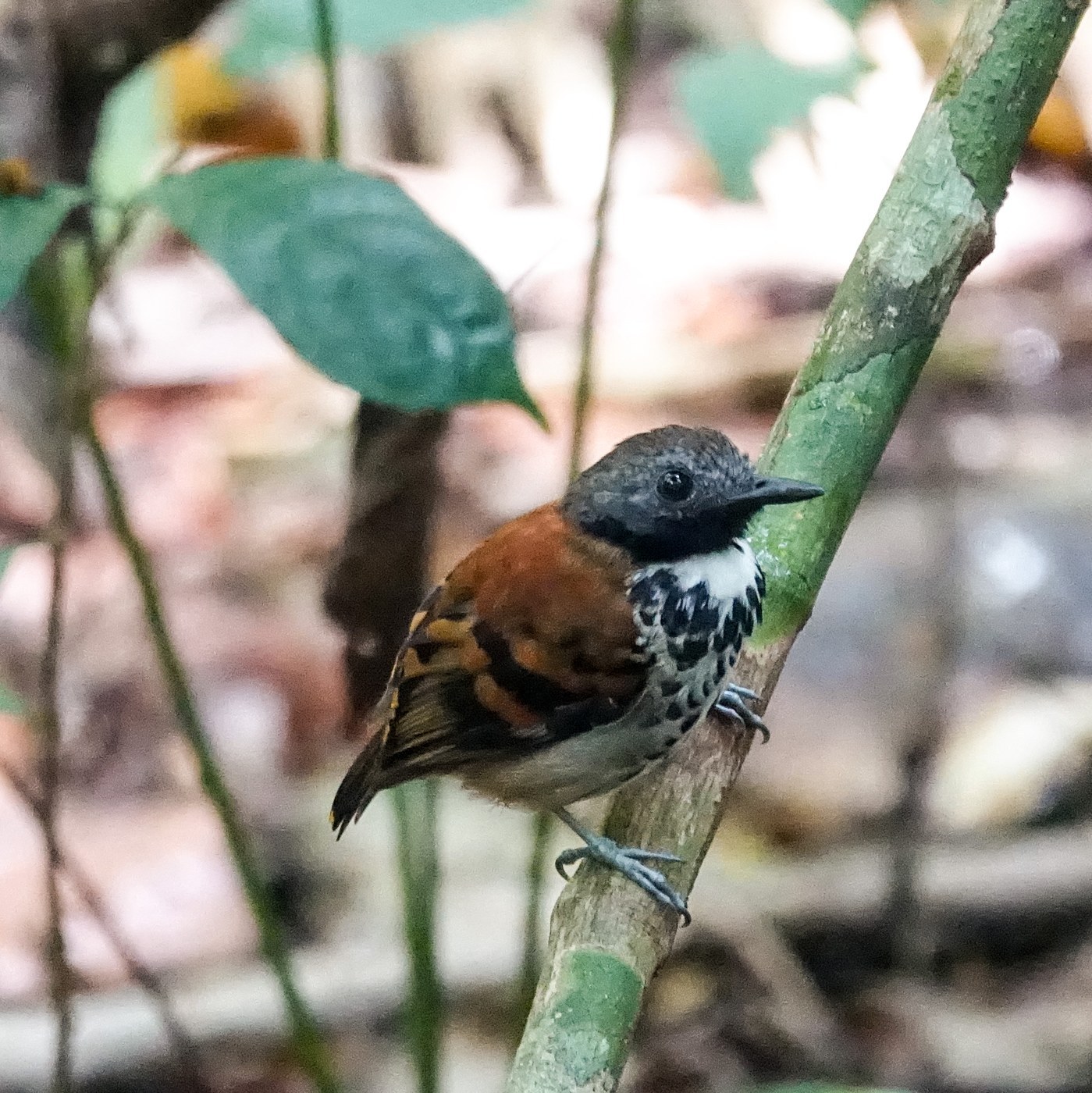
Spotted Antbird
Hylophylax naevioides
A small, boldly spotted antbird of Central American and Chocó forests that habitually follows army ant swarms to catch fleeing insects.
- Size
- 10-11 cm (4-4.3 in) long
- Habitat
- understory of humid lowland forest, often near army ant swarms
- Type
- songbird
Spotted a bird like this?
Identify any bird from a photo, free.
Overview
The Spotted Antbird is a small, compact member of the antbird family found in the forest understory from Nicaragua through Panama and Colombia to northwestern Ecuador. Males have rich rufous-brown upperparts, a black face and throat, and bold black spots across a white breast, set off by two crisp white wingbars. Females share the pattern but are paler and buffier, with less contrasting spotting.
This species is one of the classic "professional" ant-following birds of Neotropical forests, rarely seen far from an active army ant swarm.
How to identify it
Key field marks
- Small size, short tail, and an upright, alert posture close to the ground.
- Rufous-brown back and crown; black face/throat; white underparts marked with bold black spots (male) or buffier with lighter spotting (female).
- Two conspicuous white wingbars.
Similar species
Bicolored Antbird is larger, plainer, and lacks spotting. Ocellated Antbird is much larger with a scaly, scalloped pattern rather than discrete spots and bare blue facial skin. Within its range, the combination of small size and bold spotting on white underparts is diagnostic.
Habitat & range
Spotted Antbirds inhabit the understory of humid lowland and foothill evergreen forest, generally below about 900-1,000 m. Their range runs from Nicaragua through Costa Rica, Panama, and Pacific/northern Colombia to northwestern Ecuador (the Chocó bioregion). They are non-migratory, sedentary residents that hold territories year-round, though individuals may shift locally to track moving ant swarms.
Behavior & voice
Voice
The song is a short, thin series of whistled notes that rises then falls, distinctive enough to help locate an ant swarm even before the bird is seen.
Feeding
Spotted Antbirds are obligate army ant followers, perching on low stems and saplings just above the swarm front to snatch insects, spiders, and other small arthropods flushed by the advancing ants — they do not eat the ants themselves.
Nesting and breeding
Pairs build a small open cup nest low in the understory. Both parents incubate and feed nestlings. Because army ant swarms move unpredictably, pairs must balance nest defense with following productive swarms for feeding opportunities.
Frequently asked questions
Do Spotted Antbirds eat the army ants?
No, they eat insects, spiders, and other small creatures that flee from the advancing ant swarm, not the ants themselves.
How can I find a Spotted Antbird?
Listen and look for an active army ant swarm on the forest floor in Central American or Chocó rainforest — this species is almost always found attending one.
What distinguishes males from females?
Males have crisp black spots on white underparts; females show a similar pattern but paler and buffier with less bold spotting.
Where do Spotted Antbirds live?
In lowland and foothill rainforest understory from Nicaragua through Panama and Colombia to northwestern Ecuador.
Spotted Antbird guides
In-depth guides for identifying, finding, and understanding Spotted Antbird.
Other birds you may enjoy

Black Redstart
13-14.5 cm (5.1-5.7 in) long, 23-26 cm wingspan

Black-throated Sparrow
12-14 cm (4.7-5.5 in) long, about 19-20 cm (7.5-8 in) wingspan

Greater Bird-of-paradise
Body about 43 cm; males with additional flank plumes up to 50 cm and long tail wires

Blue Tit
11-12 cm (4.3-4.7 in) long, 17-20 cm wingspan

Red-billed Quelea
11.5–13 cm long, wingspan about 20–22 cm
White-plumed Antbird
13-14 cm (5-5.5 in) long

Pyrrhuloxia
19-22 cm (7.5-8.7 in) long, 30 cm wingspan

Blue-gray Tanager
16-18 cm (6-7 in) long

Blackburnian Warbler
11-13 cm (4.3-5.1 in) long, 20-22 cm wingspan

Bluethroat
13-14 cm (5.1-5.5 in) long, 20-22 cm wingspan

Eurasian Nuthatch
12-14.5 cm (4.7-5.7 in) long, 22.5-27 cm wingspan

Wood Thrush
19-21 cm (7.5-8.3 in) long, about 33 cm (13 in) wingspan