
Spotted Antbird Identification Guide
A small Central American antbird best known for the male's neat black spots on a white breast and its strong association with army ant swarms.
Read the full Spotted Antbird encyclopedia entry →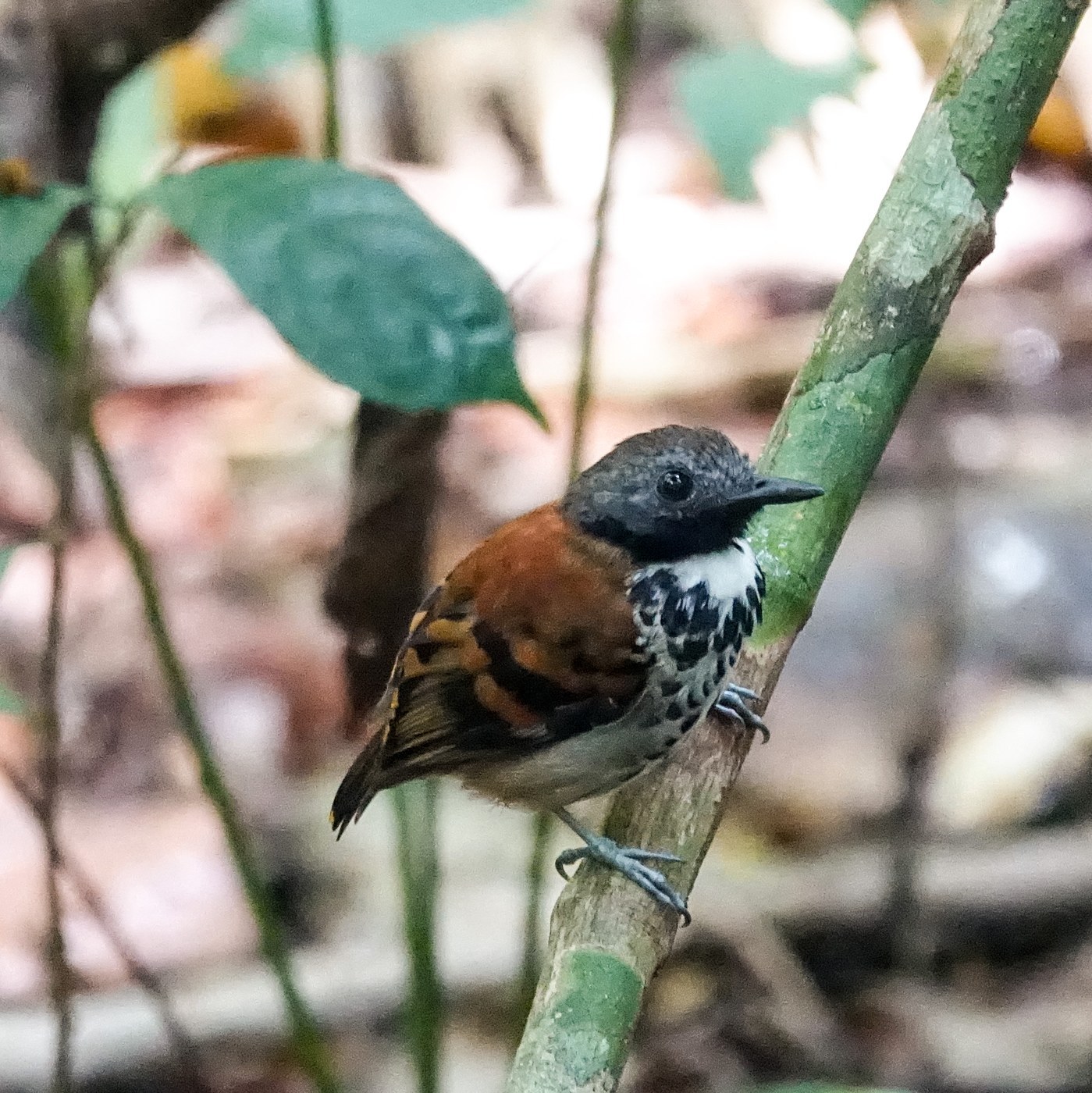
Key Field Marks
- Size & shape: Small, around 4.7 inches (12 cm), with a short tail and the alert, upright posture typical of antbirds.
- Male plumage: Rich rufous-orange crown and upperparts; white underparts boldly marked with round black spots across the breast and flanks, giving a neat polka-dot look; black-and-white streaked or barred pattern on the face/nape area.
- Female plumage: Similar rufous upperparts but underparts are buffy-orange with fine dark barring/streaking rather than bold round spots.
- Behavior: A classic army-ant-following species, staying low over swarms to snatch flushed insects; often perches sideways on vertical stems, flicking wings and tail; usually in pairs.
Separating It From Similar Species
- Spotted-backed and other spotted antbirds — many antbird species share "spotted" in the name and pattern; Spotted Antbird's combination of rufous-orange upperparts with bold black spots on a clean white breast (male) is diagnostic within its Central American/Chocó range.
- Bicolored Antbird — larger, plainer, without the spotted underparts, also an ant-follower and often present at the same swarms.
- Ocellated Antbird — much larger, with bright blue facial skin and scaled/ocellated (not simple round-spotted) underparts.
- At an ant swarm, size, the bold white-with-black-spots breast, and rufous back reliably separate male Spotted Antbird from co-occurring species.
Habitat, Range & Season
Resident in humid lowland and foothill forest from Honduras and Nicaragua through Costa Rica, Panama, and into western Colombia and Ecuador (Chocó region). Found in forest understory, especially where army ant swarms are active, up to around 1,000 m. Non-migratory; pairs hold territories and track ant swarm activity within them.
Voice
A thin, high, accelerating series of sharp notes, often speeding into a brief trill; also gives sharp single "chip" call notes while foraging at swarms.
Frequently asked questions
Why is the Spotted Antbird often seen at army ant swarms?
It is an obligate to near-obligate ant-follower, relying on flushed insects and other small prey stirred up by advancing army ant columns, rather than eating the ants themselves.
How do I tell a male from a female Spotted Antbird?
Males have bold round black spots on a clean white breast, while females show finer dark barring on buffy-orange underparts instead of discrete spots.
How does it differ from the Bicolored Antbird at the same swarm?
Bicolored Antbird is larger and plainer overall without spotted underparts, while Spotted Antbird is smaller with a rufous back and boldly spotted white breast.
What is its range?
Humid forest from Honduras and Nicaragua south through Costa Rica and Panama into the Chocó region of Colombia and Ecuador.