
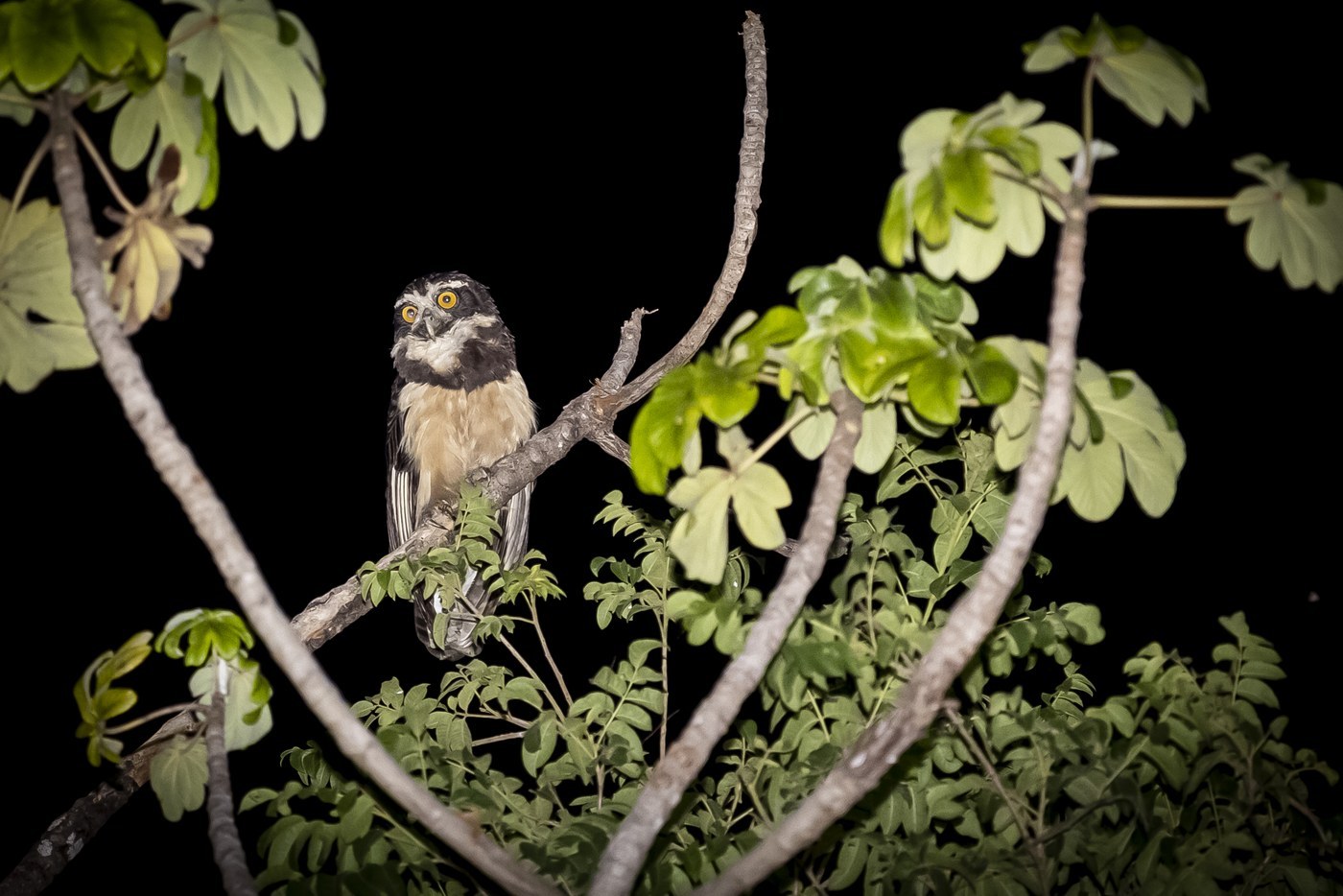
Spectacled Owl
Pulsatrix perspicillata
A large, dark-headed owl named for the bold white "spectacles" that ring its eyes, with a strikingly different all-white juvenile plumage.
- Size
- 43-52 cm (17-20 in) long
- Habitat
- humid lowland and foothill forest
- Type
- owl
Spotted a bird like this?
Identify any bird from a photo, free.
Overview
The Spectacled Owl is a large, powerful owl of Neotropical forests, named for the distinctive white markings around its yellow eyes that resemble a pair of spectacles or a mask. Adults have a dark chocolate-brown head, throat, and upperparts, a brown breast band, and pale buffy-cream underparts. Juveniles look dramatically different from adults, being almost entirely white with a dark facial mask, and take several years to molt into full adult plumage — a transformation striking enough that young and old birds were once thought to be different species.
How to identify it
Key field marks
- Large size and bulky build.
- Dark brown head and upperparts with bold white eyebrow and throat patch forming "spectacles" around bright yellow eyes.
- Brown breast band above pale buffy underparts.
- No ear tufts.
Similar species
Other large Neotropical owls, such as Crested Owl, have prominent ear tufts, unlike the Spectacled Owl's smooth, tuftless head. The bold white spectacle pattern combined with a brown breast band is distinctive among owls sharing its range.
Habitat & range
Spectacled Owls inhabit humid lowland and foothill evergreen forest, generally below about 1,500 m, ranging from southern Mexico through Central America and across much of South America to Bolivia, Paraguay, and northern Argentina. They are non-migratory residents of forest interior and edge, and are largely nocturnal, roosting quietly in dense foliage by day.
Behavior & voice
Voice
A distinctive deep, resonant series of knocking or tapping notes, sometimes likened to a knocking woodpecker or a stick being struck rhythmically, given mostly at night.
Feeding
Spectacled Owls hunt from a perch at night, taking a broad range of prey including small mammals, birds, large insects, and occasionally amphibians and reptiles, using powerful talons to seize prey in the dark understory or canopy.
Nesting and breeding
Nests are typically placed in natural tree cavities. A single egg is usually laid, and the young remain dependent on the parents for an unusually long period — up to a year or more — during which they transition slowly from all-white juvenile down to the dark adult plumage.
Frequently asked questions
Why is it called the Spectacled Owl?
Bold white markings around its yellow eyes and across the upper breast resemble a pair of spectacles against its otherwise dark brown head.
Why do juvenile Spectacled Owls look so different from adults?
Juveniles are almost entirely white with a dark facial mask, gradually molting into the dark brown-and-buff adult plumage over a few years.
What does the Spectacled Owl's call sound like?
A deep, resonant series of knocking or tapping notes, quite unlike the hoots of many other owls.
What does a Spectacled Owl eat?
A varied diet of small mammals, birds, large insects, and occasionally amphibians and reptiles, hunted at night from a perch.
Spectacled Owl guides
In-depth guides for identifying, finding, and understanding Spectacled Owl.
Other birds you may enjoy
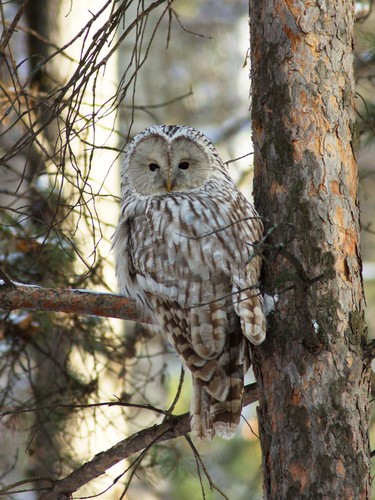
Ural Owl
50-62 cm long, wingspan about 1.0-1.3 m
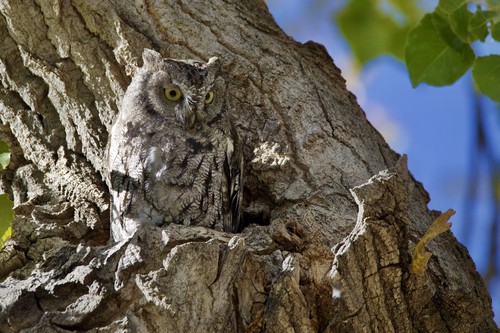
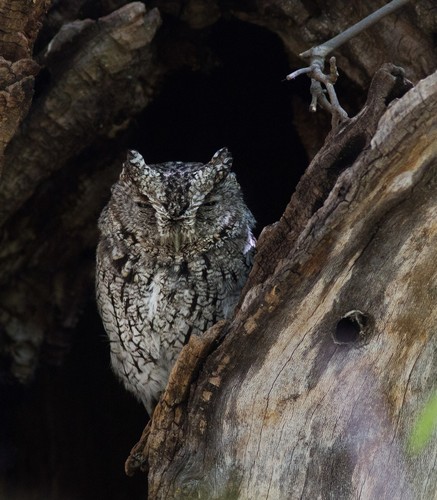
Western Screech-Owl
19-25 cm (7.5-10 in) long, about 55 cm (21.5 in) wingspan
Whiskered Screech-Owl
17-19 cm (6.7-7.5 in) long, 43 cm wingspan
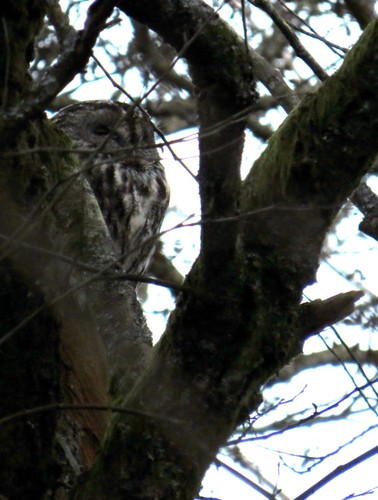
Tawny Owl
37-43 cm (15-17 in) long, 81-96 cm wingspan
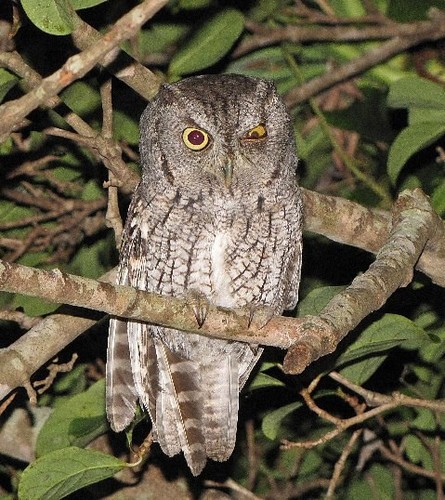
Screech Owl
16-25 cm long, wingspan about 46-61 cm
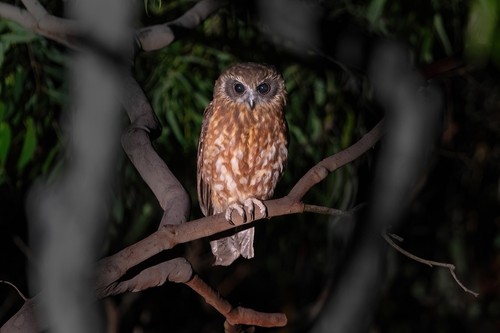
Southern Boobook
27-36 cm (11-14 in) long
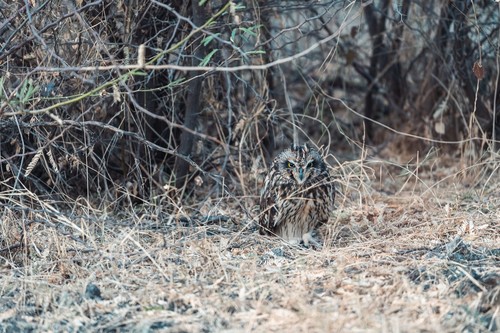
Short-eared Owl
34-42 cm (13-17 in) long, 85-110 cm wingspan
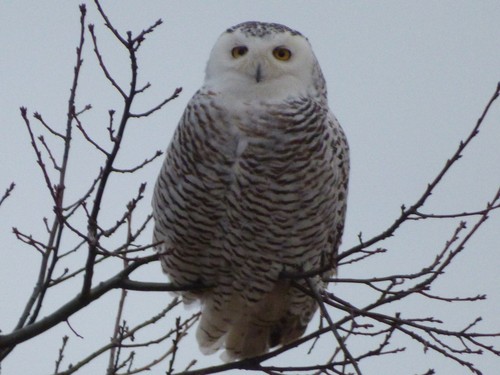
Snowy Owl
52-71 cm (20-28 in) long, 125-150 cm (49-59 in) wingspan
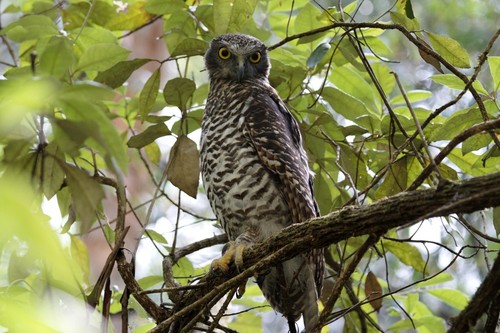
Powerful Owl
60-65 cm (24-26 in) long, 112-135 cm (44-53 in) wingspan
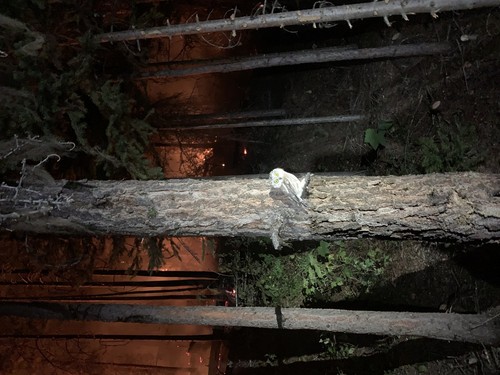
Northern Saw-whet Owl
18-21 cm (7-8.5 in) long, 42-56 cm (17-22 in) wingspan
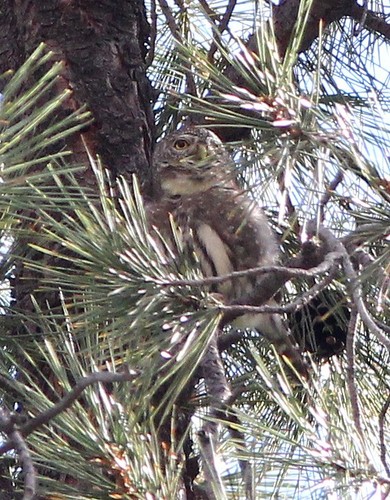
Northern Pygmy-Owl
16-18 cm (6.3-7.1 in) long, 35-39 cm wingspan
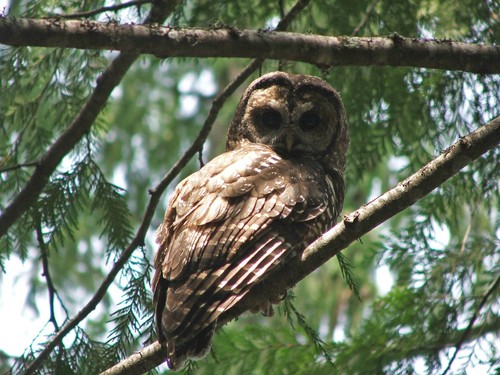
Spotted Owl
43-48 cm (17-19 in) long, 100-114 cm wingspan