
Spectacled Owl Identification Guide
A large, dark tropical owl named for the bold white eyebrow-and-throat pattern that ringds its yellow eyes like a pair of spectacles.
Read the full Spectacled Owl encyclopedia entry →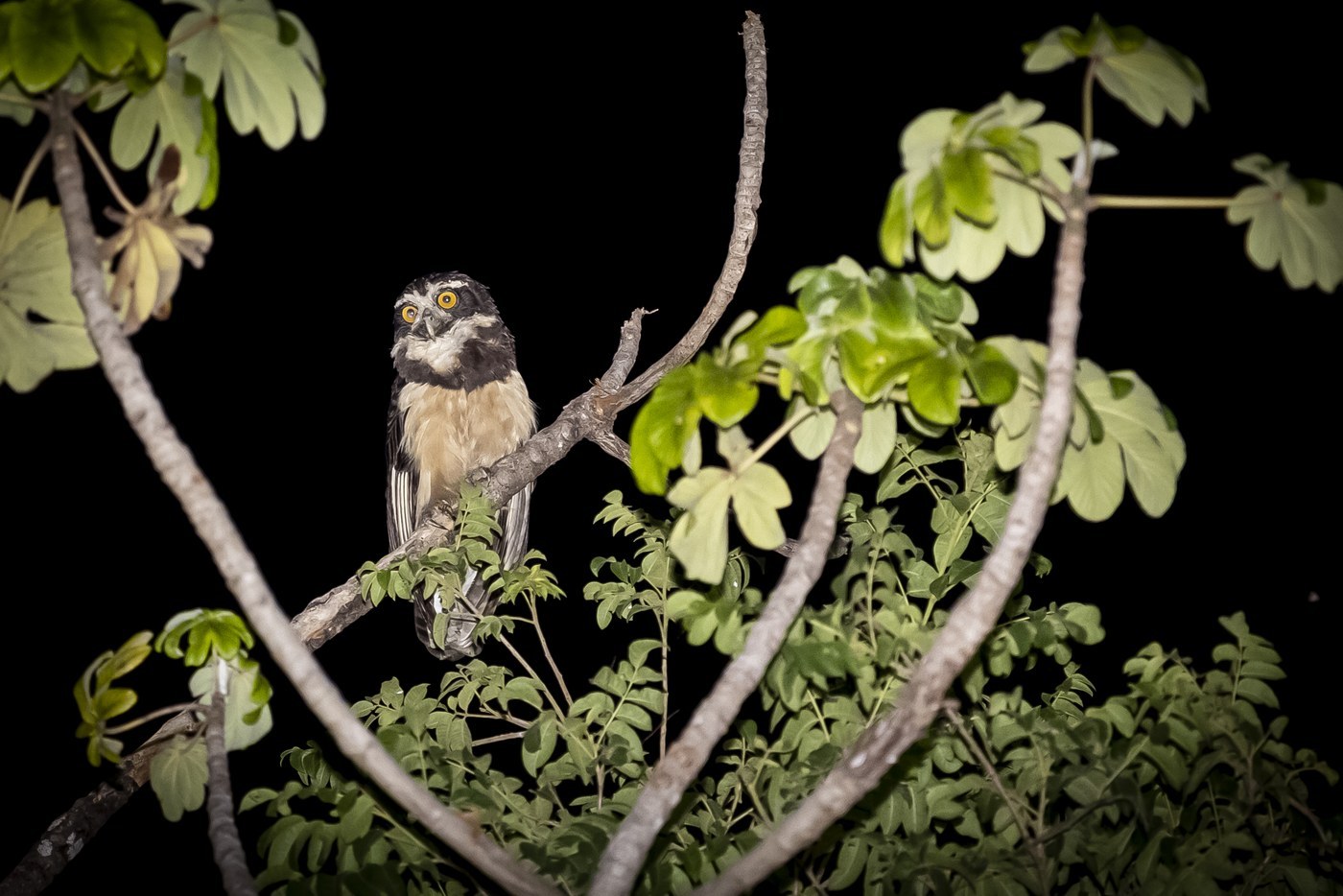
Key Field Marks
- Size & shape: A large owl, 17–19 inches (43–48 cm), with a big rounded head, no ear tufts, and a bulky body.
- Plumage: Dark chocolate-brown crown, face, and upperparts; bold white eyebrows and white throat/upper-breast band form the "spectacles"; underparts otherwise rich tawny-buff.
- Eyes & bill: Bright yellow eyes stand out against the dark face; pale yellowish-horn bill.
- Juveniles: Strikingly different — mostly white/creamy overall with a dark brown to blackish facial mask around the eyes, essentially an inverse of the adult pattern; this plumage is held for a year or more before molting toward adult plumage through intermediate stages.
- Behavior: Strictly nocturnal, roosting quietly in dense foliage by day; sits upright and still, relying on camouflage and stillness rather than flushing.
Separating It From Similar Species
- Black-and-white Owl and Black-banded Owl — both lack the yellow spectacles and tawny underparts, being more finely barred black-and-white overall.
- Crested Owl — has long white eyebrow "tufts" that project upward like horns, different from the flat spectacled pattern, and lacks the bold white throat band.
- Juvenile Spectacled Owls are sometimes mistaken for a different species entirely due to the largely white plumage, but the dark facial mask and overall shape match the adult.
Habitat, Range & Season
Resident from southern Mexico through Central America and much of South America east of the Andes to Bolivia and northern Argentina. Inhabits humid lowland and foothill forest, forest edge, and gallery forest, generally below 1,500 m though found higher locally. Non-migratory; pairs are territorial year-round.
Voice
A distinctive, deep, resonant series of hollow knocking notes, often rendered as "pop-pop-pop-pop-pop", accelerating slightly and dropping in pitch — quite unlike typical owl hoots and sometimes likened to a knuckle-rap or a muffled woodpecker-like tapping. Also gives a harsh bark-like call.
Frequently asked questions
What is the easiest field mark for an adult Spectacled Owl?
The dark brown face and upperparts contrasting with bold white eyebrows and a white throat band around bright yellow eyes.
Why do juveniles look so different from adults?
Young Spectacled Owls wear a mostly white or creamy plumage with a dark facial mask, essentially the reverse of the adult pattern, before gradually molting into adult coloration over roughly two years.
What does the Spectacled Owl sound like?
A deep, resonant, accelerating series of hollow knocking or popping notes, quite different from a typical hoot.
Where does it live?
Lowland and foothill tropical forest from southern Mexico through Central America and much of northern and central South America.