
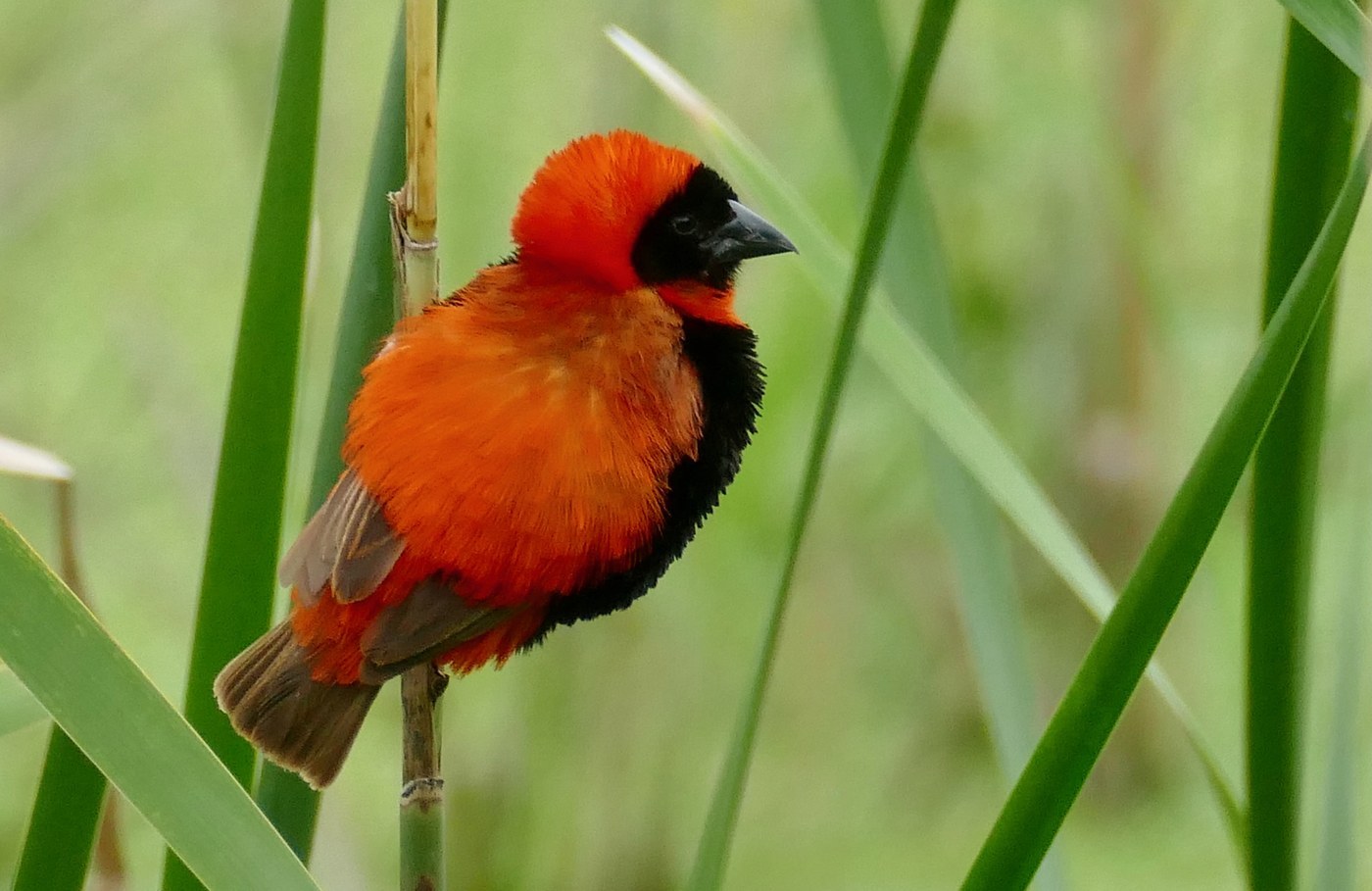
Southern Red Bishop
Euplectes orix
A small African wetland bird whose breeding male turns a brilliant scarlet and black, nesting in dense reedbed colonies.
- Size
- About 11-13 cm long
- Habitat
- Wetlands, reedbeds, and tall grassland near water
- Type
- songbird
Spotted a bird like this?
Identify any bird from a photo, free.
Overview
The Southern Red Bishop is a small, sparrow-sized member of the weaver family widespread across sub-Saharan Africa, closely tied to marshes, reedbeds, and rank grassland near water. Its common name comes from the striking transformation the breeding male undergoes.
In breeding plumage, the male is unmistakable: brilliant scarlet-red covering the crown, face-surround, back, and rump, contrasting with a black face, throat, and belly. Outside the breeding season, males molt into a cryptic sparrow-like brown, heavily streaked plumage similar to the female, which is dull brown and streaky year-round.
The species is highly polygynous, with dominant males holding reedbed territories where several females may nest.
How to identify it
Key field marks
- Breeding male: scarlet-red crown, mantle, and rump with a contrasting black face, throat, and belly
- Non-breeding male and female: streaky brown, sparrow-like, with a stout conical bill
- Short, rounded wings and a fairly short tail
- Often seen flying low and fast over reedbeds during the breeding season
Similar species
- Yellow-crowned Bishop shows golden-yellow rather than red on the crown and rump in breeding male plumage.
- Fire-fronted (Zanzibar) Bishop and other red-plumaged bishops have more restricted ranges and subtly different patterns of black on the face.
- Female and non-breeding males of all bishop species are very similar and best separated by range, bill shape, and associating breeding males nearby.
Habitat & range
Range
Widespread across sub-Saharan Africa, from Senegal east to Ethiopia and south through East and southern Africa to South Africa.
Habitat
Favors wetlands, marshes, reedbeds, rank grass along rivers and dams, and adjacent grassland or agricultural fields, especially during the non-breeding season when it forms large foraging flocks.
Movements
Mostly resident, though some local and seasonal movements occur in response to water availability and food supply, with birds sometimes forming large nomadic flocks outside the breeding season.
Behavior & voice
Behavior
Highly gregarious outside the breeding season, forming large mixed flocks with other seed-eating birds. During breeding, males become territorial and aggressively defend clusters of nest sites within a reedbed colony.
Voice
Gives sharp chirping and buzzing notes, along with a wheezy, chattering song often delivered during display flights over the breeding territory.
Feeding
Feeds mainly on grass and other seeds, taken from the ground or directly from seedheads, and also eats insects, especially when raising young.
Nesting and breeding
The male weaves several oval, woven nests of grass and reed strips attached to reed stems within his territory, then displays to attract females, who choose a nest and line it themselves. The species is polygynous, with a successful male mating with multiple females across the breeding season, each raising a brood independently.
Frequently asked questions
How do you identify a Southern Red Bishop?
During breeding season, look for a small bird that is brilliant scarlet-red with a contrasting black face, throat, and belly; outside the breeding season it looks like a streaky brown sparrow.
Where does the Southern Red Bishop live?
It is found across sub-Saharan Africa in wetlands, reedbeds, and tall grass near water.
Why do male Southern Red Bishops change color?
Males molt into brilliant red-and-black breeding plumage to attract mates and defend territory, then revert to camouflaged brown plumage resembling the female outside the breeding season.
Are Southern Red Bishops polygynous?
Yes, a single territorial male typically mates with multiple females who nest within his reedbed territory.
What does a Southern Red Bishop eat?
It eats mainly grass seeds along with insects, especially while feeding chicks.
Southern Red Bishop guides
In-depth guides for identifying, finding, and understanding Southern Red Bishop.
Other birds you may enjoy

Black Redstart
13-14.5 cm (5.1-5.7 in) long, 23-26 cm wingspan

Black-throated Sparrow
12-14 cm (4.7-5.5 in) long, about 19-20 cm (7.5-8 in) wingspan

Greater Bird-of-paradise
Body about 43 cm; males with additional flank plumes up to 50 cm and long tail wires

Blue Tit
11-12 cm (4.3-4.7 in) long, 17-20 cm wingspan

Red-billed Quelea
11.5–13 cm long, wingspan about 20–22 cm
White-plumed Antbird
13-14 cm (5-5.5 in) long

Pyrrhuloxia
19-22 cm (7.5-8.7 in) long, 30 cm wingspan

Blue-gray Tanager
16-18 cm (6-7 in) long

Blackburnian Warbler
11-13 cm (4.3-5.1 in) long, 20-22 cm wingspan

Bluethroat
13-14 cm (5.1-5.5 in) long, 20-22 cm wingspan

Eurasian Nuthatch
12-14.5 cm (4.7-5.7 in) long, 22.5-27 cm wingspan

Wood Thrush
19-21 cm (7.5-8.3 in) long, about 33 cm (13 in) wingspan