
Southern Red Bishop Identification Guide
A small African wetland bird whose breeding male is a vivid ball of scarlet and black, best told from similar bishops by its black belly and display flights over reeds and tall grass.
Read the full Southern Red Bishop encyclopedia entry →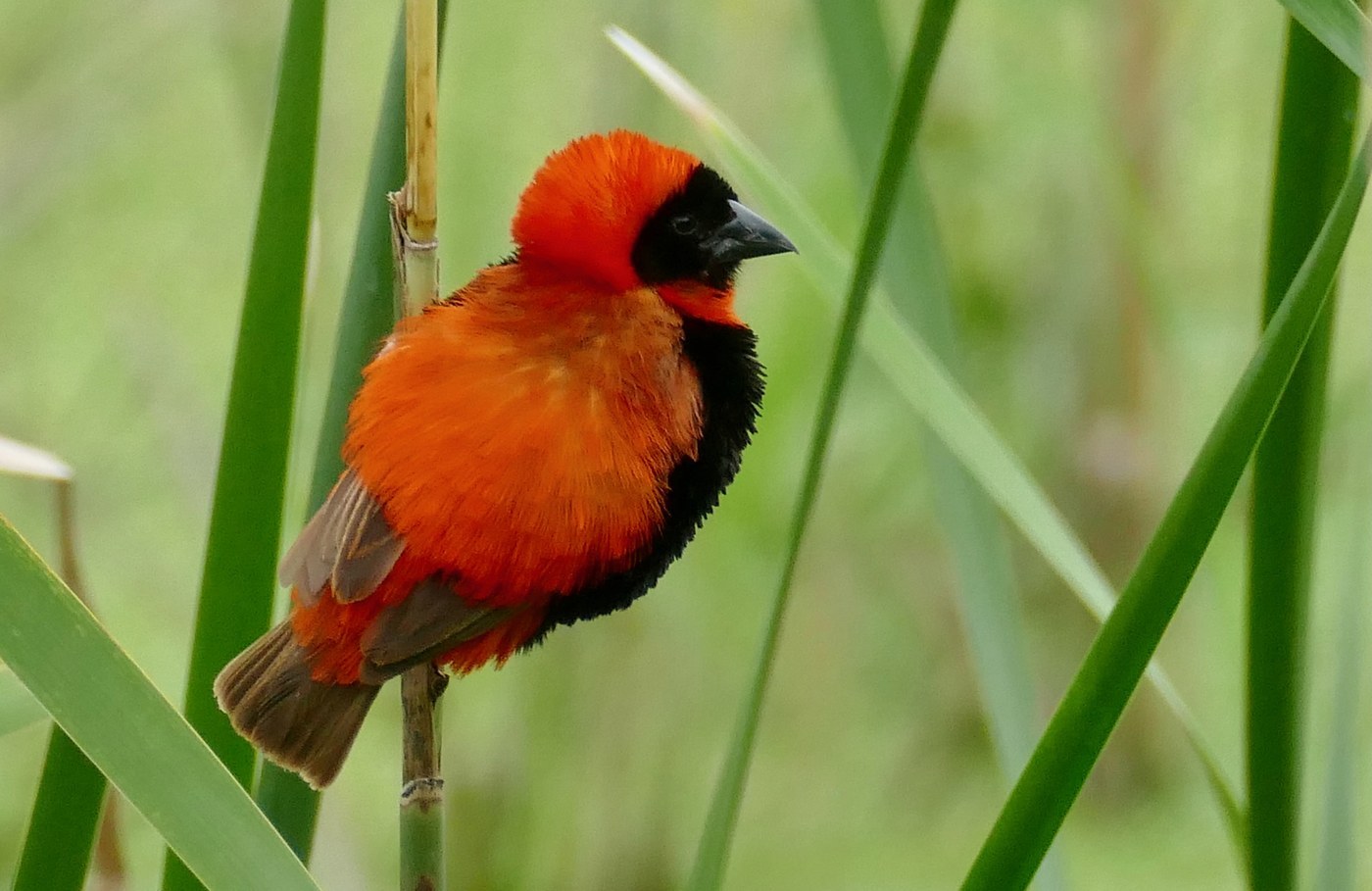
Key Field Marks
- Size & shape: A small, stocky, sparrow-sized weaver-finch about 10–11 cm long, with a short tail and a stout conical bill.
- Breeding male: Brilliant scarlet-red crown, back, and rump contrasting with a black face, throat, breast, and belly — the black extends broadly across the underparts, a key mark separating it from other bishop species.
- Female / non-breeding male: Dull, heavily streaked brown, sparrow-like, with pale eyebrow stripe — very similar to other female bishops and weavers, best identified by presence of breeding males nearby or habitat/range.
- Bill: Short, conical, black in breeding males, paler horn-colored in females/non-breeding birds.
Separating It From Similar Species
- Yellow Bishop (also called Cape Bishop in some regions) has yellow rather than red in breeding male plumage, easily separated by color alone.
- Black-winged Bishop and Fire-fronted Bishop show more orange-red tones and different extents of black on the face/underparts; range and the precise boundary of black on the belly/breast are useful in areas of range overlap.
- Zanzibar Red Bishop, sometimes treated as a subspecies or close relative, looks very similar but occupies a distinct coastal East African range, so location helps confirm identification.
- Non-breeding males and females of all bishop species look extremely similar; identification is far easier when brightly colored breeding males are present.
Where and When to See It
Southern Red Bishops are common, widespread residents across much of sub-Saharan Africa, strongly tied to wetland habitats: reedbeds, marshes, tall rank grass near water, and adjacent agricultural land. They can be seen year-round, but breeding-plumaged males — by far the easiest life stage to identify — are most reliably seen during the local breeding season (spring/summer, timing varies by region), when males molt into their striking scarlet-and-black plumage and perform display flights.
Voice
A buzzy, sizzling, chattering song often given during display flights, along with sharp chirping contact calls; not particularly melodic but distinctive once learned in combination with the visual display.
Behavior Tip for Identification
Breeding males are highly polygynous and perform low, fluffed-up "bumblebee" display flights over their reedbed territory, puffing out their body feathers into an almost spherical shape — this display, combined with the scarlet-and-black coloring, makes breeding males unmistakable.
Frequently asked questions
How do I tell a Southern Red Bishop from a Yellow Bishop?
Color is the simplest cue: breeding male Southern Red Bishop is scarlet-red and black, while breeding male Yellow Bishop is yellow and black — the two are not easily confused when males are in breeding plumage.
Why are female and non-breeding bishops so hard to identify?
They are dull, streaky brown and very similar across bishop species, lacking the distinctive bright breeding-male colors, so they are best identified by association with breeding males, habitat, or range.
What is the 'bumblebee' display flight?
A low, fluttering display flight performed by breeding male bishops with body feathers puffed out into a rounded shape, used to attract females and advertise territory over reedbeds and grassland.
What habitat should I search for Southern Red Bishops?
Wetland-associated habitats such as reedbeds, marshes, and tall grass near water, as well as adjacent farmland, across most of sub-Saharan Africa.
Is the Southern Red Bishop migratory?
It is generally resident and non-migratory, though some local, nomadic movements can occur in response to habitat and food availability.