
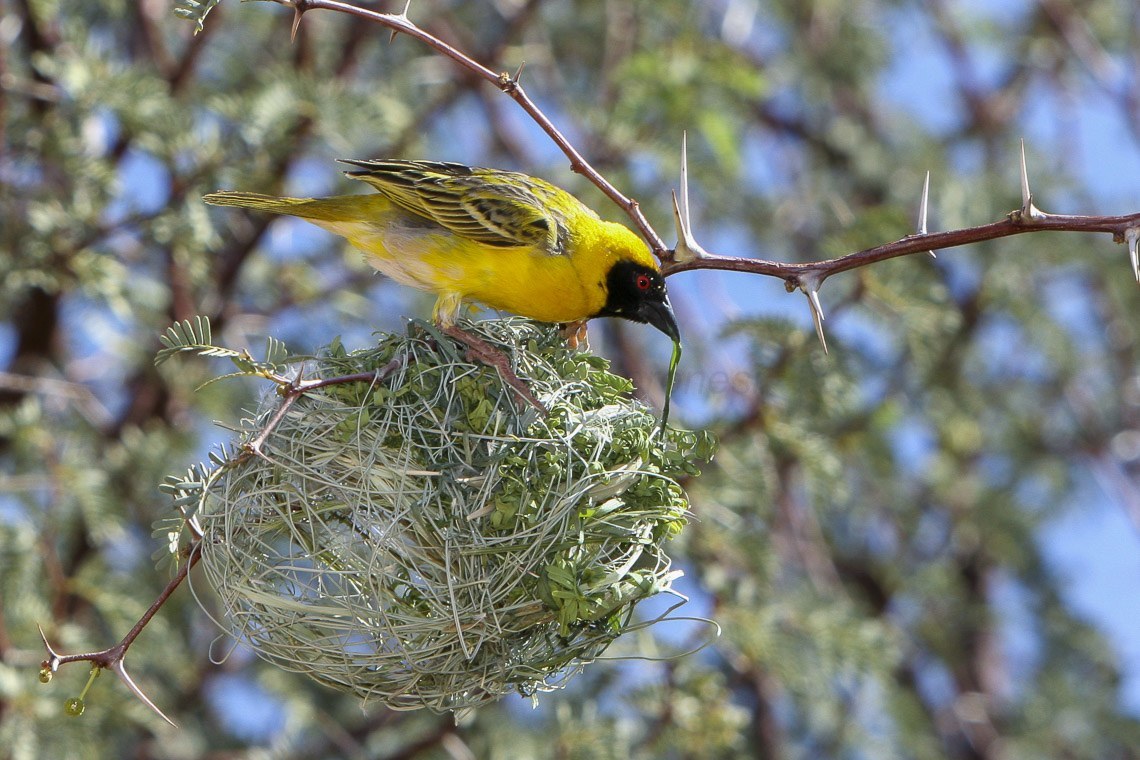
Southern Masked Weaver
Ploceus velatus
A common, widespread southern African weaver whose breeding males are bright yellow with a black face mask and red eyes, known for its intricately woven grass nests.
- Size
- 14–15 cm long, wingspan about 24 cm
- Habitat
- Savanna, woodland edges, farmland, and gardens across southern Africa
- Type
- songbird
Spotted a bird like this?
Identify any bird from a photo, free.
Overview
The Southern Masked Weaver is one of the most familiar and widespread weaverbirds in southern Africa, often seen in gardens, farmland, and open woodland.
Appearance
- Breeding male: bright golden-yellow body, black facial mask extending down over the throat, red or orange-red eyes, and a stout black bill
- Non-breeding male and female: duller, streaky olive-brown and yellow plumage with a paler eye, lacking the black mask
- Stocky build typical of weavers, with a strong, conical bill adapted for seed-cracking
Males molt out of the striking breeding plumage outside the breeding season, becoming much less conspicuous.
How to identify it
Key field marks
- Breeding male: solid black face mask reaching the throat, bright yellow body, red eye
- The mask has a straight (not pointed) rear edge on the throat, useful for separating masked weaver species
- Females and non-breeding males are streaky yellow-olive and best told from similar weavers by range and eye color
Similar species
- Village Weaver males have a mottled black-and-yellow back and a more variable, often more extensive black hood, plus a heavier bill.
- Lesser Masked Weaver has a pale (whitish) eye rather than red, and a more sharply pointed black mask.
- Overall, red eyes plus a clean-edged black mask on a yellow body identify breeding male Southern Masked Weavers in most of their range.
Habitat & range
Range
Widespread across southern Africa, including South Africa, Namibia, Botswana, Zimbabwe, and into parts of Zambia and Angola.
Habitat
Adaptable and common in savanna, thornveld, farmland, riverine woodland, and suburban gardens, often near water or reedbeds where it nests.
Movements
Generally resident, though local movements may occur in response to food and water availability.
Behavior & voice
Behavior
Polygynous and colonial, with males building several nests in a loose colony to attract multiple females, often performing wing-flapping displays at the nest entrance to court females.
Voice
A harsh, chattering, swizzling song combined with buzzy notes, typically given by displaying males near the nest.
Feeding
Forages on the ground and in vegetation for seeds and grain, supplemented with insects, especially when feeding nestlings.
Nesting
Males weave elaborate, rounded nests with a downward-facing entrance from strips of grass and palm fronds, usually suspended over water or from thorny branches for protection from predators; females inspect and choose completed nests before mating.
Frequently asked questions
How do you identify a male Southern Masked Weaver?
In breeding plumage, look for a bright yellow body, a solid black face mask down to the throat, and striking red eyes.
What does a female Southern Masked Weaver look like?
Females are duller, streaky olive-yellow birds without the black mask, making them harder to distinguish from other female weavers.
How can you tell a Southern Masked Weaver from a Village Weaver?
Southern Masked Weaver males have a plain yellow back and a cleaner black mask, while Village Weaver males have a mottled black-and-yellow back and often a more extensive black hood.
Why do Southern Masked Weavers build so many nests?
Males are polygynous and build multiple nests in a colony to attract several females, who then choose which completed nest to accept.
Southern Masked Weaver guides
In-depth guides for identifying, finding, and understanding Southern Masked Weaver.
Other birds you may enjoy

Black Redstart
13-14.5 cm (5.1-5.7 in) long, 23-26 cm wingspan

Black-throated Sparrow
12-14 cm (4.7-5.5 in) long, about 19-20 cm (7.5-8 in) wingspan

Greater Bird-of-paradise
Body about 43 cm; males with additional flank plumes up to 50 cm and long tail wires

Blue Tit
11-12 cm (4.3-4.7 in) long, 17-20 cm wingspan

Red-billed Quelea
11.5–13 cm long, wingspan about 20–22 cm
White-plumed Antbird
13-14 cm (5-5.5 in) long

Pyrrhuloxia
19-22 cm (7.5-8.7 in) long, 30 cm wingspan

Blue-gray Tanager
16-18 cm (6-7 in) long

Blackburnian Warbler
11-13 cm (4.3-5.1 in) long, 20-22 cm wingspan

Bluethroat
13-14 cm (5.1-5.5 in) long, 20-22 cm wingspan

Eurasian Nuthatch
12-14.5 cm (4.7-5.7 in) long, 22.5-27 cm wingspan

Wood Thrush
19-21 cm (7.5-8.3 in) long, about 33 cm (13 in) wingspan