
Southern Masked Weaver Identification Guide
A common African weaver whose breeding male is bright yellow with a sharp black facial mask and red eye, best confirmed by its kidney-shaped woven nest and swizzling chatter song.
Read the full Southern Masked Weaver encyclopedia entry →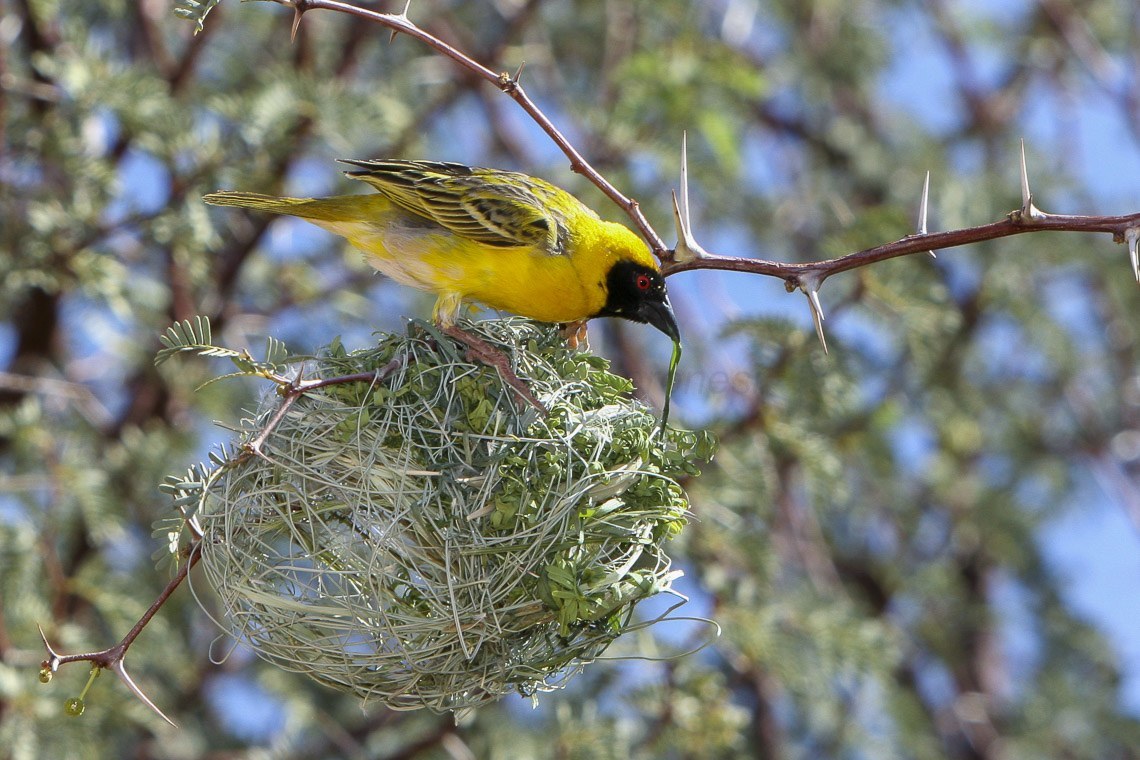
Key Field Marks
- Size & shape: A small, stocky weaver about 13–15 cm long with a fairly heavy, conical bill adapted for seed-eating.
- Breeding male: Vivid golden-yellow body with a black face mask that extends from the forehead down through the throat, a striking red eye, and a plain (unmarked) olive-yellow back and wings — the lack of black speckling on the back is a useful mark.
- Female / non-breeding male: Dull, streaky olive-brown above and paler yellowish below, with a pale (not red) eye — much less conspicuous and harder to identify to species without a male nearby.
- Bill: Stout, black in breeding males, dull pinkish/horn in females and non-breeding birds.
Separating It From Similar Species
- Village Weaver males have a heavier bill and a mottled, speckled black-and-yellow back rather than the plain yellow-green back of Southern Masked Weaver, and the black mask often extends further onto the crown.
- Lesser Masked Weaver males have a pale/whitish eye (not red) and the black mask is usually more restricted, not reaching as far onto the crown; it also tends to favor a more restricted range and habitat.
- Other Ploceus weavers in the region can be separated by combinations of eye color, back pattern, and mask extent — always check eye color and back pattern together, since female/non-breeding weavers of many species look very similar.
Where and When to See It
Southern Masked Weavers are common, widespread, non-migratory residents across much of southern Africa, found in savanna, farmland, semi-arid scrub, riverine vegetation, and gardens — they adapt very well to human-altered landscapes and are frequent visitors to bird feeders. They can be seen year-round, but breeding activity (and the best chance to see males in full bright plumage actively building nests) peaks during the local spring and summer wet season.
Voice
An energetic, buzzy, swizzling chatter that often speeds up and includes harsh nasal notes, typically given by displaying males near their nests; colonies can be quite noisy with overlapping song from multiple males.
Behavior Tip for Identification
Watch for the male's nest-building and display: he weaves an intricate, kidney- or oval-shaped nest from strips of grass or palm fronds suspended from a branch (often over water for predator protection) and performs a wing-flapping display while hanging upside-down beneath the nest to attract a female.
Frequently asked questions
How do I tell a Southern Masked Weaver from a Village Weaver?
Southern Masked Weaver males have a plain, unspeckled yellow-green back, while Village Weaver males show a mottled black-and-yellow speckled back and a heavier bill.
What color eye does a male Southern Masked Weaver have?
A bright red eye — this helps separate it from the similar Lesser Masked Weaver, whose males have a pale or whitish eye.
Why are female weavers so hard to identify?
Females and non-breeding males of many weaver species look similarly dull, streaky olive-brown with pale eyes, lacking the bold breeding-male colors and mask patterns that make species identification much easier.
What does a Southern Masked Weaver nest look like?
A tightly woven, kidney- or oval-shaped nest made of grass strips or palm fronds, usually suspended from a branch, often over water, built by the male as part of his courtship display.