
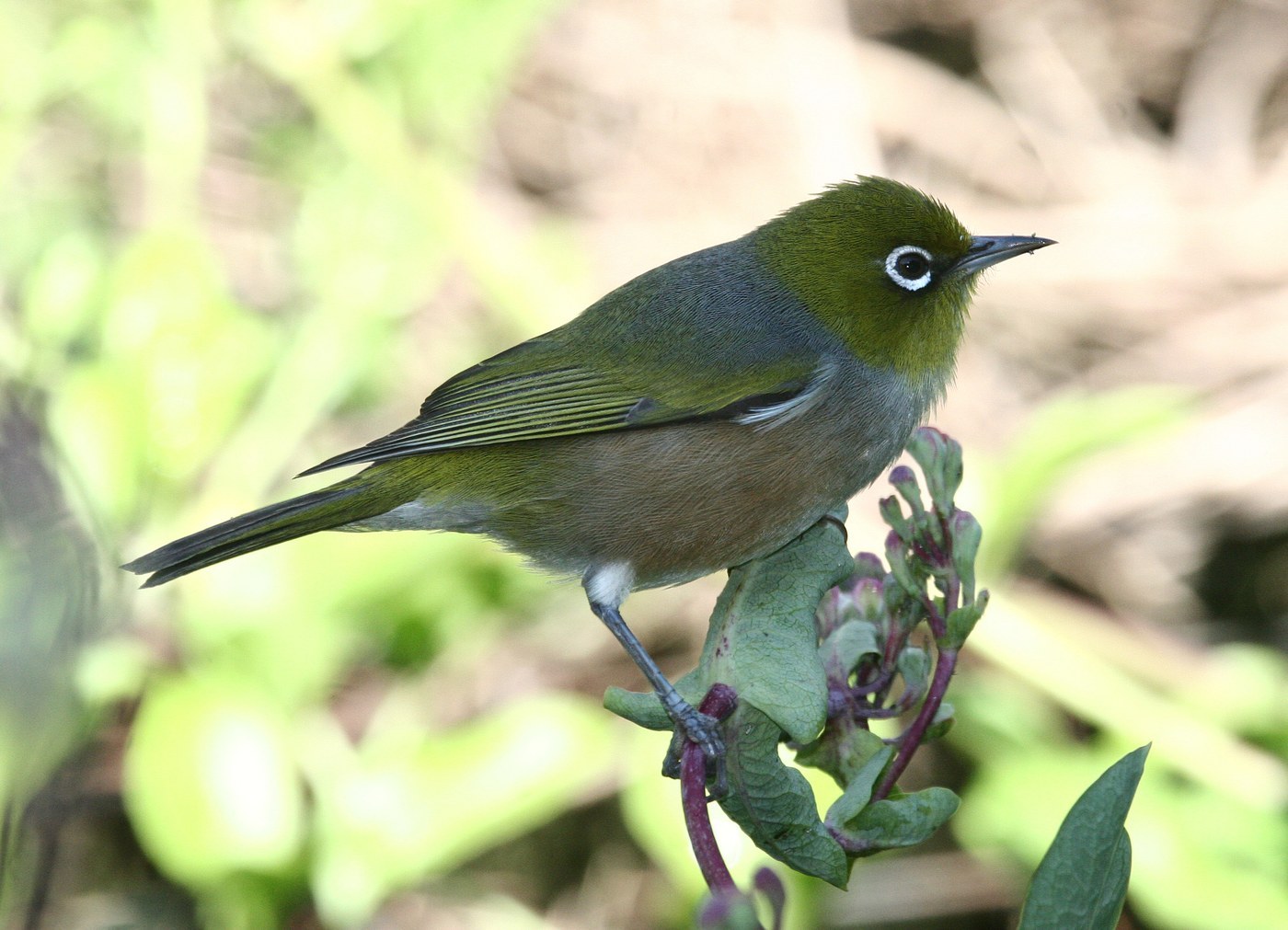
Silvereye
Zosterops lateralis
A small olive-green bird with a distinctive white eye-ring, often seen in active flocks raiding garden fruit trees.
- Size
- 10-13 cm (4-5 in) long
- Habitat
- forests, woodlands, gardens, and scrub across Australia and New Zealand
- Type
- songbird
Spotted a bird like this?
Identify any bird from a photo, free.
Overview
The Silvereye is a small, active songbird easily recognised by the bold ring of white feathers encircling each eye, set against olive-green upperparts, a grey back (in some populations), and underparts that range from whitish to buff or cinnamon depending on subspecies and region. This distinctive eye-ring, from which the bird takes its name, is visible even at a distance and makes the species one of the easier small birds to identify.
Highly social outside the breeding season, Silvereyes typically move in loose, twittering flocks through foliage, gardens, and orchards, and are well known to gardeners for their fondness for ripening soft fruit, as well as for visiting nectar-rich flowers and sugar-water feeders.
The species is a strong disperser and has colonised New Zealand from Australia within historical times, arriving in such numbers in the nineteenth century that it earned the Māori name 'tauhou', meaning 'stranger', reflecting its relatively recent and well-documented establishment there.
How to identify it
Key field marks
- Small size with a bold white ring around each eye
- Olive-green upperparts
- Underparts varying from whitish to buff or cinnamon depending on subspecies
- Short, fine, slightly downcurved bill
- Active, social behaviour, often in loose flocks
Similar species
No other common Australian garden bird has the Silvereye's combination of small size, olive-green upperparts, and bold white eye-ring, making it one of the more straightforward small birds to identify. Thornbills and gerygones lack the distinctive white eye-ring and have different, thinner bills.
Habitat & range
Habitat
Silvereyes are highly adaptable, occurring in forests, woodlands, coastal scrub, heathland, gardens, and orchards, wherever suitable foliage and food are available.
Range
The species is widespread across southern, eastern, and southwestern Australia and Tasmania, and has self-established in New Zealand, where it is now common and widespread.
Migration
Many southeastern Australian and Tasmanian populations are strongly migratory, moving north in autumn in loose flocks and returning south in spring, while other populations, particularly in warmer regions, are more sedentary.
Behavior & voice
Behavior
Outside the breeding season, Silvereyes are highly gregarious, forming loose, active flocks that move constantly through foliage, gardens, and orchards, often giving soft contact calls as they forage together.
Voice
Calls include a soft, plaintive 'tsee' contact note, while the song is a subdued, warbling chatter, often given quietly from cover.
Feeding
It has a varied diet including insects and other invertebrates, soft fruit, berries, and nectar, and readily visits gardens with fruiting trees or nectar-rich flowers.
Nesting and breeding
The nest is a small, neat, cup-shaped structure of grass, hair, and spider web, slung in a fork of a shrub or tree; both parents share incubation and feeding of the young, and pairs may raise multiple broods in a season.
Frequently asked questions
How can I identify a Silvereye?
Look for its small size, olive-green upperparts, and the bold white ring of feathers around each eye.
Do Silvereyes eat garden fruit?
Yes, they are well known for feeding on ripening soft fruit in gardens and orchards, as well as insects and nectar.
Do Silvereyes migrate?
Many southeastern Australian and Tasmanian populations migrate north in flocks for winter, while others are more sedentary.
How did Silvereyes reach New Zealand?
They naturally colonised New Zealand from Australia in the nineteenth century, arriving in such numbers that they earned the Māori name 'tauhou', meaning 'stranger'.
What does a Silvereye eat?
A varied diet of insects, soft fruit, berries, and nectar.
Silvereye guides
In-depth guides for identifying, finding, and understanding Silvereye.
Other birds you may enjoy

Black Redstart
13-14.5 cm (5.1-5.7 in) long, 23-26 cm wingspan

Black-throated Sparrow
12-14 cm (4.7-5.5 in) long, about 19-20 cm (7.5-8 in) wingspan

Greater Bird-of-paradise
Body about 43 cm; males with additional flank plumes up to 50 cm and long tail wires

Blue Tit
11-12 cm (4.3-4.7 in) long, 17-20 cm wingspan

Red-billed Quelea
11.5–13 cm long, wingspan about 20–22 cm
White-plumed Antbird
13-14 cm (5-5.5 in) long

Pyrrhuloxia
19-22 cm (7.5-8.7 in) long, 30 cm wingspan

Blue-gray Tanager
16-18 cm (6-7 in) long

Blackburnian Warbler
11-13 cm (4.3-5.1 in) long, 20-22 cm wingspan

Bluethroat
13-14 cm (5.1-5.5 in) long, 20-22 cm wingspan

Eurasian Nuthatch
12-14.5 cm (4.7-5.7 in) long, 22.5-27 cm wingspan

Wood Thrush
19-21 cm (7.5-8.3 in) long, about 33 cm (13 in) wingspan