
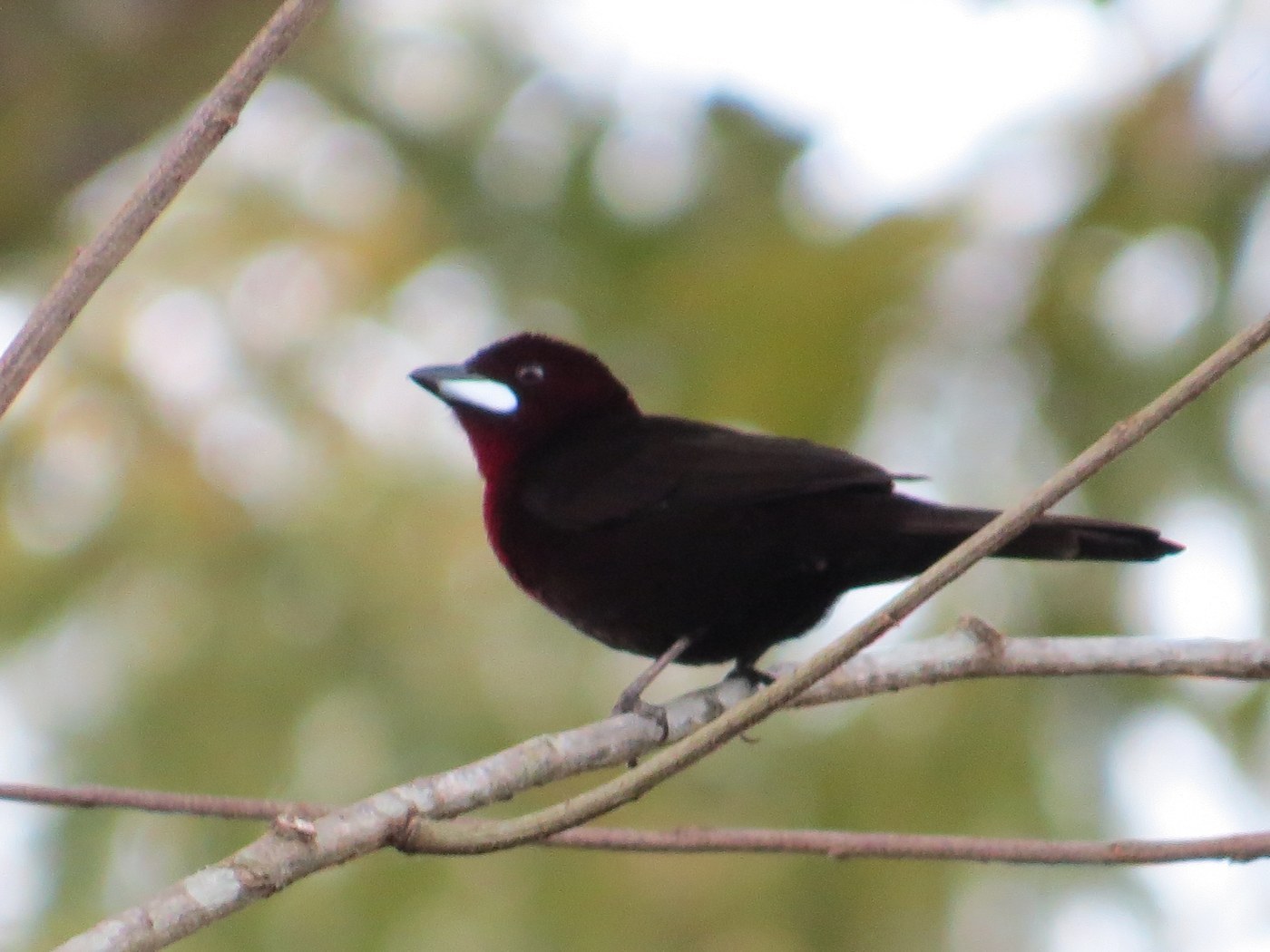
Silver-beaked Tanager
Ramphocelus carbo
A velvety deep-red South American tanager with a glowing crimson rump and a pale, silvery lower mandible that gives the species its name.
- Size
- 18-19 cm (7-7.5 in) long, 24-27 cm wingspan
- Habitat
- forest edges, secondary growth, riverside thickets, and gardens
- Type
- songbird
Spotted a bird like this?
Identify any bird from a photo, free.
Overview
The Silver-beaked Tanager is a richly colored songbird of lowland South America, with males cloaked in a deep, velvety maroon-red that glows brighter and more crimson on the rump and throat, especially in good light. The bird's signature feature is its bicolored bill: a dark upper mandible paired with a pale, silvery-white lower mandible that flashes conspicuously as the bird calls or feeds.
Females and immatures are far duller, washed in dusky brownish-red or olive-brown tones, lacking the male's velvety richness but still showing a hint of the pale lower bill. Highly social and conspicuous, this tanager is one of the most frequently seen birds along forest edges and gardens across much of the Amazon basin and the Guianas.
How to identify it
Key field marks
- Deep, velvety maroon-red plumage overall in males, brightest and most crimson on the rump and throat
- Distinctive silvery-white lower mandible contrasting with a dark upper mandible
- Females and immatures duller brownish-red to olive-brown
- Stocky build with a short, thick, conical bill typical of tanagers
Similar species
- Crimson-backed Tanager is black overall with a red back and belly rather than being red-bodied throughout, and its range mostly does not overlap.
- Masked Crimson Tanager shows a black face mask and brighter scarlet plumage, and prefers riverside habitats.
- Scarlet-rumped Tanager (Central America) is black with a scarlet rump patch, quite different from the overall red body of the Silver-beaked Tanager.
Habitat & range
Habitat
Favors forest edges, secondary growth, river-edge thickets, clearings, plantations, and gardens; generally avoids deep, unbroken primary forest interior.
Range
Widespread across the Amazon basin and adjacent lowlands, including Colombia, Venezuela, the Guianas, Ecuador, Peru, Bolivia, and Brazil, mostly below 1,200 m elevation.
Migration
Non-migratory and resident throughout its range, though it can be locally nomadic in response to fruiting trees.
Behavior & voice
Behavior
Gregarious and conspicuous, usually seen in pairs or small flocks that often join mixed-species foraging groups at forest edges and fruiting trees.
Voice
Gives a sharp, husky "chip" or "tsuk" call note, along with a simple, scratchy warbling song that is not especially musical.
Feeding
Feeds mainly on soft fruit and berries, supplemented with insects and occasional nectar, typically foraging in the low and mid-story of edge habitats.
Nesting
Builds an open cup nest of plant fibers and rootlets low in dense vegetation; the female typically lays 2 eggs, and both parents help provision the young.
Frequently asked questions
How do you identify a Silver-beaked Tanager?
Look for a stocky, deep maroon-red bird with a brighter crimson rump and throat, and a pale, silvery-white lower mandible that stands out against the dark upper bill.
Why is it called the Silver-beaked Tanager?
It gets its name from the pale, silvery-white lower half of its bill, which contrasts sharply with the dark upper mandible.
What do Silver-beaked Tanagers eat?
Mostly soft fruit and berries, along with insects and occasional nectar.
Where do Silver-beaked Tanagers live?
In forest edges, secondary growth, and gardens across the Amazon basin and Guianas in northern and central South America.
Silver-beaked Tanager guides
In-depth guides for identifying, finding, and understanding Silver-beaked Tanager.
Other birds you may enjoy

Black Redstart
13-14.5 cm (5.1-5.7 in) long, 23-26 cm wingspan

Black-throated Sparrow
12-14 cm (4.7-5.5 in) long, about 19-20 cm (7.5-8 in) wingspan

Greater Bird-of-paradise
Body about 43 cm; males with additional flank plumes up to 50 cm and long tail wires

Blue Tit
11-12 cm (4.3-4.7 in) long, 17-20 cm wingspan

Red-billed Quelea
11.5–13 cm long, wingspan about 20–22 cm
White-plumed Antbird
13-14 cm (5-5.5 in) long

Pyrrhuloxia
19-22 cm (7.5-8.7 in) long, 30 cm wingspan

Blue-gray Tanager
16-18 cm (6-7 in) long

Blackburnian Warbler
11-13 cm (4.3-5.1 in) long, 20-22 cm wingspan

Bluethroat
13-14 cm (5.1-5.5 in) long, 20-22 cm wingspan

Eurasian Nuthatch
12-14.5 cm (4.7-5.7 in) long, 22.5-27 cm wingspan

Wood Thrush
19-21 cm (7.5-8.3 in) long, about 33 cm (13 in) wingspan