
Silver-beaked Tanager Identification Guide
A common South American tanager with deep maroon-red plumage and a stout, pale silvery-based bill, often seen in noisy pairs or small flocks at forest edges and gardens.
Read the full Silver-beaked Tanager encyclopedia entry →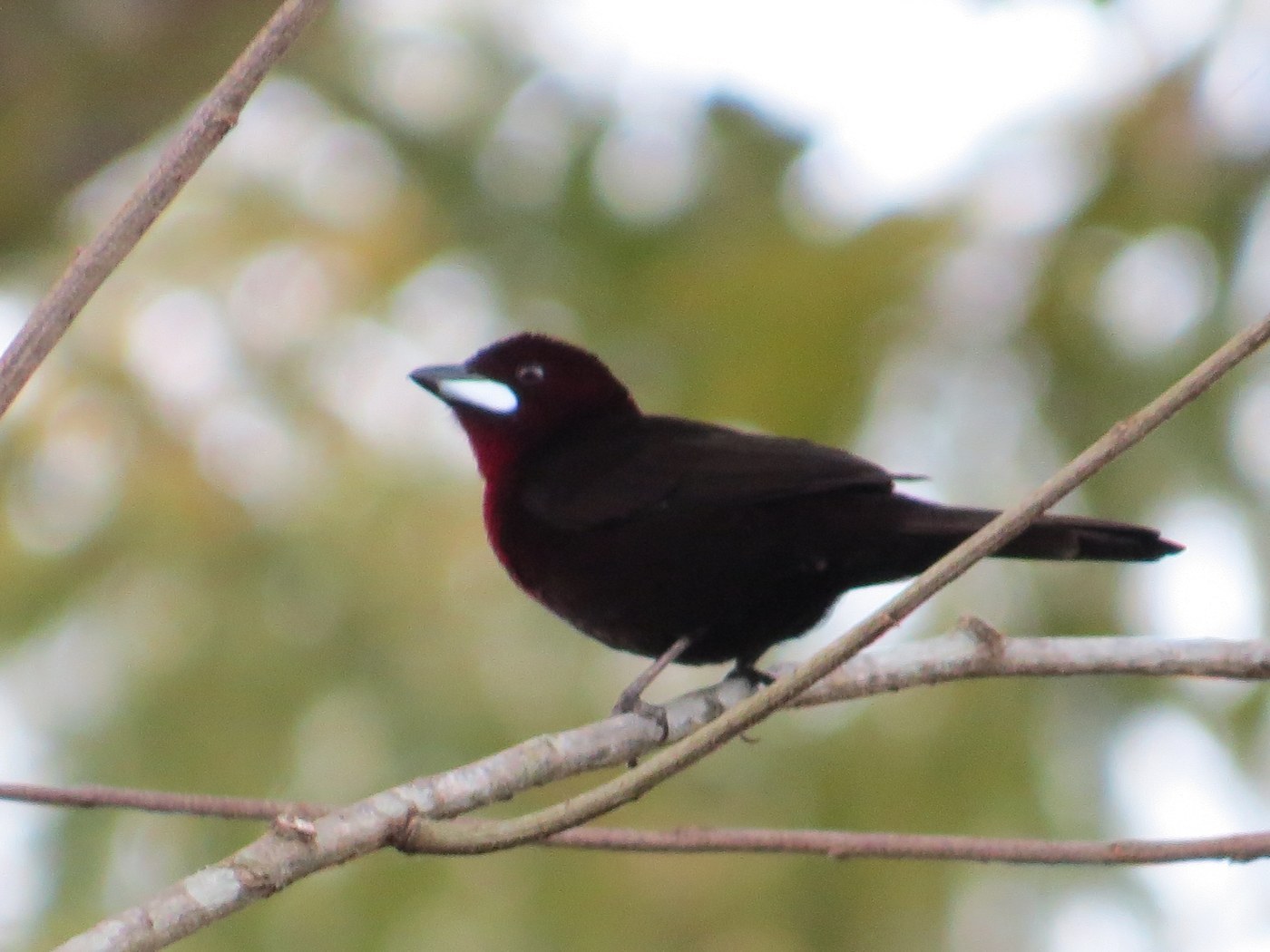
Overview
The Silver-beaked Tanager (Ramphocelus carbo) is an abundant, conspicuous tanager of forest edges, second growth, and gardens across much of tropical South America. Its velvety dark plumage and bright bill base make it one of the easier tanagers to identify once the key features are known, and its habit of foraging in pairs or small, chattering groups at low to mid levels makes it a frequently encountered species for birders in its range.
Key Field Marks
- Size and shape: A medium-sized tanager, roughly 18-19 cm long, with a stocky body, rounded head, and a notably thick, deep-based bill.
- Male plumage: Deep, velvety maroon-red overall, appearing almost black in poor light but glowing rich red-maroon in good light, especially on the rump and underparts; the throat and breast often show the richest, most saturated color.
- Female plumage: Duller and browner overall, with a more subdued brownish-maroon or dusky tone, lacking the male's velvety richness.
- Bill: The signature field mark — a swollen, pale silvery-blue to whitish-gray base to the lower mandible, contrasting sharply with the dark upper mandible and giving the species its name; this pale bill base is visible at a good distance and is present in both sexes, though often more pronounced in males.
- Behavior: Forages actively in pairs or small family groups at low to mid forest-edge levels, taking fruit and some insects; often joins mixed-species flocks and is vocal and easy to detect by call.
Separating It From Similar Species
- Masked Crimson Tanager: Brighter, more scarlet-red with a contrasting black mask, hood, and wings, versus the more uniformly deep maroon tone of Silver-beaked Tanager.
- Crimson-backed Tanager: Shows a brighter red back contrasting with black wings and tail, a pattern quite different from the more uniformly dark maroon Silver-beaked Tanager.
- Other Ramphocelus tanagers (e.g., Flame-rumped, Scarlet-rumped): These show a bright contrasting rump patch (yellow, orange, or scarlet) against otherwise black plumage, unlike the Silver-beaked Tanager's uniformly maroon-red body without a contrasting rump.
- Female/immature confusion species: Female Silver-beaked Tanagers can look nondescript brownish, so the pale silvery bill base remains the best mark to confirm identity even on dull-plumaged birds.
Habitat and Range
Widespread and common across much of tropical South America east of the Andes, including the Amazon Basin, the Guianas, and parts of Venezuela, Colombia, Ecuador, Peru, Bolivia, and Brazil. It favors forest edges, secondary growth, scrubby clearings, riverine vegetation, plantations, parks, and gardens, generally avoiding deep unbroken primary forest interior in favor of edge and disturbed habitats. It is a non-migratory resident throughout its range.
Voice
Gives a variety of short, sharp chip and chuck notes, often repeated in a chattering series between pair members as they forage. The song is a simple, somewhat scratchy or squeaky series of short phrases, not especially musical, and is typically less important for identification than the pale bill base, which is diagnostic at a glance.
When to Look
As a common, non-migratory resident, it can be found year-round throughout its range; early morning and late afternoon at forest edges, gardens, and fruiting trees typically offer the most active and visible foraging behavior.
Frequently asked questions
What is the best field mark for a Silver-beaked Tanager?
Look for the pale, swollen silvery-gray base to the lower mandible contrasting with dark upperparts of the bill — this is present on both sexes and is diagnostic even when the deep maroon body plumage looks dark or dull in poor light.
How do male and female Silver-beaked Tanagers differ?
Males are deep, velvety maroon-red, especially rich on the underparts and rump, while females are duller brownish-maroon; both sexes show the characteristic pale bill base.
Where does the Silver-beaked Tanager live?
It is common across much of tropical South America east of the Andes, in forest edges, secondary growth, riverside vegetation, and gardens, from Colombia and Venezuela south through the Amazon Basin to Bolivia and Brazil.
What does a Silver-beaked Tanager eat?
Mainly fruit, supplemented with insects and other small invertebrates, gleaned while foraging in pairs or small groups at low to mid levels.
Is the Silver-beaked Tanager rare?
No, it is one of the most common and widespread tanagers within its range and is frequently encountered at forest edges and in gardens.