
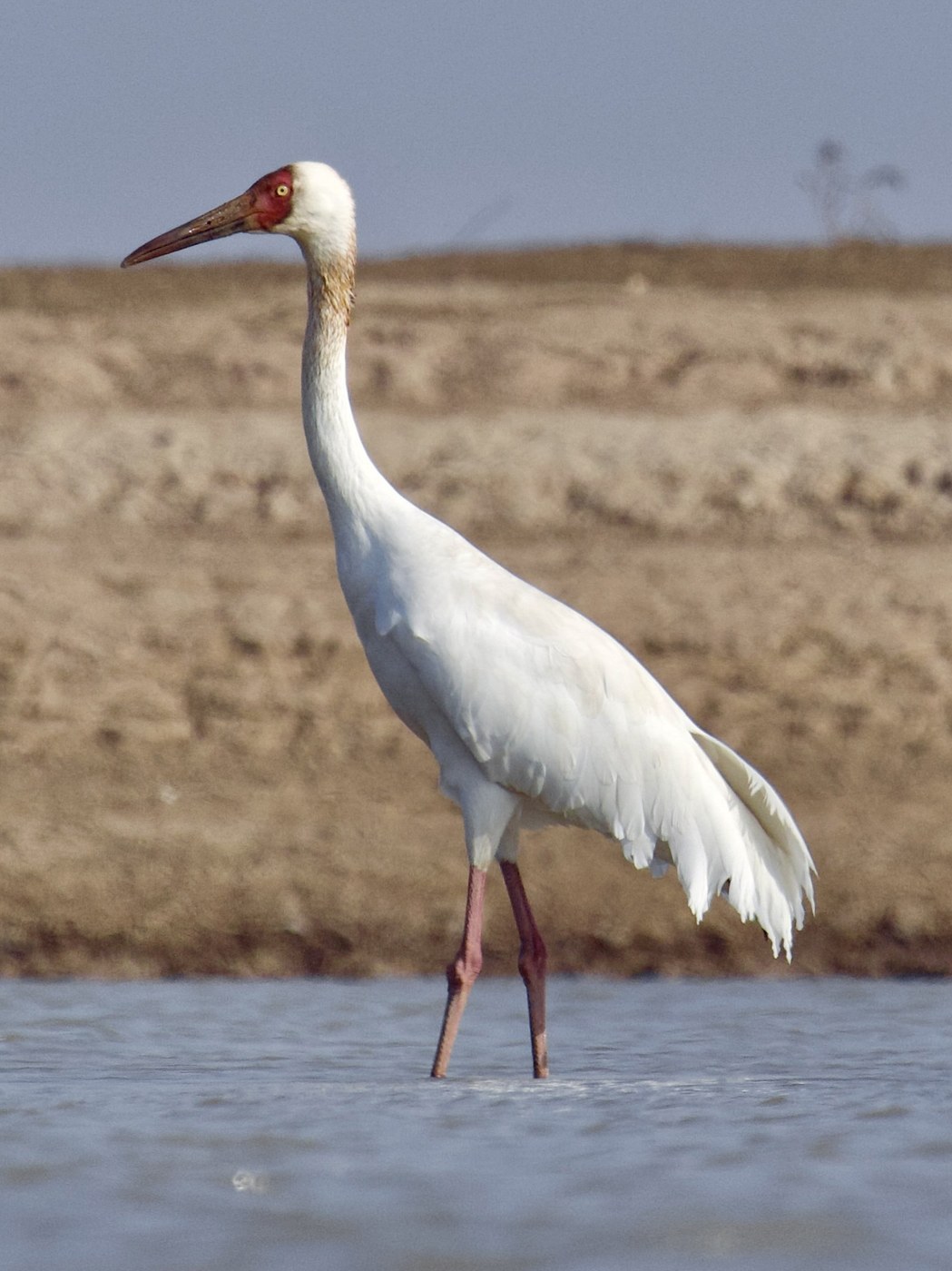
Siberian Crane
Leucogeranus leucogeranus
A critically endangered white crane that breeds on remote Russian Arctic tundra and undertakes one of the longest migrations of any crane to wintering wetlands in China.
- Size
- 135-140 cm (53-55 in) long, 210-230 cm wingspan
- Habitat
- Arctic tundra wetlands (breeding) and freshwater lakes and marshes (wintering)
- Type
- wading-bird
Spotted a bird like this?
Identify any bird from a photo, free.
Overview
The Siberian Crane is a large, entirely white crane with black primary flight feathers visible only in flight, a bright red face and bill, and pale pinkish legs. It is one of the most endangered crane species in the world, with the vast majority of the remaining wild population belonging to a single migratory flock.
Unlike most other cranes, the Siberian Crane feeds heavily on aquatic vegetation and is closely tied to wetlands throughout its annual cycle, both on its remote Arctic breeding grounds and its wintering areas.
How to identify it
Key field marks
- Entirely white body plumage
- Black primary flight feathers, visible mainly in flight
- Bright red bare skin on the face and a red bill
- Pale pinkish legs
Similar species
The Whooping Crane is similarly white with black wingtips but is found only in North America. The Red-crowned Crane has a black neck rather than an all-white neck, distinguishing it readily from the Siberian Crane.
Habitat & range
Siberian Cranes breed on remote, marshy Arctic and sub-Arctic tundra in northern Russia, nesting in extremely isolated wetlands far from human disturbance. The main surviving population, known as the Eastern population, migrates an extraordinary distance to winter almost exclusively at Poyang Lake in China, a critical wintering wetland that supports the vast majority of the world's remaining birds.
Historically, separate Western and Central populations wintered in Iran and India respectively, but both have effectively disappeared, with the Western population reduced to only a handful of individuals and the Central population believed extinct, underscoring the extreme vulnerability of the species.
Behavior & voice
Siberian Cranes feed mainly on aquatic plants, tubers, and roots, probing in shallow water and mud with their long bill, a diet more herbivorous than that of most other crane species.
They give loud, flute-like calls and perform courtship dances similar to other cranes, though their remote breeding range makes their behavior less studied than more accessible species. Nests are built on the ground in isolated tundra wetlands, typically with two eggs, though usually only one chick survives. The species' extreme dependence on a small number of wintering and staging wetlands, especially Poyang Lake, makes it acutely vulnerable to habitat changes such as dam construction and water level fluctuations.
Frequently asked questions
Why is the Siberian Crane critically endangered?
Nearly the entire world population depends on a single wintering site, Poyang Lake in China, making it extremely vulnerable to habitat changes there, while separate western populations have already collapsed to near extinction.
Where do Siberian Cranes breed?
They breed in extremely remote, marshy Arctic and sub-Arctic tundra wetlands in northern Russia.
What do Siberian Cranes eat?
Unlike most cranes, they feed heavily on aquatic plants, tubers, and roots, foraging with their bill in shallow water and mud.
How many Siberian Cranes are left?
The surviving Eastern population numbers roughly a few thousand birds, while the historic Western and Central populations have nearly or completely disappeared.
Siberian Crane guides
In-depth guides for identifying, finding, and understanding Siberian Crane.
Other birds you may enjoy
Demoiselle Crane
85-100 cm (33-39 in) long, 155-180 cm wingspan
Boat-billed Heron
41-56 cm (16-22 in) long
Purple Heron
78-90 cm (31-35 in) long, 120-152 cm wingspan
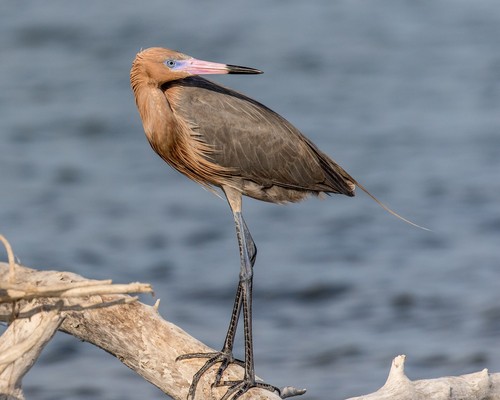
Reddish Egret
68-82 cm (27-32 in) long, 116-125 cm wingspan
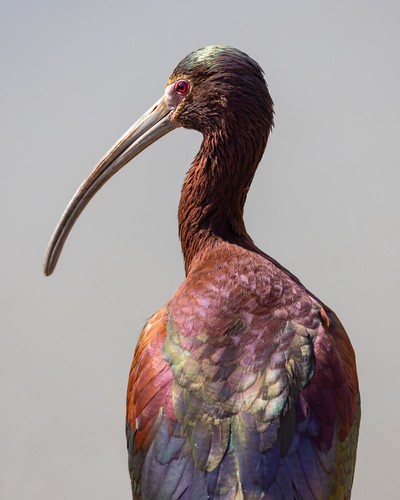
White-faced Ibis
46-56 cm (18-22 in) long, 88-93 cm wingspan
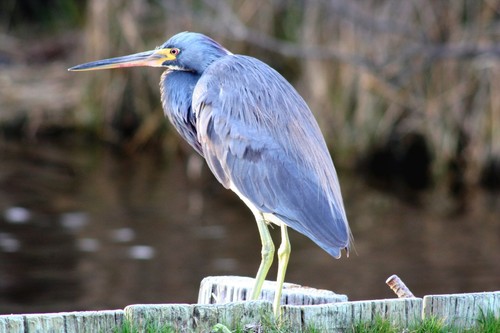
Tricolored Heron
61-76 cm (24-30 in) long, about 96 cm wingspan
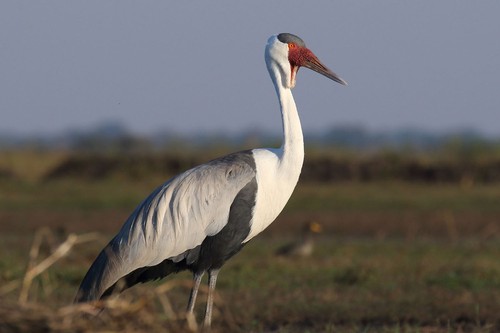
Wattled Crane
120-175 cm (47-69 in) tall, one of the tallest cranes, wingspan up to about 230 cm (7.5 ft)
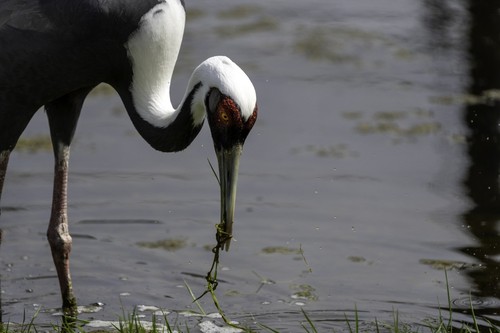
White-naped Crane
112-125 cm (44-49 in) long, 195-210 cm wingspan
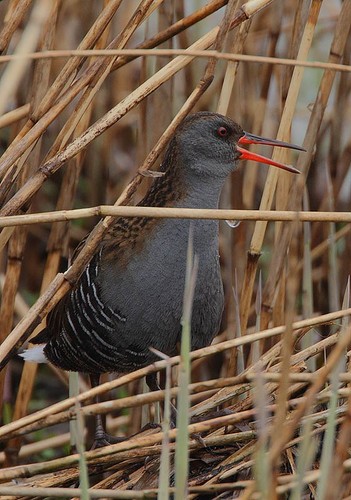
Water Rail
23-28 cm (9-11 in) long, wingspan 38-45 cm
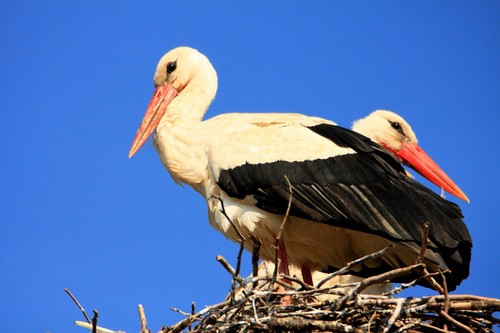
White Stork
100-125 cm (39-49 in) long, 155-215 cm wingspan
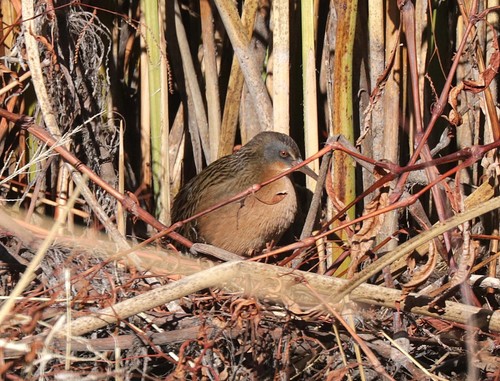
Virginia Rail
20-27 cm (8-11 in) long, wingspan 32-38 cm

Wattled Jacana
17-23 cm (7-9 in) long