
Siberian Crane Identification Guide
A critically endangered, all-white crane with black wingtips and a bare red face, best identified by its snowy plumage and habit of wading deep in wetlands to feed on aquatic tubers.
Read the full Siberian Crane encyclopedia entry →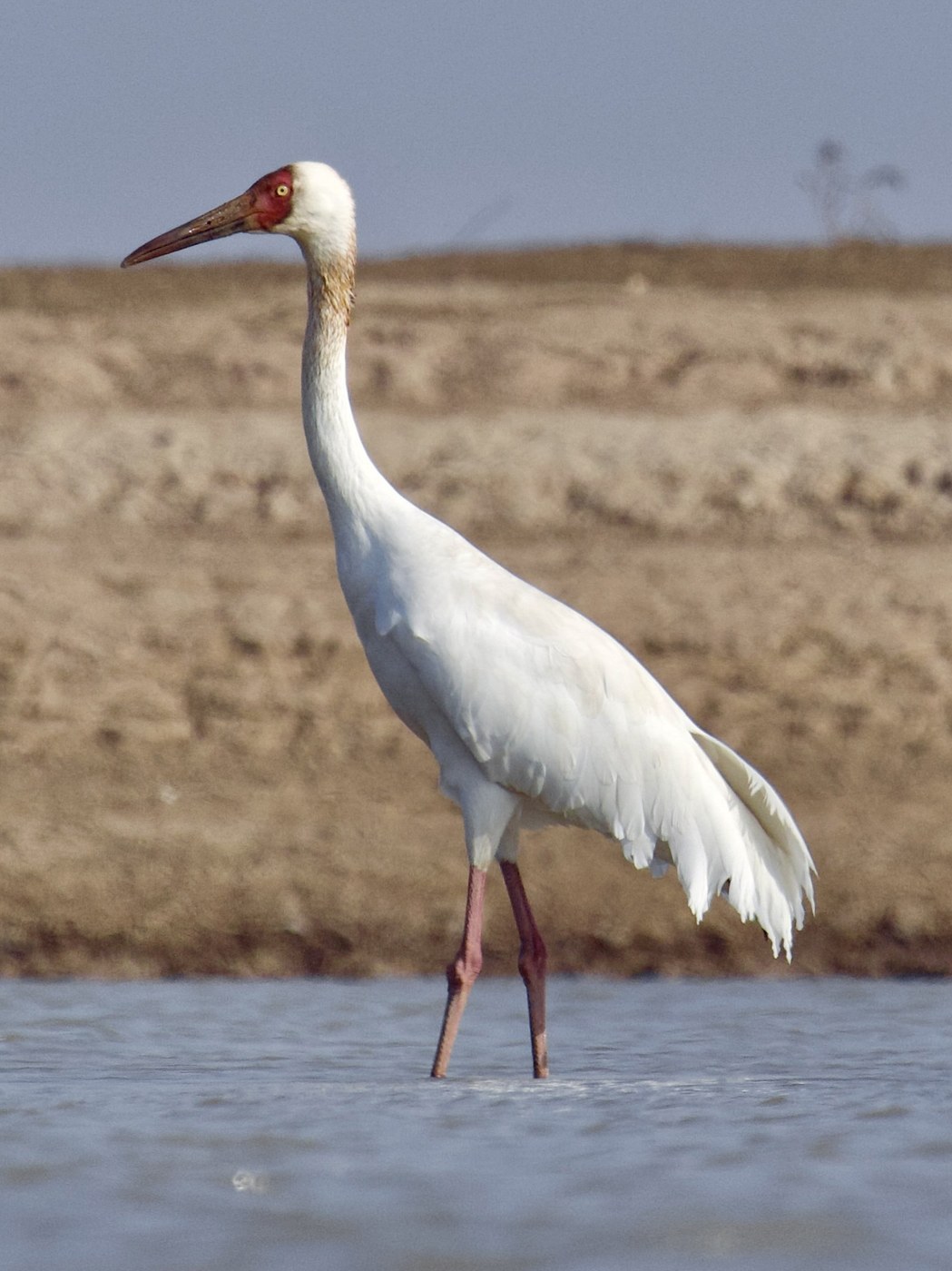
Overview
The Siberian Crane (Leucogeranus leucogeranus), also known as the Siberian White Crane or Snow Crane, is one of the world's rarest cranes and one of the most striking, with an almost entirely white adult plumage. It breeds in remote Arctic and subarctic wetlands of Russia and winters at just a handful of key wetland sites, most famously Poyang Lake in China, making it a major flagship species for wetland conservation.
Key Field Marks
- Size and shape: A large crane, standing about 1.2-1.4 m tall, with a long neck, long dark legs, and a notably long, straight bill.
- Plumage: Adults are almost entirely pure white over the body, neck, and folded wings — the whitest of all crane species.
- Wingtips: In flight, adults show contrasting black primary feathers against the white body and wing coverts, a striking pattern visible at considerable distance.
- Face: Bare, brick-red to orange-red facial skin extending from the base of the bill around the eye, contrasting sharply with the white plumage.
- Bill: Long, straight, reddish-orange to brownish-red bill, notably longer and straighter than in most other crane species, adapted for probing deep into mud and shallow water for tubers.
- Legs: Pinkish-red to reddish legs, long and slender.
- Juveniles: Show cinnamon-buff or rusty coloring mixed into the white plumage and lack the full red facial skin, gradually whitening over their first couple of years.
- Behavior: Feeds by wading in shallow water and wet mud, probing with its long bill for roots and tubers of aquatic plants; often forages standing in deeper water than other crane species, sometimes submerging the head and neck.
Separating It From Similar Species
- Whooping Crane: Also mostly white with black wingtips and a similar overall look, but Whooping Crane occurs only in North America, while Siberian Crane is restricted to Asia — there is no range overlap, so location alone separates them.
- Common Crane: Overall gray, not white, with a black-and-white head and neck pattern and a red crown patch, very different from the all-white Siberian Crane.
- Great White Egret and other white herons/egrets: Much smaller-bodied with a slimmer neck typically held in an S-curve in flight (cranes fly with neck outstretched), lack black wingtips, and have a yellow or blackish (not reddish) bill.
- Eurasian Spoonbill: All-white but has a distinctive flattened, spoon-shaped bill and flies with neck outstretched like a crane, but is much smaller and lacks black wingtips.
Habitat and Range
Breeds in remote, undisturbed tundra and taiga wetlands of arctic Siberia in two widely separated populations (a small western/central population and a much larger eastern population). The eastern population migrates a huge distance to winter almost entirely at Poyang Lake in the Yangtze River basin of China, while the tiny remnant western population historically wintered at sites in Iran and India, though those birds have become vanishingly rare or possibly extirpated in recent years. Winter habitat consists of shallow freshwater lakes, marshes, and wet grasslands with abundant submerged and emergent aquatic vegetation.
Voice
Gives loud, far-carrying, flute-like trumpeting calls, higher-pitched and more musical than the calls of many other crane species, used in duets between paired birds and as contact calls in flight. Calls are useful for locating birds in large wetlands but plumage is normally diagnostic once a bird is in view.
When to Look
The realistic opportunity for most birders is at wintering grounds, especially Poyang Lake, China, from approximately November through March, when the vast majority of the world's remaining Siberian Cranes gather there. The species is listed as Critically Endangered, so sightings anywhere are notable and should be reported to local conservation authorities.
Frequently asked questions
How do you identify a Siberian Crane?
Look for an almost entirely white crane with contrasting black wingtips visible in flight, bare red facial skin, and a long, straight, reddish bill — a combination unique among Asian cranes.
Where can I see a Siberian Crane?
The best place is Poyang Lake in China during winter (roughly November to March), where nearly the entire world population of the eastern breeding group congregates.
How rare is the Siberian Crane?
It is Critically Endangered, with a total population estimated in the low thousands, concentrated almost entirely in one wintering area, making it one of the most threatened crane species in the world.
What does a Siberian Crane eat?
It feeds mainly on roots and tubers of aquatic plants, probing in shallow water and mud with its long bill, and will also take some aquatic invertebrates and grains.
How is a Siberian Crane different from a Whooping Crane?
The two look similar (white body, black wingtips) but do not overlap in range — Siberian Crane is found only in Asia, while Whooping Crane occurs only in North America.