
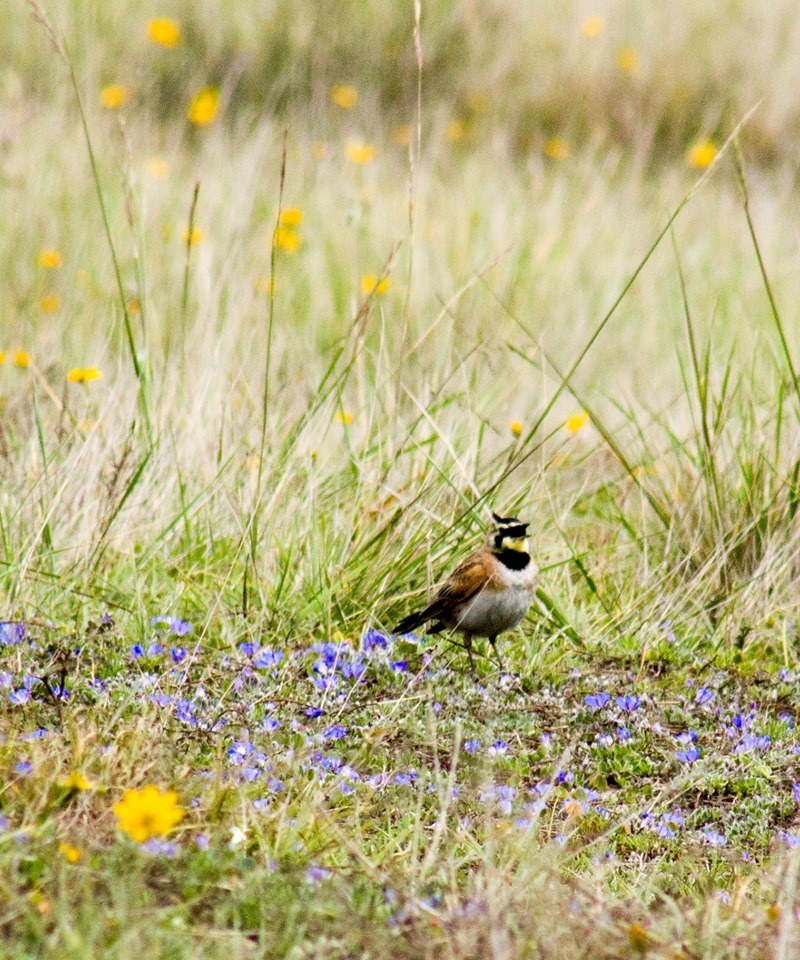
Shore Lark
Eremophila alpestris
A striking ground-dwelling lark with a black-and-yellow face pattern and small black feather 'horns' on the crown.
- Size
- 16-20 cm long; wingspan around 30-35 cm
- Habitat
- Open tundra, alpine terrain, sandy beaches, and short-grass or bare ground habitats
- Type
- songbird
Spotted a bird like this?
Identify any bird from a photo, free.
Overview
The Shore Lark, known as the Horned Lark in North America, is a distinctive and widely distributed lark recognized by its bold facial pattern. Adults show a black mask across the face and a black breast band set against a yellow or whitish throat and face, along with small, dark feather tufts on the crown that resemble tiny horns, most visible when the bird is alert.
Upperparts are warm brown to grayish-brown, often with a pinkish or rufous tint on the nape, and underparts are pale, whitish to buffy. Plumage brightness and color tone vary considerably across the many subspecies found around the Northern Hemisphere.
Sexes differ slightly, with females showing a duller, less contrasting version of the male's face and breast pattern.
How to identify it
Key field marks
- Black mask and black breast band contrasting with yellow or white face and throat
- Small blackish feather tufts ("horns") on the crown, raised when alert
- Brownish upperparts, often with a rufous or pinkish nape
- Terrestrial habits, walking rather than hopping
- Found on bare or very short ground, often in flocks outside the breeding season
Similar species
- No other European or North American lark shares the combination of black facial mask, black breast band, and crown "horns," making the Shore Lark/Horned Lark fairly distinctive once seen well.
- Juveniles and non-breeding birds can look duller and might be confused at a distance with pipits, but the facial pattern and horn tufts, even if reduced, usually remain visible on close view.
Habitat & range
Habitat
Shore Larks breed in open, sparsely vegetated environments including Arctic and alpine tundra, montane plateaus, and rocky uplands. In winter, many populations move to lowland habitats such as coastal beaches, dunes, plowed fields, and short-grass areas.
Range
This species has one of the most extensive breeding ranges of any lark, spanning Arctic and subarctic regions and mountain ranges across North America, Europe, and Asia, making it the only lark native to North America.
Migration
Northern and high-altitude breeding populations are migratory, moving to lower latitudes and elevations for winter, while some southern populations are resident year-round.
Behavior & voice
Behavior
Shore Larks forage by walking across open ground, often in small flocks outside the breeding season, sometimes mixing with other open-country songbirds such as buntings or pipits in winter fields and coastal areas.
Voice
The song is a thin, high-pitched, tinkling series of notes, often delivered during a high song flight over open tundra or upland terrain. Calls include a clear, high "tsee-titi" or similar thin whistled note.
Feeding
Diet consists mainly of seeds, especially in the non-breeding season, supplemented by insects and other invertebrates during the breeding period when protein demands are higher for raising chicks.
Nesting and breeding
Nests are built on the ground in a shallow scrape, typically well hidden among sparse tundra or alpine vegetation. Clutches usually contain 3-5 eggs, and the short breeding season at high latitudes or elevations means nesting is tightly timed to the brief window of snow-free conditions.
Frequently asked questions
What is the difference between Shore Lark and Horned Lark?
They are the same species, Eremophila alpestris; 'Shore Lark' is the name used in Europe, while 'Horned Lark' is the name used in North America.
How do you identify a Shore Lark?
Look for a black facial mask and breast band contrasting with a yellow or white throat, plus tiny dark feather 'horns' on the crown.
Where does the Shore Lark breed?
It breeds in Arctic tundra, alpine and montane terrain, and open uplands across North America, Europe, and Asia.
What does a Shore Lark eat?
Mainly seeds, especially outside the breeding season, along with insects and other invertebrates during summer.
Where do Shore Larks go in winter?
Many populations move from high-latitude or high-altitude breeding grounds down to lowland fields, coastal beaches, and dunes.
Shore Lark guides
In-depth guides for identifying, finding, and understanding Shore Lark.
Other birds you may enjoy

Black Redstart
13-14.5 cm (5.1-5.7 in) long, 23-26 cm wingspan

Black-throated Sparrow
12-14 cm (4.7-5.5 in) long, about 19-20 cm (7.5-8 in) wingspan

Greater Bird-of-paradise
Body about 43 cm; males with additional flank plumes up to 50 cm and long tail wires

Blue Tit
11-12 cm (4.3-4.7 in) long, 17-20 cm wingspan

Red-billed Quelea
11.5–13 cm long, wingspan about 20–22 cm
White-plumed Antbird
13-14 cm (5-5.5 in) long

Pyrrhuloxia
19-22 cm (7.5-8.7 in) long, 30 cm wingspan

Blue-gray Tanager
16-18 cm (6-7 in) long

Blackburnian Warbler
11-13 cm (4.3-5.1 in) long, 20-22 cm wingspan

Bluethroat
13-14 cm (5.1-5.5 in) long, 20-22 cm wingspan

Eurasian Nuthatch
12-14.5 cm (4.7-5.7 in) long, 22.5-27 cm wingspan

Wood Thrush
19-21 cm (7.5-8.3 in) long, about 33 cm (13 in) wingspan