
Shore Lark Identification Guide
The Eurasian name for the Horned Lark, a ground-dwelling open-country bird identified by its black facial mask, small dark 'horns,' and yellow throat.
Read the full Shore Lark encyclopedia entry →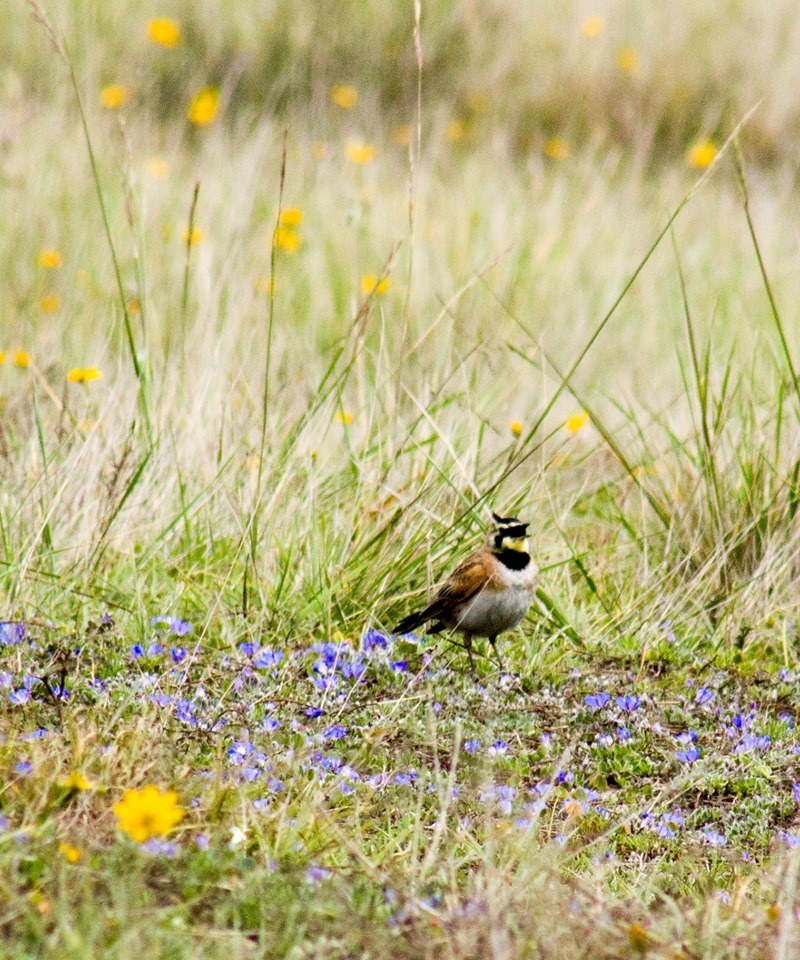
Key Field Marks
- Size & shape: A small, slender, ground-dwelling songbird about 16–20 cm long, with a horizontal posture, longish wings, and a short crest that forms tiny feather "horns."
- Face pattern: Bold black mask through the eye and across the lower face, contrasting with a yellow (or whitish, depending on subspecies) throat and face, and a black breast band.
- Crown: Small black feather tufts ("horns") on the crown, visible at close range or when raised, giving the species its alternate name Horned Lark.
- Upperparts: Sandy brown to pinkish-brown, streaked, providing excellent camouflage on bare ground and shingle.
- Behavior: Walks (rather than hops) in short runs while foraging on open ground; forms loose flocks in winter, often on stubble fields, saltmarshes, and coastal shingle.
Separating It From Similar Species
- Skylark: Larger, with a streaky brown breast (not a bold black band), a small erectile crest but no facial mask or "horns," and a famous prolonged aerial song-flight; lacks the yellow face pattern entirely.
- Snow Bunting: Found in similar open winter habitats but shows extensive white in the wings and a stubby seed-eating bill, without the black facial mask of Shore Lark.
- Lapland Longspur (Lapland Bunting): Also occurs in similar winter flocks on stubble/coastal fields, but lacks the yellow face and has a different, more rufous nape patch (in some plumages) and a stouter finch-like bill.
Where & When to See It
- Habitat: Breeds on Arctic and alpine tundra, rocky and sparsely vegetated high ground; in winter, found on coastal shingle beaches, saltmarshes, dunes, and arable stubble fields, typically near the coast in western Europe.
- Range: Breeds across Arctic Eurasia and locally in alpine areas farther south (as well as North America, where it is called Horned Lark); European wintering birds are concentrated along North Sea coasts (e.g., eastern England, Netherlands, Scandinavia).
- Season: A winter visitor to temperate coasts (roughly October–March in much of western Europe), with breeding confined to the far north or high mountains in summer.
Voice
- Song is a thin, tinkling, somewhat scratchy series of notes, often given in a short display flight; flight call is a distinctive high, thin tsee-titi or tsi-tsi, useful for picking flocks out overhead.
Frequently asked questions
Is Shore Lark the same species as Horned Lark?
Yes, Shore Lark is simply the British/European name for the same species known as Horned Lark in North America (Eremophila alpestris).
How do I identify a Shore Lark in winter?
Look for its black facial mask and breast band contrasting with a yellow throat and face, sandy-brown streaked upperparts, and small feather 'horns' on the crown, often seen in flocks on coastal shingle or stubble fields.
Where can Shore Larks be found in winter in Europe?
They are typically found on open coastal habitats such as shingle beaches, saltmarshes, and dunes along North Sea coasts, including eastern England and the Netherlands.
What is the difference between Shore Lark and Skylark?
Shore Lark has a distinctive black-and-yellow facial pattern and small crown 'horns,' while Skylark lacks any facial mask and instead has a streaky brown breast and a small erectile crest.