
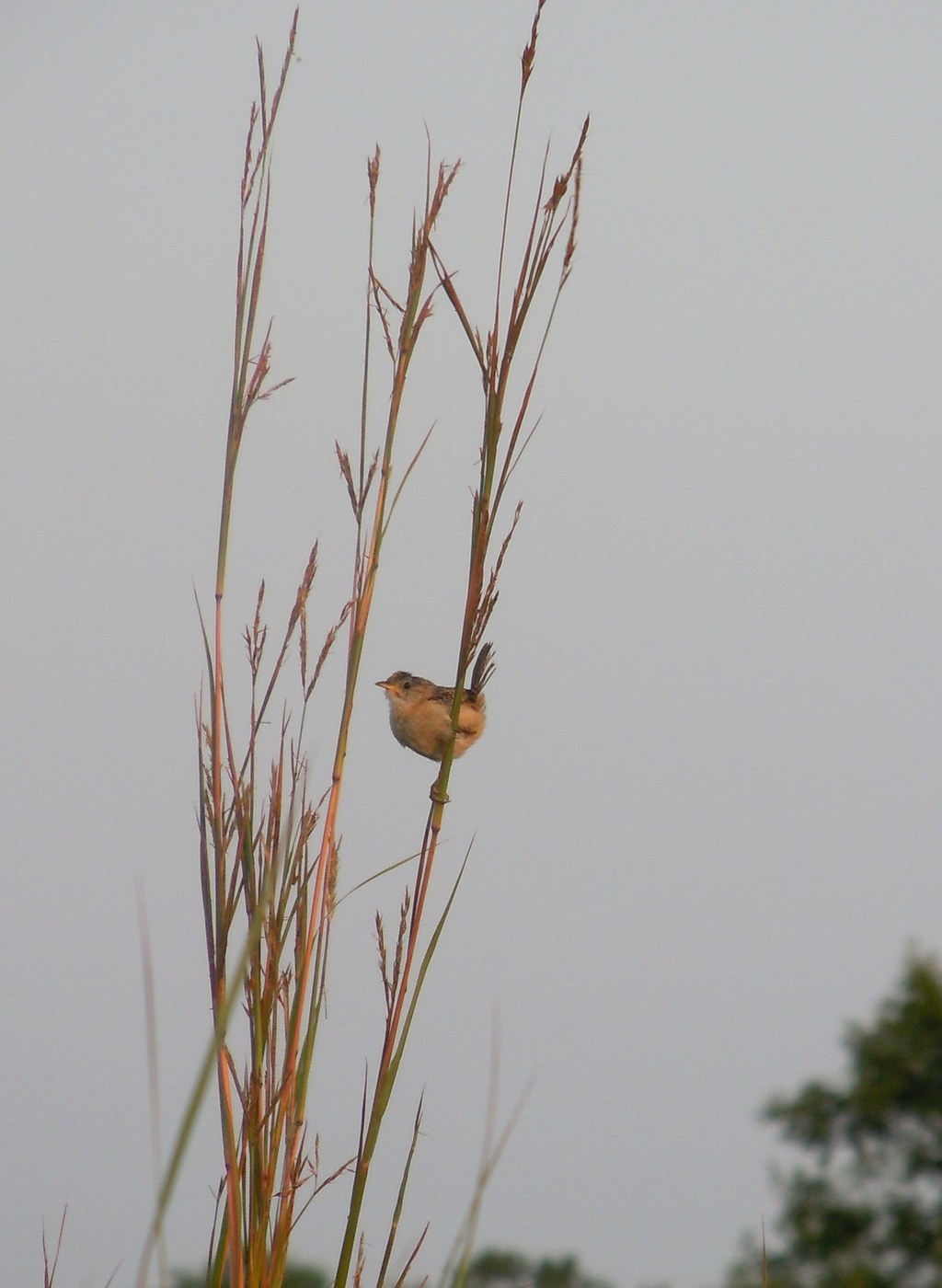
Sedge Wren
Cistothorus stellaris
A tiny, secretive wren of wet sedge meadows, notable for its erratic breeding movements and finely streaked crown.
- Size
- 10-12 cm (3.9-4.7 in) long, 13-15 cm wingspan
- Habitat
- wet meadows, sedge marshes, and damp grassy fields of central and eastern North America
- Type
- songbird
Spotted a bird like this?
Identify any bird from a photo, free.
Overview
The Sedge Wren is a small, secretive wren of wet grassy and sedge-dominated meadows, distinguished from the closely related Marsh Wren by its smaller size, shorter, more delicate bill, and finely streaked (rather than plain) crown. Its overall plumage is buffy brown with fine dark streaking across the crown, back, and wings, and a faint, less bold eyebrow than the Marsh Wren.
Unlike most songbirds, the Sedge Wren shows a highly irregular, nomadic breeding pattern, often nesting in one location early in the season and then relocating — sometimes hundreds of miles — to breed again later in the same season in a different area, tracking the availability of suitable wet meadow habitat.
How to identify it
Key Field Marks
- Small size, noticeably smaller than Marsh Wren
- Finely streaked crown (versus plain brown crown in Marsh Wren)
- Buffy overall tone, streaked back
- Short, fine bill
- Indistinct, narrow eyebrow stripe
Similar Species
- Marsh Wren: larger, with a plain unstreaked crown, a bolder white eyebrow, and preference for deeper cattail/bulrush marsh rather than drier sedge meadow.
- House Wren: lacks streaking on the crown and back, and prefers drier upland habitat rather than wet meadows.
- Grasshopper Sparrow: superficially similar streaked, buffy appearance but is a sparrow with a conical bill and flat head, not a wren shape.
Habitat & range
Habitat
Sedge Wrens favor wet meadows, sedge marshes, and damp grassy fields — generally drier and shallower than the deep cattail marsh preferred by Marsh Wrens.
Range
The species breeds across the north-central United States and southern Canada, with a secondary, later breeding population sometimes appearing farther east or south later in the season; it winters in the southeastern United States.
Migration
Sedge Wrens are migratory but notably irregular and nomadic in their breeding distribution, sometimes breeding in a location only briefly before relocating elsewhere within the same season, a pattern less pronounced in most other migratory songbirds.
Behavior & voice
Behavior
Sedge Wrens are secretive and difficult to observe, staying low in dense grass and sedge and typically reluctant to fly far when flushed, often preferring to run or scurry through vegetation instead.
Voice
The song is a dry, staccato series of chips followed by a rattling trill, quite different in cadence from the gurgling song of the Marsh Wren; often given from low within grassy cover.
Feeding
Diet consists almost entirely of insects and spiders gleaned from grass and sedge vegetation close to the ground.
Nesting
Males build multiple globe-shaped dummy nests, similar to Marsh Wrens, woven into grass or sedge clumps, with the female selecting and lining one for egg-laying. Clutches typically number 4-8 eggs, and the species' unpredictable, shifting breeding locations make nesting studies challenging.
Frequently asked questions
How do I tell a Sedge Wren from a Marsh Wren?
Sedge Wren is smaller with a finely streaked crown and prefers drier sedge meadows, while Marsh Wren has a plain unstreaked crown, a bolder eyebrow, and favors deeper cattail marsh.
Why does the Sedge Wren sometimes breed in two different places in one year?
It has an unusually nomadic breeding strategy, sometimes nesting in one area early in the season and then relocating, occasionally long distances, to breed again later in a different area with suitable wet meadow habitat.
Where does the Sedge Wren live?
In wet meadows, sedge marshes, and damp grassy fields across the north-central United States and southern Canada, wintering in the southeastern United States.
Is the Sedge Wren easy to see?
No, it is quite secretive, staying low in dense grass and sedge cover and often more easily heard than seen.
What does the Sedge Wren eat?
Almost entirely insects and spiders gleaned from grass and sedge vegetation near the ground.
Sedge Wren guides
In-depth guides for identifying, finding, and understanding Sedge Wren.
Other birds you may enjoy

Black Redstart
13-14.5 cm (5.1-5.7 in) long, 23-26 cm wingspan

Black-throated Sparrow
12-14 cm (4.7-5.5 in) long, about 19-20 cm (7.5-8 in) wingspan

Greater Bird-of-paradise
Body about 43 cm; males with additional flank plumes up to 50 cm and long tail wires

Blue Tit
11-12 cm (4.3-4.7 in) long, 17-20 cm wingspan

Red-billed Quelea
11.5–13 cm long, wingspan about 20–22 cm
White-plumed Antbird
13-14 cm (5-5.5 in) long

Pyrrhuloxia
19-22 cm (7.5-8.7 in) long, 30 cm wingspan

Blue-gray Tanager
16-18 cm (6-7 in) long

Blackburnian Warbler
11-13 cm (4.3-5.1 in) long, 20-22 cm wingspan

Bluethroat
13-14 cm (5.1-5.5 in) long, 20-22 cm wingspan

Eurasian Nuthatch
12-14.5 cm (4.7-5.7 in) long, 22.5-27 cm wingspan

Wood Thrush
19-21 cm (7.5-8.3 in) long, about 33 cm (13 in) wingspan