
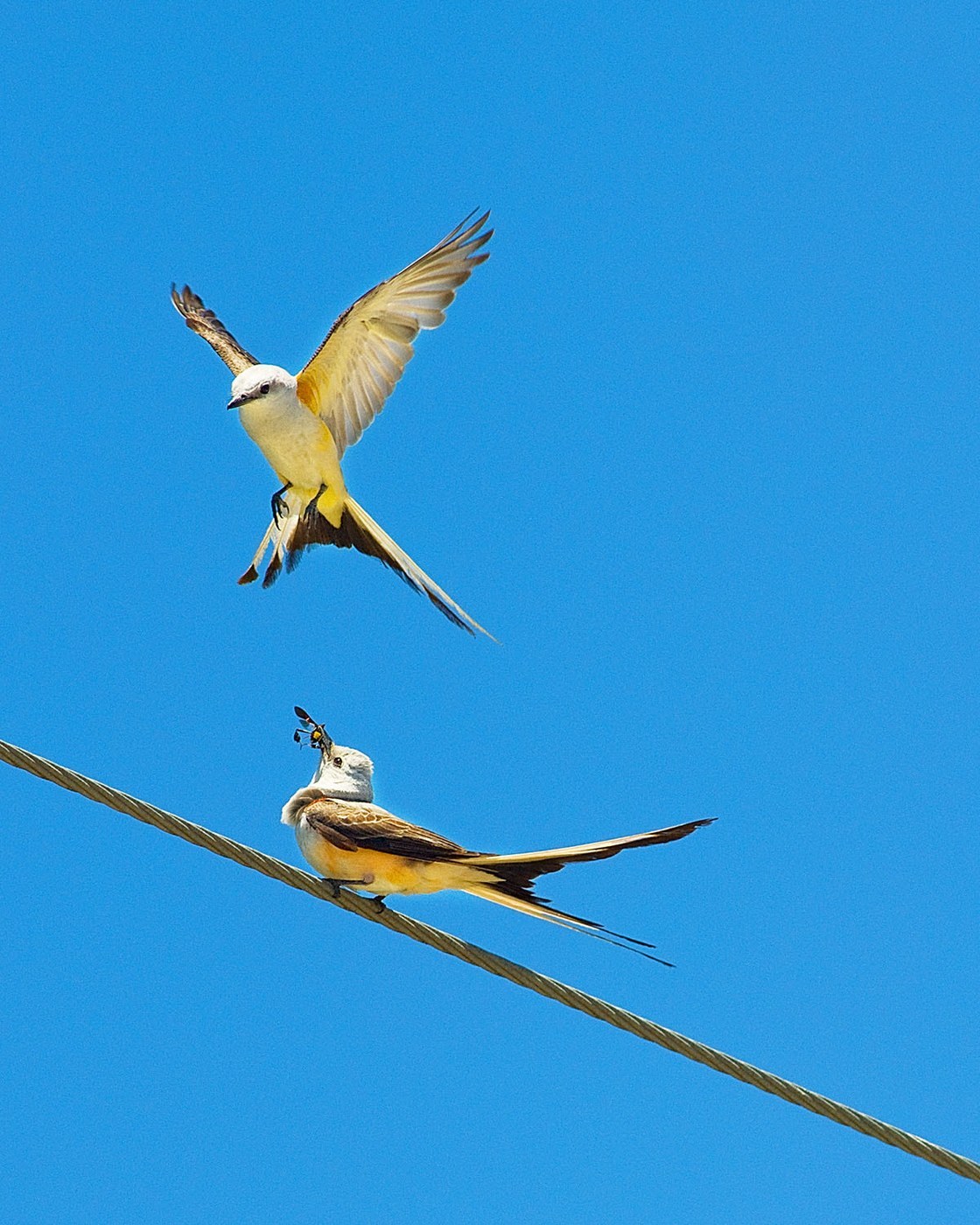
Scissor-tailed Flycatcher
Tyrannus forficatus
An elegant pale gray flycatcher with an extraordinarily long, deeply forked tail and salmon-pink flanks, a signature bird of Texas and Oklahoma grasslands.
- Size
- 33-38 cm (13-15 in) long including tail, 38 cm wingspan
- Habitat
- open grassland, savanna, and ranchland of the south-central United States
- Type
- songbird
Spotted a bird like this?
Identify any bird from a photo, free.
Overview
The Scissor-tailed Flycatcher is one of the most visually striking songbirds in North America, instantly recognizable by its extraordinarily long, deeply forked black-and-white tail, which can account for more than half its total length. The body is pale gray above with whitish underparts washed with salmon-pink on the flanks and under the wings, and a subtle reddish patch on the crown that is rarely visible. In flight, the long tail streams behind the bird and can be opened and closed like a pair of scissors, giving the species its name.
A beloved symbol of the southern Great Plains, this species is the state bird of Oklahoma and is often seen perched prominently on fences and utility wires in open country, where it performs spectacular aerial courtship displays involving steep dives and rapid tail-snapping.
How to identify it
Key Field Marks
- Extremely long, deeply forked black-and-white tail, often longer than the body itself, especially in males
- Pale gray head and back with whitish underparts
- Salmon-pink to scarlet wash on the flanks, sides, and underwing linings
- Concealed reddish-orange crown patch, visible mainly during displays
Similar Species
- Fork-tailed Flycatcher, a rare vagrant from South America, has an even longer, all-black tail and a black cap contrasting with white underparts lacking the salmon wash.
- No regularly occurring North American species shares this combination of pale gray body, salmon flanks, and extremely long forked tail, making adults essentially unmistakable.
- Juveniles have shorter tails and duller salmon coloring, but retain the same general pattern.
Habitat & range
Scissor-tailed Flycatchers breed in open grassland, savanna, ranchland, and agricultural areas of the south-central United States, with the core range centered on Texas, Oklahoma, and neighboring states, extending into parts of Kansas, Louisiana, and New Mexico. They favor habitats with scattered trees, fences, or utility wires for perching amid open ground for foraging.
The species migrates to winter in southern Mexico and Central America, often gathering in large communal roosts of hundreds of birds during migration and on the wintering grounds.
Behavior & voice
Voice
Gives sharp, high-pitched kip and chattering calls, along with a more elaborate cackling vocalization used during courtship and territorial disputes.
Feeding
Sallies from an exposed perch such as a wire or fence post to catch flying insects, including grasshoppers and beetles, sometimes pursuing prey with agile, twisting flight enabled by its long tail; also eats some berries and fruit.
Nesting
Builds a bulky cup nest of twigs and grass in an isolated tree or shrub, often incorporating string, cloth, or other debris; performs spectacular aerial courtship displays involving steep climbs, tumbling dives, and rapid opening and closing of the tail.
Frequently asked questions
How do I identify a Scissor-tailed Flycatcher?
Look for a pale gray flycatcher with an extremely long, deeply forked black-and-white tail and salmon-pink flanks, often perched on fences or wires in open grassland.
Where can I see a Scissor-tailed Flycatcher?
It breeds in open grassland and ranchland of the south-central United States, especially Texas and Oklahoma, where it is the state bird.
Why is the tail of the Scissor-tailed Flycatcher so long?
The extremely long, forked tail, especially prominent in males, plays a key role in courtship displays and aerial maneuvering, and males typically have longer tails than females.
Do Scissor-tailed Flycatchers migrate?
Yes, they migrate to winter in southern Mexico and Central America, often forming large communal roosts during migration.
What does the Scissor-tailed Flycatcher eat?
It feeds mainly on flying insects such as grasshoppers and beetles caught by sallying from an exposed perch, supplemented with some fruit.
Scissor-tailed Flycatcher guides
In-depth guides for identifying, finding, and understanding Scissor-tailed Flycatcher.
Other birds you may enjoy

Black Redstart
13-14.5 cm (5.1-5.7 in) long, 23-26 cm wingspan

Black-throated Sparrow
12-14 cm (4.7-5.5 in) long, about 19-20 cm (7.5-8 in) wingspan

Greater Bird-of-paradise
Body about 43 cm; males with additional flank plumes up to 50 cm and long tail wires

Blue Tit
11-12 cm (4.3-4.7 in) long, 17-20 cm wingspan

Red-billed Quelea
11.5–13 cm long, wingspan about 20–22 cm
White-plumed Antbird
13-14 cm (5-5.5 in) long

Pyrrhuloxia
19-22 cm (7.5-8.7 in) long, 30 cm wingspan

Blue-gray Tanager
16-18 cm (6-7 in) long

Blackburnian Warbler
11-13 cm (4.3-5.1 in) long, 20-22 cm wingspan

Bluethroat
13-14 cm (5.1-5.5 in) long, 20-22 cm wingspan

Eurasian Nuthatch
12-14.5 cm (4.7-5.7 in) long, 22.5-27 cm wingspan

Wood Thrush
19-21 cm (7.5-8.3 in) long, about 33 cm (13 in) wingspan