
Scissor-tailed Flycatcher Identification Guide
An elegant open-country flycatcher with an extremely long, deeply forked black-and-white tail and salmon-pink flanks.
Read the full Scissor-tailed Flycatcher encyclopedia entry →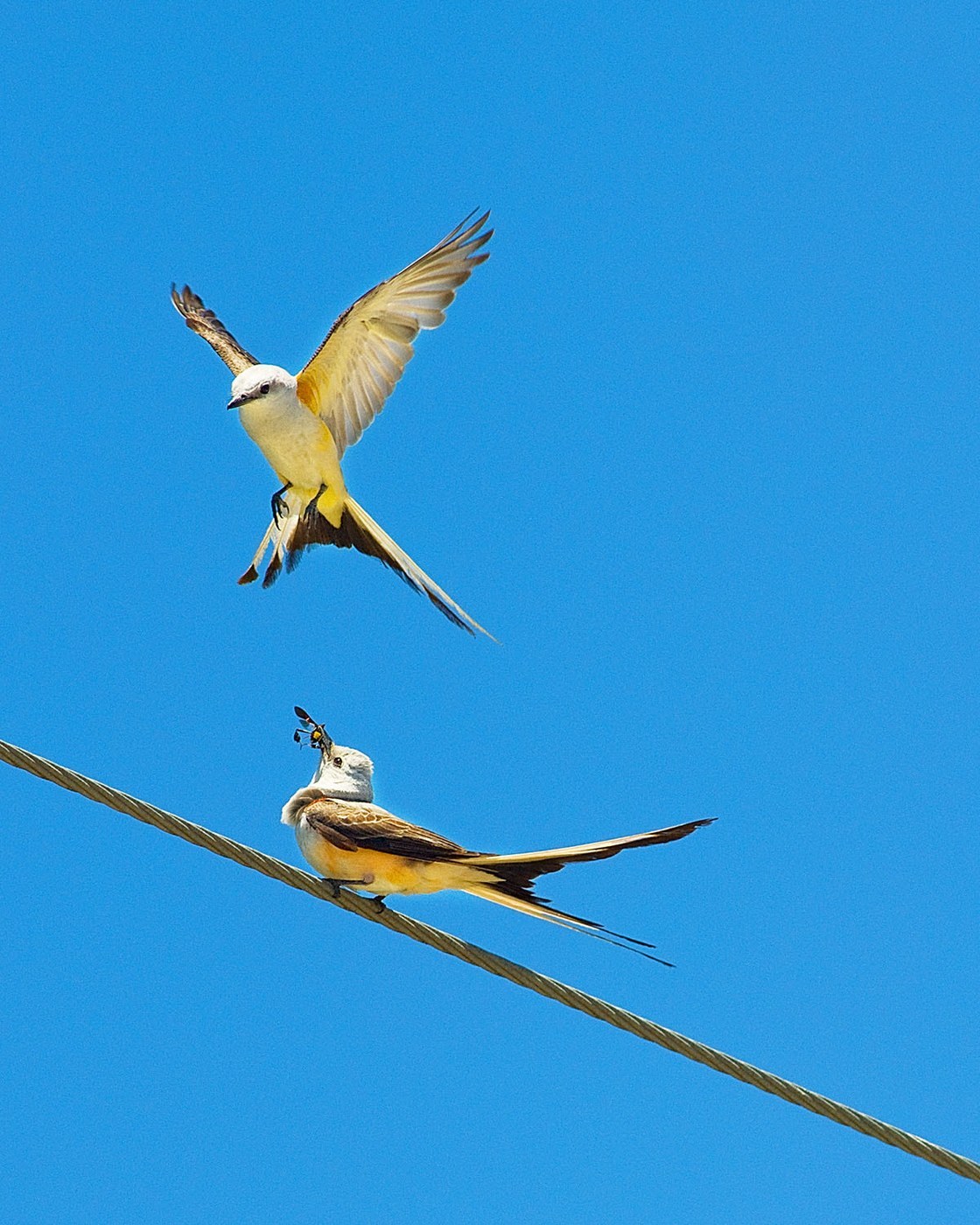
Key Field Marks
- Size & shape: A slender flycatcher roughly 19–24 cm in body length, but with an extraordinarily long, deeply forked tail that can nearly double its overall length — males have noticeably longer tail streamers than females.
- Plumage: Pale grey head and back, whitish underparts washed with soft salmon-pink on the flanks and under the wings, black wings, and a black-and-white scissor-like tail.
- Perching habit: Frequently seen perched upright on fences, utility wires, and isolated trees in open country, tail often held closed and pointed downward until it flies.
- Flight: Buoyant and acrobatic, with the long tail opening and closing like scissors during aerial maneuvers and courtship display flights.
Separating It From Similar Species
- Fork-tailed Flycatcher (a rare vagrant) has a sharply demarcated black cap contrasting with clean white underparts and lacks the salmon-pink wash — Scissor-tailed's grey crown blends into its back rather than forming a hooded look.
- Juveniles and females have shorter tails than adult males but still show the diagnostic pale grey-and-salmon color pattern that separates them from all other North American flycatchers.
Habitat, Range & Season
- Breeds in open country, prairies, ranchland, and roadsides of the south-central United States, centered on Texas and Oklahoma, with smaller numbers in neighboring states.
- Winters from southern Mexico to Panama, often gathering in large communal roosts.
- Present on breeding grounds roughly April through September; a rare but regular vagrant well outside its normal range during migration.
Behavior
- Hunts flying insects by sallying from an exposed perch and hawking prey in flight, sometimes hovering briefly.
- Highly territorial around nests, aggressively chasing off hawks, crows, and other intruders.
- Forms spectacular pre-migratory roosts of hundreds to thousands of birds in Texas in late summer.
Voice
- Calls include sharp, high "kip" or "pik" notes.
- Also gives a rapid, chattering series of notes, especially during aggressive interactions or display flights.
Frequently asked questions
How can I tell a Scissor-tailed Flycatcher from a Fork-tailed Flycatcher?
Scissor-tailed has a pale grey head blending into its back and salmon-pink flanks, while Fork-tailed Flycatcher has a sharply contrasting black cap over clean white underparts and no pink wash.
Do both male and female Scissor-tailed Flycatchers have long tails?
Both sexes have elongated forked tails, but males typically have noticeably longer streamers than females and juveniles.
Where is the best place to see Scissor-tailed Flycatchers?
Open ranchland, prairies, and roadside wires across Texas and Oklahoma during the breeding season offer the most reliable viewing; they are the state bird of Oklahoma.
Where do Scissor-tailed Flycatchers go in winter?
They migrate to southern Mexico and Central America, sometimes forming large communal roosts before and during migration.