
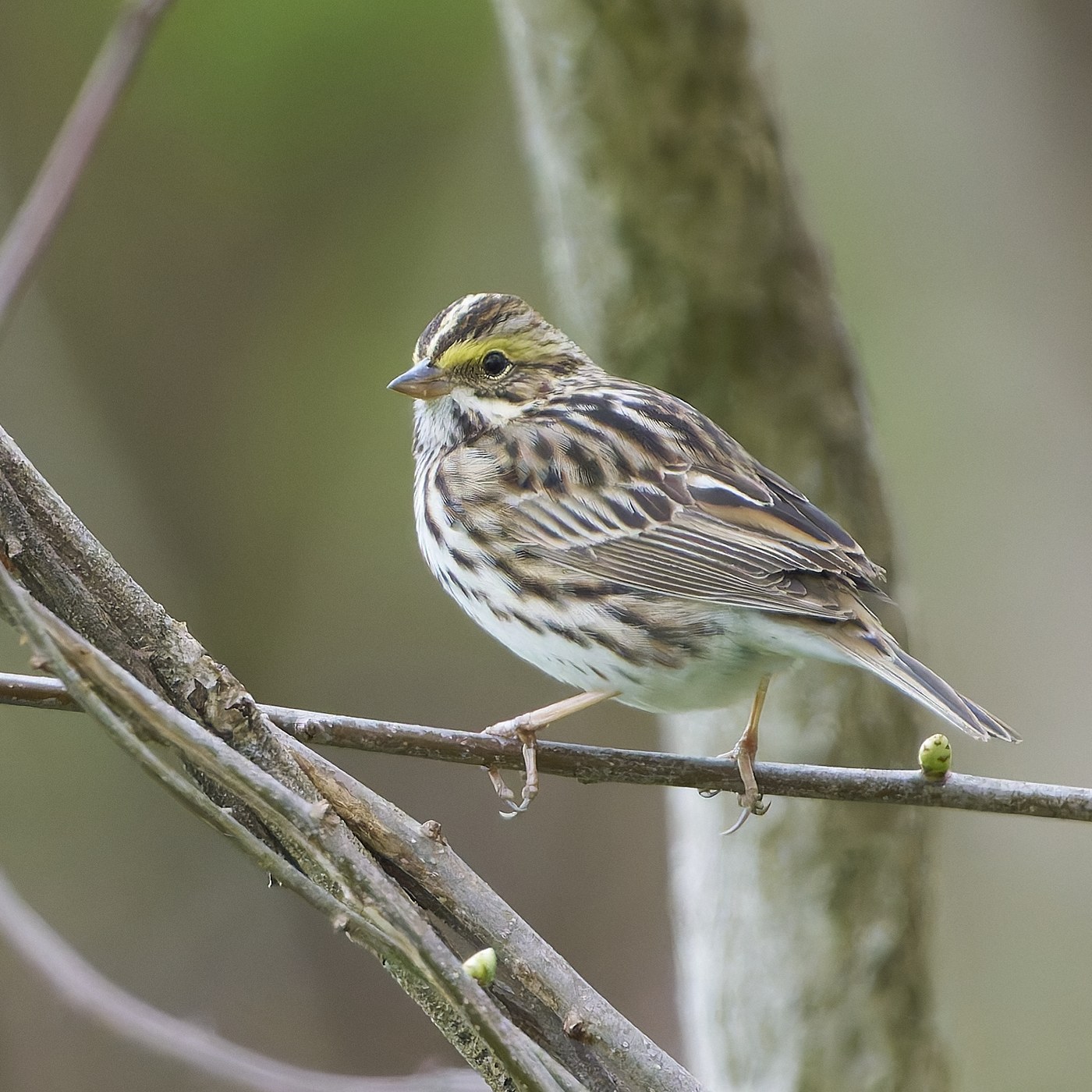
Savannah Sparrow
Passerculus sandwichensis
A streaky, ground-dwelling sparrow with a yellow eyebrow patch and short notched tail, widespread across open grassy habitats in North America.
- Size
- 11-15 cm (4.3-5.9 in) long, 18-25 cm wingspan
- Habitat
- open grasslands, meadows, saltmarshes, and agricultural fields
- Type
- songbird
Spotted a bird like this?
Identify any bird from a photo, free.
Overview
The Savannah Sparrow is a small, streaky brown sparrow of open grassy habitats, showing crisp dark streaking on a white breast and flanks, a pale central crown stripe, and, in most populations, a small patch of yellow in front of and above the eye. The tail is notably short and slightly notched compared to many other sparrows.
Plumage varies somewhat across its many subspecies, ranging from pale and sandy in interior populations to darker and more heavily marked in coastal saltmarsh populations, but the overall streaky, ground-loving pattern is consistent throughout.
How to identify it
Key field marks
- Fine, crisp dark streaking on a whitish breast and flanks
- Small yellow patch above the lores (in front of the eye), variable in extent
- Short, notched tail
- Pink legs and a pale central crown stripe
Similar species
- Song Sparrow is larger, longer-tailed, and typically shows a heavier central breast spot, without the yellow lores.
- Vesper Sparrow is larger with a white eye-ring and white outer tail feathers, lacking the yellow face patch.
- Grasshopper Sparrow has an unstreaked, plain buffy breast, unlike the Savannah Sparrow's crisply streaked underparts.
Habitat & range
Savannah Sparrows are widespread breeders across most of Canada, Alaska, and the northern and western United States, in open grasslands, hayfields, tundra, and coastal saltmarshes; a distinct saltmarsh-adapted population (the "Belding's" group) breeds along the California coast. Wintering birds spread across the southern US, Mexico, and Central America, using similar open, grassy, or marshy habitats.
The species is highly migratory across most of its range, though some coastal populations are resident, and it often occurs in loose flocks during migration and winter, sometimes mixed with other grassland sparrows.
Behavior & voice
Savannah Sparrows forage on the ground and in low grass, walking or running rather than hopping, and typically flush low over the grass for a short distance before dropping back down, often with a diagnostic buzzy flight call. They can be inconspicuous outside the breeding season, staying low and well hidden in dense grass.
The song is a thin, insect-like buzzy trill, typically starting with a few short introductory notes, "tsit-tsit-tsit-seeee-saaay," and delivered from a low perch such as a fence post or grass stem. Diet consists mainly of insects during the breeding season and seeds the rest of the year. Nests are well concealed cups placed on the ground in dense grass, with clutches of typically three to six eggs.
Frequently asked questions
How do you identify a Savannah Sparrow?
Look for a small, crisply streaked brown-and-white sparrow with a short notched tail, pink legs, and often a small patch of yellow above the eye (lores).
What does a Savannah Sparrow sound like?
A thin, buzzy, insect-like song, typically a few short chip notes followed by two buzzy trills, delivered from a low perch.
Where do Savannah Sparrows live?
In open grasslands, hayfields, tundra, and coastal saltmarshes across most of Canada, Alaska, and the northern US in summer, and across the southern US, Mexico, and Central America in winter.
What is the difference between a Savannah Sparrow and a Song Sparrow?
Savannah Sparrows are smaller with a shorter, notched tail and a yellow patch over the eye, while Song Sparrows are larger, longer-tailed, and usually show a heavier central breast spot without any yellow on the face.
Do Savannah Sparrows migrate?
Most populations are migratory, wintering across the southern US, Mexico, and Central America, though some coastal populations remain resident year-round.
Savannah Sparrow guides
In-depth guides for identifying, finding, and understanding Savannah Sparrow.
Other birds you may enjoy

Black Redstart
13-14.5 cm (5.1-5.7 in) long, 23-26 cm wingspan

Black-throated Sparrow
12-14 cm (4.7-5.5 in) long, about 19-20 cm (7.5-8 in) wingspan

Greater Bird-of-paradise
Body about 43 cm; males with additional flank plumes up to 50 cm and long tail wires

Blue Tit
11-12 cm (4.3-4.7 in) long, 17-20 cm wingspan

Red-billed Quelea
11.5–13 cm long, wingspan about 20–22 cm
White-plumed Antbird
13-14 cm (5-5.5 in) long

Pyrrhuloxia
19-22 cm (7.5-8.7 in) long, 30 cm wingspan

Blue-gray Tanager
16-18 cm (6-7 in) long

Blackburnian Warbler
11-13 cm (4.3-5.1 in) long, 20-22 cm wingspan

Bluethroat
13-14 cm (5.1-5.5 in) long, 20-22 cm wingspan

Eurasian Nuthatch
12-14.5 cm (4.7-5.7 in) long, 22.5-27 cm wingspan

Wood Thrush
19-21 cm (7.5-8.3 in) long, about 33 cm (13 in) wingspan