
Savannah Sparrow Identification Guide
A common, variable streaky brown sparrow of open grassy habitats, best identified by its yellow lores, pink legs, and short notched tail.
Read the full Savannah Sparrow encyclopedia entry →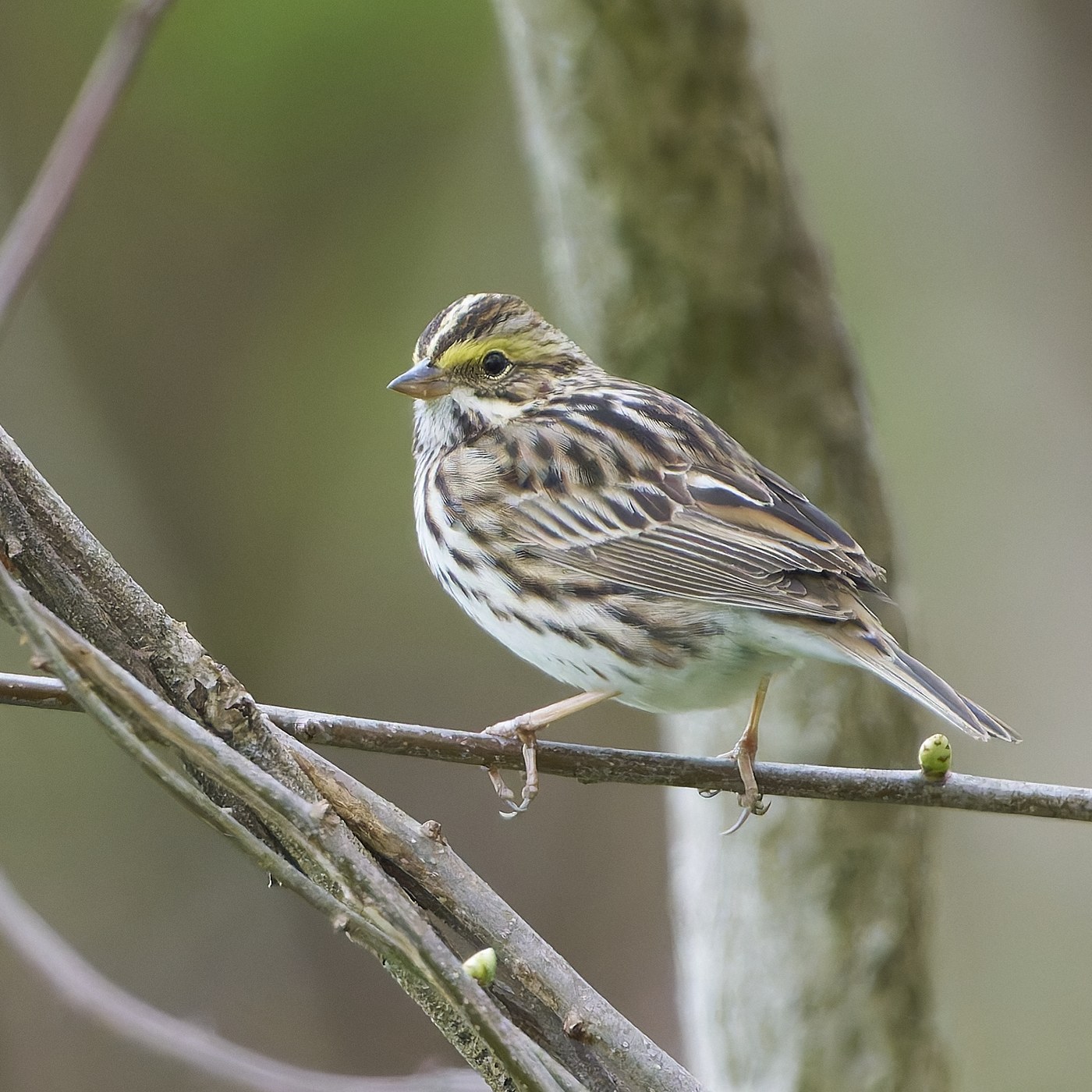
Key Field Marks
- Size & shape: A small, compact sparrow with a short, notched tail (unlike the long, rounded tail of Song Sparrow) and a relatively flat-headed profile.
- Face: Yellow or yellowish tinge in the lores (area between the eye and bill) and often extending faintly over the eyebrow — a key mark, though it can be subtle or nearly absent in some individuals/subspecies.
- Underparts: Crisp dark streaking on a white breast and flanks, sometimes converging into a central breast spot (variable, can cause confusion with Song Sparrow).
- Upperparts: Brown and buff streaked back with a pale central crown stripe.
- Legs: Pale pinkish legs, generally paler than the legs of many similar sparrows.
- Behavior: Prefers to walk or run through grass rather than hop; when flushed flies low with a jerky, twisting flight and drops back into cover quickly, often giving a diagnostic short flight before disappearing.
Separating Savannah Sparrow from Similar Species
- Song Sparrow: Larger, with a longer, rounded (not notched) tail, heavier and more diffuse breast streaking often forming an obvious central spot, and lacks the yellow lores.
- Vesper Sparrow: Larger, grayer overall, with a distinct white eye-ring, chestnut lesser covert patch on the shoulder, and white outer tail feathers visible in flight — no yellow lores.
- Grasshopper Sparrow: Shorter-tailed still, with an unstreaked buffy breast (not streaked) and a flatter, more "spiky-tailed" look; behaves even more secretively.
- Ipswich Sparrow (a large, pale subspecies of Savannah Sparrow found on Atlantic dunes in winter): Notably paler and larger than typical inland Savannah Sparrows, found almost exclusively on coastal dunes.
Where & When to See One
Savannah Sparrow is one of the most widespread and abundant sparrows in North America, breeding across a huge range from Alaska and Canada south through the northern and western United States in grasslands, meadows, agricultural fields, tundra edges, and coastal marshes. It is highly variable geographically, with numerous subspecies differing in size and color saturation. Northern breeders migrate to winter across the southern U.S., Mexico, and Central America, while some populations are resident. Look for it walking through short grass, weedy fields, airports, and dune grass, often flushing just ahead of your feet.
Voice
A thin, insect-like song beginning with a few chip notes and trailing into a buzzy trill: tsit-tsit-tsit-seeeeeer-sirrr, often described as sounding like it's running out of energy toward the end.
Frequently asked questions
What is the key field mark for Savannah Sparrow?
Look for a small streaky sparrow with a short notched tail, pale pink legs, and a yellowish tinge in the lores in front of the eye, which together separate it from most other streaky grassland sparrows.
How do you tell Savannah Sparrow from Song Sparrow?
Savannah Sparrow has a shorter, notched tail and often shows yellow lores, while Song Sparrow has a longer, rounded tail, heavier streaking that typically forms a central breast spot, and no yellow on the face.
What is the Ipswich Sparrow?
It is a large, pale subspecies of Savannah Sparrow that breeds on Sable Island, Nova Scotia, and winters almost exclusively on Atlantic coastal dunes from Canada to Georgia, looking notably washed-out compared to typical inland birds.
What habitat does Savannah Sparrow prefer?
It favors open grassy and weedy habitats such as meadows, agricultural fields, tundra edges, airports, and coastal dune grass, generally avoiding wooded or shrubby areas.
Does the Savannah Sparrow migrate?
Most northern and interior populations are migratory, wintering across the southern United States, Mexico, and Central America, though some coastal and southern populations remain resident year-round.