
Satin Bowerbird
Ptilonorhynchus violaceus
A songbird best known for the male's glossy, satiny blue-black plumage, violet eyes, and elaborate stick bower decorated almost exclusively with blue objects to attract a mate.
- Size
- 27-33 cm (10.5-13 in) long
- Habitat
- rainforest, wet eucalypt forest, and forest edges
- Type
- songbird
Spotted a bird like this?
Identify any bird from a photo, free.
Overview
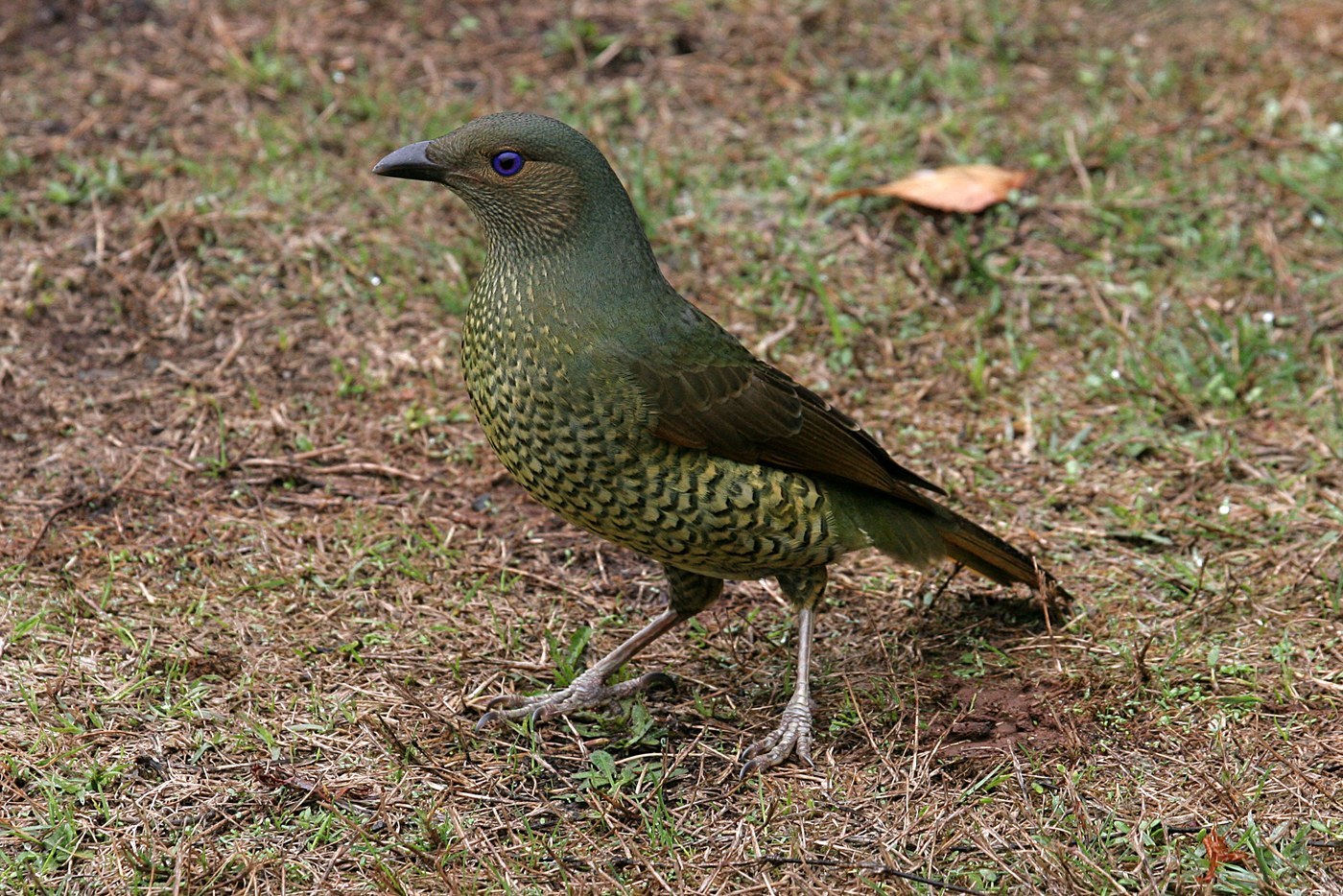
The Satin Bowerbird is a striking songbird in which the fully mature male displays deep, glossy blue-black plumage with an iridescent satin sheen, set off by vivid violet-blue eyes and a pale bill. Females and immature males, which can take up to seven years to acquire full adult plumage, are quite different: olive-green above with heavily scalloped grey-and-white underparts, making the sexes and age classes look almost like separate species.
The male is renowned for building and maintaining an elaborate avenue-shaped bower of sticks, which he decorates almost exclusively with blue objects, from flowers and feathers to, in modern times, discarded plastic and clothes pegs, using the structure and its collection of ornaments purely as a stage for courtship display rather than as a nest.
How to identify it
Key field marks
- Adult male: glossy, satiny blue-black plumage overall with violet-blue eyes
- Female/immature male: olive-green above with heavily scalloped grey-and-white underparts
- Pale, slightly hooked bill
- Males build a stick avenue bower decorated with blue objects
Similar species
- Regent Bowerbird male is black and golden-yellow rather than glossy blue-black.
- Female Satin Bowerbirds can resemble female Regent or Green Catbirds but are best told by range, subtle plumage pattern, and behavior near a bower.
Habitat & range
Habitat
Inhabits rainforest, wet eucalypt forest, and forest edges, and readily visits gardens near forest in parts of its range.
Range
Found in two disjunct populations along the east coast of Australia: from southeastern Queensland to Victoria, and a separate population in the Wet Tropics of far north Queensland.
Migration
Mostly sedentary, with some local and altitudinal movement outside the breeding season.
Behavior & voice
Behavior
Males spend much of the breeding season building, maintaining, and decorating an avenue-shaped bower of sticks, arranging blue and sometimes yellow objects around it and performing an energetic courtship display for visiting females; females alone build the nest and raise young.
Voice
A harsh, wheezy chattering song, often incorporating mimicry of other birds and even mechanical sounds, given especially at the bower.
Feeding
Eats a wide variety of fruit, insects, leaves, and flowers, foraged in the forest canopy and on the ground.
Nesting
The female builds a simple, shallow cup nest of twigs high in a tree, entirely unrelated to the male's display bower; lays 1-3 cream to buff eggs with darker streaking.
Frequently asked questions
Why does a male Satin Bowerbird collect blue objects?
He decorates his stick avenue bower almost exclusively with blue items, from flowers to man-made objects, as part of an elaborate courtship display intended to attract and impress visiting females.
Is the bower a nest?
No, the bower is used purely for courtship display; the female builds a completely separate, simple nest elsewhere to lay her eggs and raise the young alone.
How long does it take for a male Satin Bowerbird to get its blue-black adult plumage?
Males can take up to about seven years to molt into their full glossy blue-black adult plumage, appearing olive-green like females until then.
What does a Satin Bowerbird eat?
A varied diet of fruit, insects, leaves, and flowers foraged in the forest canopy and on the ground.
Satin Bowerbird guides
In-depth guides for identifying, finding, and understanding Satin Bowerbird.
Other birds you may enjoy

Black Redstart
13-14.5 cm (5.1-5.7 in) long, 23-26 cm wingspan

Black-throated Sparrow
12-14 cm (4.7-5.5 in) long, about 19-20 cm (7.5-8 in) wingspan

Greater Bird-of-paradise
Body about 43 cm; males with additional flank plumes up to 50 cm and long tail wires

Blue Tit
11-12 cm (4.3-4.7 in) long, 17-20 cm wingspan

Red-billed Quelea
11.5–13 cm long, wingspan about 20–22 cm
White-plumed Antbird
13-14 cm (5-5.5 in) long

Pyrrhuloxia
19-22 cm (7.5-8.7 in) long, 30 cm wingspan

Blue-gray Tanager
16-18 cm (6-7 in) long

Blackburnian Warbler
11-13 cm (4.3-5.1 in) long, 20-22 cm wingspan

Bluethroat
13-14 cm (5.1-5.5 in) long, 20-22 cm wingspan

Eurasian Nuthatch
12-14.5 cm (4.7-5.7 in) long, 22.5-27 cm wingspan

Wood Thrush
19-21 cm (7.5-8.3 in) long, about 33 cm (13 in) wingspan