
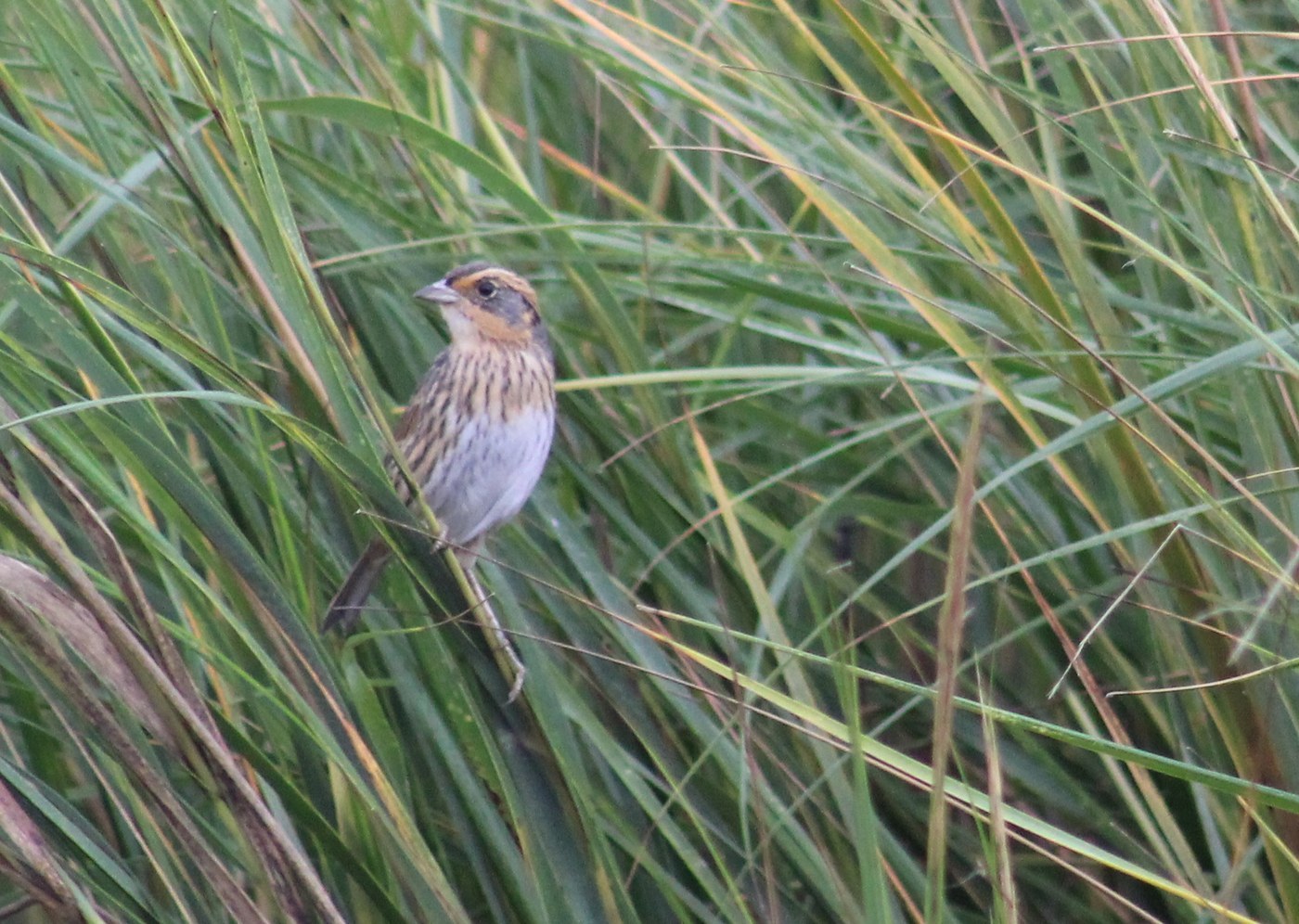
Saltmarsh Sparrow
Ammospiza caudacuta
A tidal marsh specialist with a bright orange face and crisp streaked breast, among the most threatened songbirds in North America due to sea level rise.
- Size
- 12-13 cm (4.7-5 in) long, about 18 cm (7 in) wingspan
- Habitat
- Atlantic Coast tidal salt marshes
- Type
- songbird
Spotted a bird like this?
Identify any bird from a photo, free.
Overview
The Saltmarsh Sparrow is a small, secretive songbird found nowhere but the salt marshes of the Atlantic Coast, where its entire life cycle, from nesting to feeding, is tied to the rhythm of the tides. It is one of the most range-restricted sparrows in North America and, as a result, one of the most vulnerable to habitat loss.
Adults show a bright orange-buff face triangle contrasting with a gray cheek patch, and crisp, sharply defined black streaking across a white breast and flanks, distinguishing it from the closely related Nelson's Sparrow. The tail is short and appears spiky or pointed at the tips of the feathers, a trait shared across the genus.
The species has an unusual breeding system in which males do not pair with females, and nesting is precisely timed to avoid the highest tides, a strategy increasingly overwhelmed by accelerating sea level rise.
How to identify it
Key Field Marks
- Bright orange-buff triangle on the face, framing a gray cheek patch
- Crisp, sharply defined black streaking on a whitish breast and flanks
- Short, spiky-tipped tail
- Longer, more pointed bill than the similar Nelson's Sparrow
Similar Species
- Nelson's Sparrow: very similar but shows softer, blurrier streaking, a shorter bill, and a plainer gray nape; the two species hybridize where their ranges overlap along the coast
- Seaside Sparrow: larger, darker overall, with a yellow spot in front of the eye and a longer, heavier bill
Because the two Ammospiza sharp-tailed sparrows overlap in parts of their range, careful attention to streak crispness and bill length is needed for certain identification.
Habitat & range
The Saltmarsh Sparrow breeds exclusively in tidal salt marshes along the Atlantic Coast of the United States, from Maine south to Virginia, nesting in the high marsh zone dominated by salt meadow cordgrass and black needlerush. It winters in coastal salt marshes farther south, from the mid-Atlantic states through Florida and along the Gulf Coast.
This extremely narrow habitat requirement makes the species highly vulnerable: as sea levels rise, high marsh nesting habitat is flooded more frequently, destroying nests before eggs can hatch or chicks can fledge, and coastal development prevents marshes from migrating inland to compensate.
Behavior & voice
Behavior
Saltmarsh Sparrows are secretive, creeping through dense marsh grass and rarely venturing far from cover, making them difficult to observe well.
Voice
The song is a buzzy, wheezy series of notes, often described as an unmusical hissing or sputtering sound, quite unlike the clear whistled songs of many songbirds.
Feeding
Diet consists of insects, spiders, small crustaceans, and seeds gathered from marsh vegetation and mud at low tide.
Nesting and Breeding
The species has an unusual mating system: males do not pair with or help raise young, instead mating with multiple females. Nests are built low in marsh grass and timed to the roughly 28-day lunar tidal cycle so that eggs hatch and chicks fledge between the highest 'spring' tides; increasingly frequent flooding from sea level rise now destroys a large share of nests each season, driving steep population declines.
Frequently asked questions
Why is the Saltmarsh Sparrow endangered?
It nests only in Atlantic Coast tidal salt marshes, and rising sea levels are flooding nests with increasing frequency, causing rapid, ongoing population declines.
How do you tell a Saltmarsh Sparrow from a Nelson's Sparrow?
Saltmarsh Sparrow shows crisper, sharper black streaking and a longer bill, while Nelson's Sparrow has softer, blurrier streaking and a shorter bill; the two were once considered one species.
Where does the Saltmarsh Sparrow live?
It breeds only in tidal salt marshes along the Atlantic Coast from Maine to Virginia and winters in coastal marshes farther south to Florida and the Gulf Coast.
How does the Saltmarsh Sparrow time its nesting?
It times nesting to the lunar tidal cycle so eggs hatch and chicks fledge between the highest tides, though rising seas increasingly disrupt this strategy.
Do male Saltmarsh Sparrows help raise chicks?
No, males do not pair with females or help raise young; females build the nest and raise chicks alone.
Saltmarsh Sparrow guides
In-depth guides for identifying, finding, and understanding Saltmarsh Sparrow.
Other birds you may enjoy

Black Redstart
13-14.5 cm (5.1-5.7 in) long, 23-26 cm wingspan

Black-throated Sparrow
12-14 cm (4.7-5.5 in) long, about 19-20 cm (7.5-8 in) wingspan

Greater Bird-of-paradise
Body about 43 cm; males with additional flank plumes up to 50 cm and long tail wires

Blue Tit
11-12 cm (4.3-4.7 in) long, 17-20 cm wingspan

Red-billed Quelea
11.5–13 cm long, wingspan about 20–22 cm
White-plumed Antbird
13-14 cm (5-5.5 in) long

Pyrrhuloxia
19-22 cm (7.5-8.7 in) long, 30 cm wingspan

Blue-gray Tanager
16-18 cm (6-7 in) long

Blackburnian Warbler
11-13 cm (4.3-5.1 in) long, 20-22 cm wingspan

Bluethroat
13-14 cm (5.1-5.5 in) long, 20-22 cm wingspan

Eurasian Nuthatch
12-14.5 cm (4.7-5.7 in) long, 22.5-27 cm wingspan

Wood Thrush
19-21 cm (7.5-8.3 in) long, about 33 cm (13 in) wingspan