
Saltmarsh Sparrow Identification Guide
A small, secretive sparrow of eastern U.S. tidal marshes, identified by its orange facial pattern, gray central crown stripe, and streaked (unstreaked-belly) underparts.
Read the full Saltmarsh Sparrow encyclopedia entry →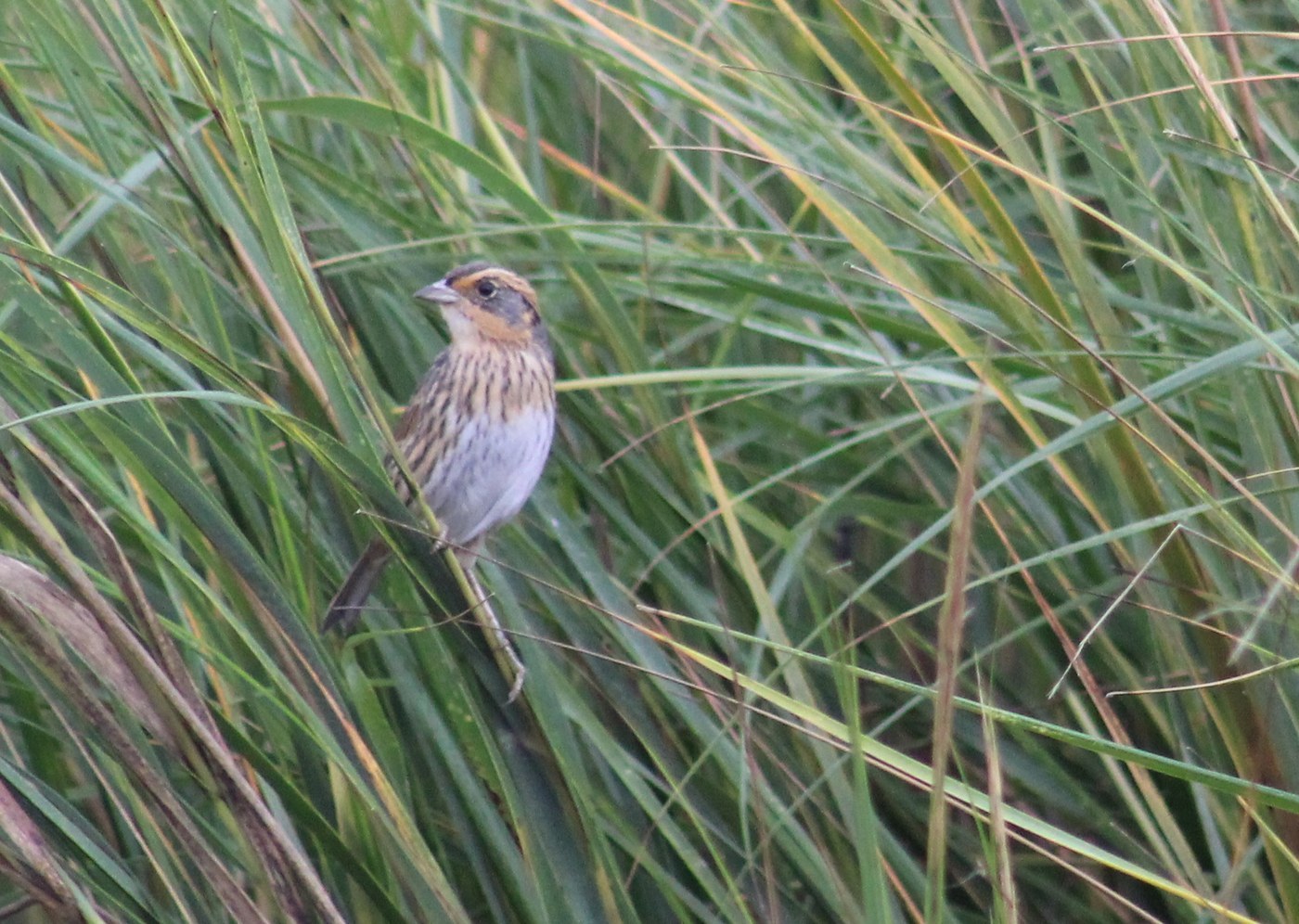
Key Field Marks
- Size & shape: A small, short-tailed sparrow with a flat-headed profile and a spiky, somewhat weak tail often held cocked or ragged-looking from marsh wear.
- Face pattern: Bright orange-buff triangle framing the gray cheek (auricular), bordered above by an orange supercilium and below by an orange malar/submoustachial area — the "orange horseshoe" is the single best mark.
- Crown: Gray central crown stripe bordered by dark lateral stripes, giving a somewhat capped look.
- Underparts: Buffy-white breast and flanks with fine, crisp dark streaking that does not converge into a central breast spot; belly is whitish and unstreaked.
- Bill & legs: Bill is fairly long and pointed for a sparrow; legs pale pinkish.
- Behavior: Extremely skulking — runs and creeps through cordgrass rather than flying, and when flushed flies low and drops back in quickly ("mouse-like").
Separating Saltmarsh Sparrow from Similar Species
- Nelson's Sparrow: Very similar and closely related (formerly considered conspecific as "Sharp-tailed Sparrow"). Nelson's shows a softer, more diffuse orange face pattern with blurrier breast streaking, a grayer nape, and generally shorter, more triangular bill; Saltmarsh has crisper, more defined streaking and a longer bill. Range and habitat overlap in migration but breeding ranges differ (Saltmarsh strictly Atlantic coast salt marsh; Nelson's breeds in interior/prairie marshes and Hudson Bay lowlands plus a narrow Atlantic coastal strip).
- Seaside Sparrow: Larger, darker, grayish-olive overall with a yellow supraloral spot (not full orange face) and a heavier bill; shares the same marsh habitat but looks noticeably larger and plainer.
- Song Sparrow: Larger, with a heavily streaked breast converging into a central spot, and lacks the orange facial pattern.
Where & When to See One
Saltmarsh Sparrow is a habitat specialist of Atlantic coast tidal salt marshes from Maine to Virginia in the breeding season, nesting low in Spartina cordgrass in a narrow band vulnerable to flooding. In winter it moves to coastal marshes from the mid-Atlantic south to Florida and the Gulf Coast. Best looked for by walking marsh edges at low tide or scanning during the highest "moon" tides, when birds are flushed into view along the marsh surface.
Voice
Song is a soft, insect-like, sputtering tup-tup-zheeeeeeee-chip, quiet and easily overlooked — quite unlike the musical songs of many other sparrows. Calls include a thin tsip.
Frequently asked questions
What is the easiest way to identify a Saltmarsh Sparrow?
Look for the bright orange face framing a gray cheek patch, combined with crisp dark breast streaking and a habit of skulking low in tidal cordgrass rather than perching in the open.
How do you tell a Saltmarsh Sparrow from a Nelson's Sparrow?
Saltmarsh Sparrow has crisper, sharper breast streaking, a more contrasting orange face, and a slightly longer bill; Nelson's Sparrow shows a softer, blurrier pattern overall and a shorter, more conical bill.
Where do Saltmarsh Sparrows nest?
They nest exclusively in Atlantic coast tidal salt marshes from Maine to Virginia, building low cup nests in Spartina cordgrass that are highly vulnerable to flooding from high tides.
Why is the Saltmarsh Sparrow considered vulnerable?
Rising sea levels and marsh loss are flooding nests before chicks can fledge, causing steep population declines, which is why it is treated as a high-priority conservation species.
What time of day is best for finding Saltmarsh Sparrows?
Visit tidal marshes around a rising or high tide, especially during monthly spring tides, when birds are pushed up out of dense cordgrass and become easier to spot briefly in the open.