
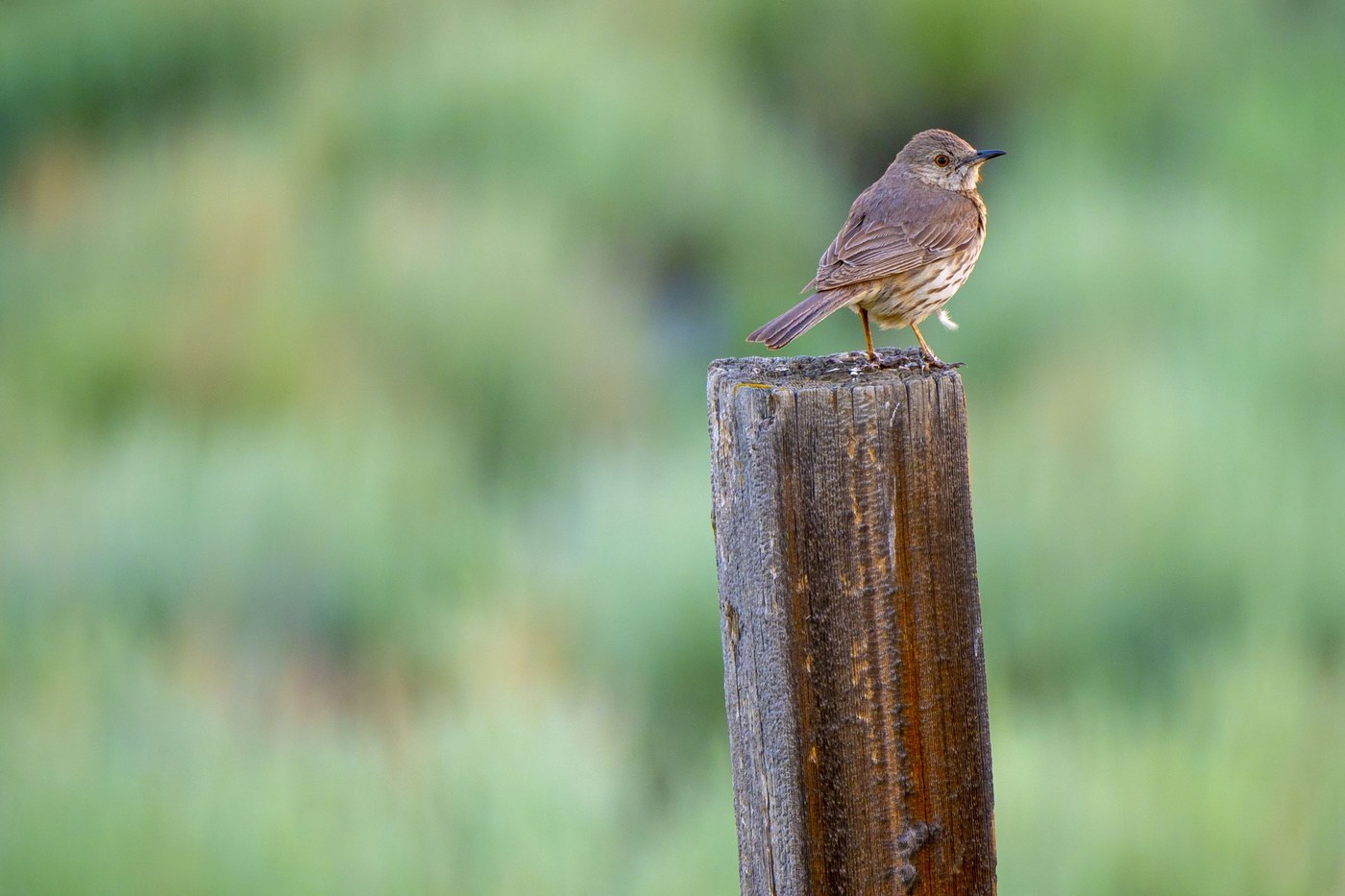
Sage Thrasher
Oreoscoptes montanus
The smallest thrasher and a sagebrush-obligate songster of the arid interior West, singing long warbling songs from atop shrubs.
- Size
- 20-22 cm (8-8.5 in) long
- Habitat
- sagebrush steppe and shrub-steppe of the arid interior West
- Type
- songbird
Spotted a bird like this?
Identify any bird from a photo, free.
Overview
The Sage Thrasher is the smallest and least strongly curved-billed member of the thrasher family, closely tied to the vast sagebrush landscapes of the interior western United States. Unlike its larger, long-billed relatives, it has a comparatively short, only slightly downcurved bill, giving it a more compact, thrush-like appearance.
Plumage is grayish-brown above with a heavily streaked breast on a whitish background, bright yellow eyes, and white corners visible in the tail during flight, all set against its favored backdrop of gray-green sagebrush.
How to identify it
Key field marks
- Small size and only slightly downcurved bill (much straighter than other thrashers)
- Grayish-brown upperparts
- Heavily streaked breast on white background
- Bright yellow eyes
- White corners on the tail, visible in flight
Similar species
Brown Thrasher is larger with a longer, more strongly curved bill, rufous (not grayish) upperparts, and heavier, bolder streaking. Northern Mockingbird lacks the streaked breast and has a different bill shape and behavior. Sage Thrasher's small size and short bill are the best clues within sagebrush habitat.
Habitat & range
Habitat
Sage Thrashers are strongly associated with extensive stands of big sagebrush and other arid shrub-steppe habitat, generally avoiding areas without a well-developed sagebrush component.
Range
The species breeds across the Great Basin and surrounding arid interior of the western United States, including parts of Washington, Oregon, Idaho, Nevada, Utah, Wyoming, Montana, and California. It winters in the southwestern US and Mexico.
Migration
Sage Thrashers are medium-distance migrants, withdrawing from northern and higher-elevation portions of the breeding range in fall to winter in warmer desert habitats farther south.
Behavior & voice
Behavior
Sage Thrashers forage mostly on the ground beneath and around sagebrush, taking insects and, especially outside the breeding season, berries and other fruit; they often run rather than fly between shrubs.
Voice
The song is a long, varied, warbling series of phrases delivered from the top of a sagebrush or other low perch, often continuing for extended periods and incorporating a wide variety of notes.
Nesting
Nests are built low within the dense branches of a sagebrush or other shrub, constructed as a bulky cup of twigs lined with softer material. Females lay 3-5 pale blue-green eggs marked with dark spots.
Frequently asked questions
How do you tell a Sage Thrasher from a Brown Thrasher?
Sage Thrasher is smaller with a short, only slightly curved bill and grayish-brown upperparts, while Brown Thrasher is larger with a long, strongly curved bill and rufous upperparts.
Where does the Sage Thrasher live?
It is closely tied to sagebrush steppe habitat across the Great Basin and arid interior of the western United States.
What does a Sage Thrasher eat?
It eats mostly insects, along with berries and other fruit, especially outside the breeding season.
Is the Sage Thrasher the smallest thrasher?
Yes, it is the smallest member of the thrasher family found in North America.
Sage Thrasher guides
In-depth guides for identifying, finding, and understanding Sage Thrasher.
Other birds you may enjoy

Black Redstart
13-14.5 cm (5.1-5.7 in) long, 23-26 cm wingspan

Black-throated Sparrow
12-14 cm (4.7-5.5 in) long, about 19-20 cm (7.5-8 in) wingspan

Greater Bird-of-paradise
Body about 43 cm; males with additional flank plumes up to 50 cm and long tail wires

Blue Tit
11-12 cm (4.3-4.7 in) long, 17-20 cm wingspan

Red-billed Quelea
11.5–13 cm long, wingspan about 20–22 cm
White-plumed Antbird
13-14 cm (5-5.5 in) long

Pyrrhuloxia
19-22 cm (7.5-8.7 in) long, 30 cm wingspan

Blue-gray Tanager
16-18 cm (6-7 in) long

Blackburnian Warbler
11-13 cm (4.3-5.1 in) long, 20-22 cm wingspan

Bluethroat
13-14 cm (5.1-5.5 in) long, 20-22 cm wingspan

Eurasian Nuthatch
12-14.5 cm (4.7-5.7 in) long, 22.5-27 cm wingspan

Wood Thrush
19-21 cm (7.5-8.3 in) long, about 33 cm (13 in) wingspan