
Sage Thrasher Identification Guide
The smallest North American thrasher, a sagebrush-steppe specialist marked by bold breast streaking, a pale eye, and a relatively short, only slightly curved bill.
Read the full Sage Thrasher encyclopedia entry →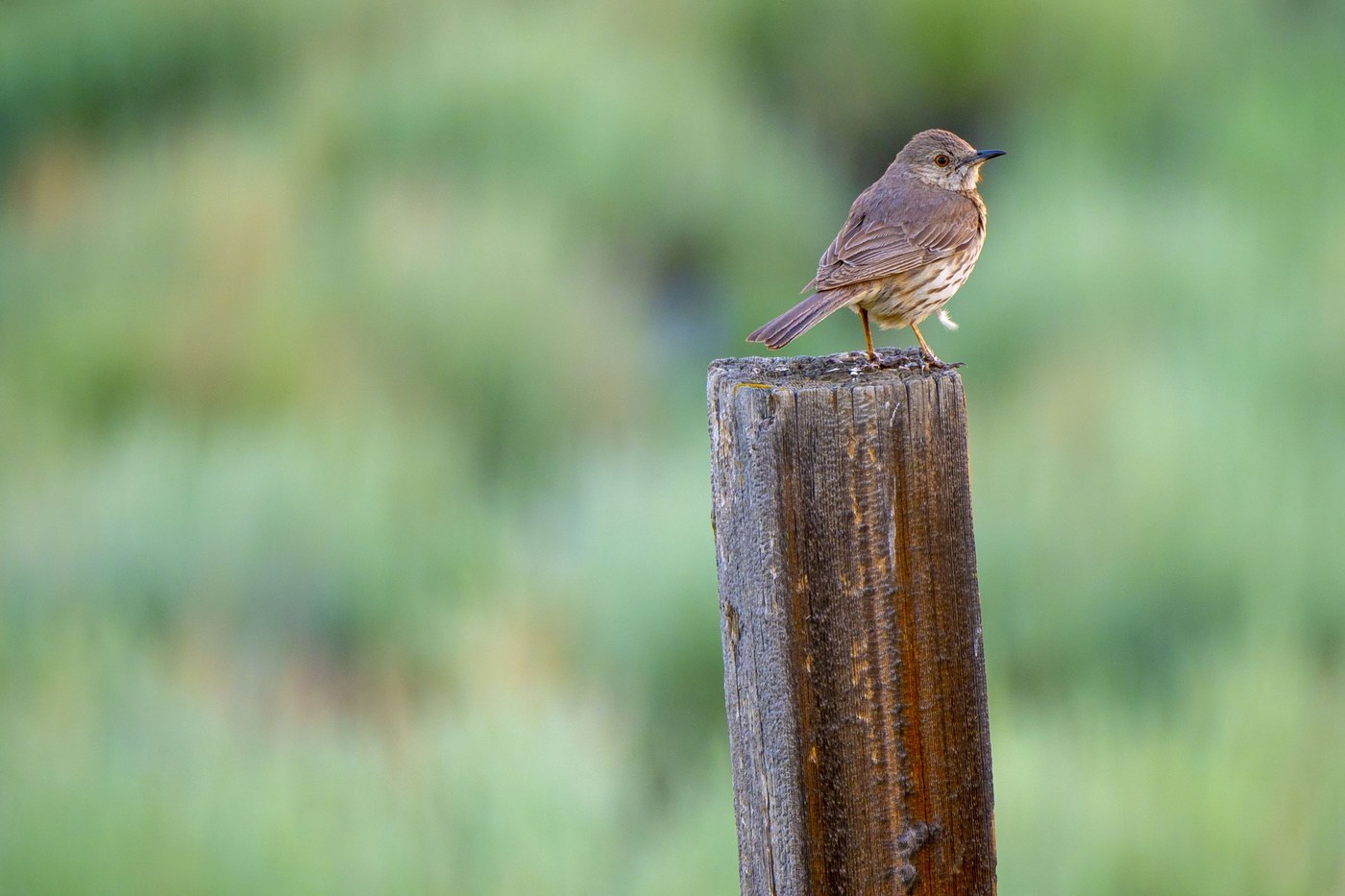
Key Field Marks
- Smallest of the North American thrashers, more compact and shorter-tailed than its larger relatives, with a relatively short bill that is only slightly curved (much less than in most other thrashers).
- Grayish-brown upperparts contrast with whitish underparts marked by bold, blackish streaking on the breast and flanks.
- Pale yellow eye stands out against the grayish head.
- Two white wing bars and white corners visible on the tail tip add extra field marks, especially useful in flight or when the tail is fanned.
- Often seen running or hopping on the ground with the tail cocked upward, or singing from an exposed perch atop a sagebrush shrub.
Similar Species
- Bendire's Thrasher: has a longer, more evenly curved bill and generally less distinct, more diffuse breast streaking; ranges overlap in parts of the Southwest.
- Sagebrush Sparrow / Bell's Sparrow: much smaller with a short conical sparrow bill, lacking the thrasher's larger size, longer tail, and pale eye.
- Northern Mockingbird: larger, plainer gray overall without the bold breast streaking, and has a longer tail with white outer tail feathers.
Habitat & Range
- Strongly tied to sagebrush steppe and shrub-steppe habitat of the Great Basin and Intermountain West of the United States and southern Canada during the breeding season.
- Winters in arid scrub and desert habitats of the southwestern United States and northern Mexico, generally in more open, sparser vegetation than the breeding grounds.
Voice
- Song is a long, musical, warbling series of varied phrases, often repeated in bursts, delivered from atop a sagebrush or other low shrub — less harsh and less mimicry-heavy than the song of the Northern Mockingbird.
- Calls include a soft chuck note given while foraging or when disturbed.
Best Times & Approach Tips
- Spring and early summer are best for hearing the full song from breeding males perched conspicuously atop sagebrush.
- Scan open sagebrush flats at ground level as well as shrub tops, since birds spend considerable time foraging and running between shrubs low to the ground.
Frequently asked questions
How can I tell Sage Thrasher from Bendire's Thrasher?
Sage Thrasher has a shorter, only slightly curved bill and bolder, more clearly defined breast streaking, while Bendire's Thrasher has a longer, more evenly curved bill and more diffuse streaking.
Is the Sage Thrasher the same as a mockingbird?
No, though related within the mimid family, Sage Thrasher is smaller, has bold breast streaking and a pale eye, and a different, less mimicry-based song than the Northern Mockingbird.
What habitat is essential for Sage Thrashers?
Sagebrush steppe and shrub-steppe habitat during the breeding season; the species is considered a sagebrush-obligate specialist across much of its range.
What does the Sage Thrasher's song sound like?
A long, musical, warbling series of varied notes delivered from an exposed perch atop a sagebrush shrub, generally more melodic and less harsh than a mockingbird's song.
Where does the Sage Thrasher spend the winter?
It winters in arid scrub and desert habitats of the southwestern United States and northern Mexico, after breeding in the sagebrush country of the Great Basin and Intermountain West.