
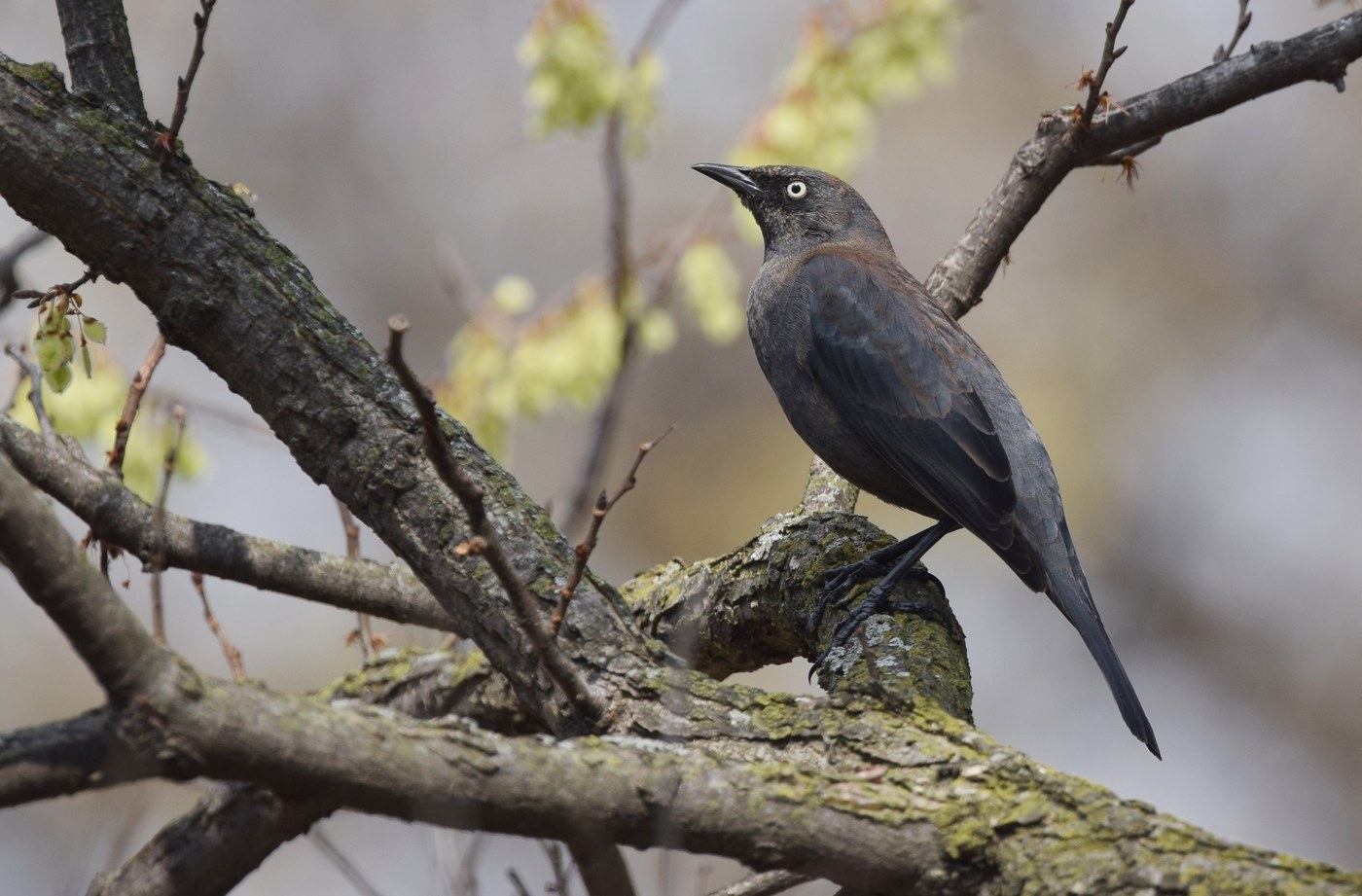
Rusty Blackbird
Euphagus carolinus
A boreal-breeding blackbird that turns rusty-edged in fall plumage, now one of the most steeply declining songbirds in North America.
- Size
- 22-24 cm (8.5-9.5 in) long
- Habitat
- wet boreal forest, bogs, and muskeg for breeding; wet woodlands and swamps in winter
- Type
- songbird
Spotted a bird like this?
Identify any bird from a photo, free.
Overview
The Rusty Blackbird is a boreal-forest specialist that has suffered one of the steepest population declines of any North American land bird over the past several decades, dropping by an estimated 85 to 95 percent, for reasons that remain only partly understood. Breeding males in spring are glossy black with pale yellow eyes, but by fall the plumage of both sexes becomes edged with warm rust-brown tones, giving the species its name.
Females are duller and grayer-brown than males even in breeding plumage, and in winter both sexes show a distinctly scaled, rusty-edged appearance quite different from their glossy spring look.
How to identify it
Key field marks
- Breeding male: glossy black plumage with pale yellow eyes
- Nonbreeding/fall plumage: rusty brown feather edges giving a scaled appearance, buffy eyebrow stripe
- Female: duller grayish-brown overall
- Slimmer build and thinner bill than a grackle
Similar species
Brewer's Blackbird lacks the rusty fall/winter feather edging and shows a cleaner glossy appearance with a purple-green sheen in males; female Brewer's is more uniformly plain gray-brown without the scaled rusty look. Common Grackle is larger with a longer, keeled tail.
Habitat & range
Habitat
Rusty Blackbirds breed in wet boreal forest habitats, including bogs, muskeg, and forested wetlands, often near beaver ponds or slow-moving streams. In winter they favor wet woodlands, swamps, and flooded bottomland forest.
Range
The species breeds across the boreal forest zone of Canada and Alaska. It winters primarily in the southeastern United States, in wet forested habitats from the mid-Atlantic south to the Gulf Coast.
Migration
Rusty Blackbirds are medium- to long-distance migrants, traveling between boreal breeding grounds and southeastern wintering areas; the causes of their dramatic population decline are thought to include loss of wetland habitat on both breeding and wintering grounds.
Behavior & voice
Behavior
Rusty Blackbirds forage in and around shallow water and wet leaf litter, flipping leaves to find insects and other invertebrates, and also eat seeds, particularly outside the breeding season; they are often found in small flocks in wooded wetlands.
Voice
The song is a squeaky, creaking series of notes, somewhat similar to a rusty hinge, though generally softer and more varied than Yellow-headed Blackbird's harsher song.
Nesting
Nests are built in shrubs or low conifers, often near water, constructed as a bulky cup. Females lay 3-5 pale blue-green eggs with dark markings.
Frequently asked questions
Why is the Rusty Blackbird declining so steeply?
Populations have dropped an estimated 85 to 95 percent over recent decades, likely due to a combination of loss of wetland habitat on its boreal breeding grounds and its southeastern US wintering grounds, though the exact causes remain only partly understood.
How do you identify a Rusty Blackbird?
In fall and winter, look for rusty brown feather edges giving a scaled appearance; breeding males are glossy black with pale yellow eyes, similar to Brewer's Blackbird but with a thinner bill and less glossy sheen.
Where does the Rusty Blackbird breed?
It breeds in wet boreal forest habitats, including bogs and muskeg, across Canada and Alaska.
Where does the Rusty Blackbird spend the winter?
It winters mainly in wet forested habitats and swamps of the southeastern United States.
Rusty Blackbird guides
In-depth guides for identifying, finding, and understanding Rusty Blackbird.
Other birds you may enjoy

Black Redstart
13-14.5 cm (5.1-5.7 in) long, 23-26 cm wingspan

Black-throated Sparrow
12-14 cm (4.7-5.5 in) long, about 19-20 cm (7.5-8 in) wingspan

Greater Bird-of-paradise
Body about 43 cm; males with additional flank plumes up to 50 cm and long tail wires

Blue Tit
11-12 cm (4.3-4.7 in) long, 17-20 cm wingspan

Red-billed Quelea
11.5–13 cm long, wingspan about 20–22 cm
White-plumed Antbird
13-14 cm (5-5.5 in) long

Pyrrhuloxia
19-22 cm (7.5-8.7 in) long, 30 cm wingspan

Blue-gray Tanager
16-18 cm (6-7 in) long

Blackburnian Warbler
11-13 cm (4.3-5.1 in) long, 20-22 cm wingspan

Bluethroat
13-14 cm (5.1-5.5 in) long, 20-22 cm wingspan

Eurasian Nuthatch
12-14.5 cm (4.7-5.7 in) long, 22.5-27 cm wingspan

Wood Thrush
19-21 cm (7.5-8.3 in) long, about 33 cm (13 in) wingspan