
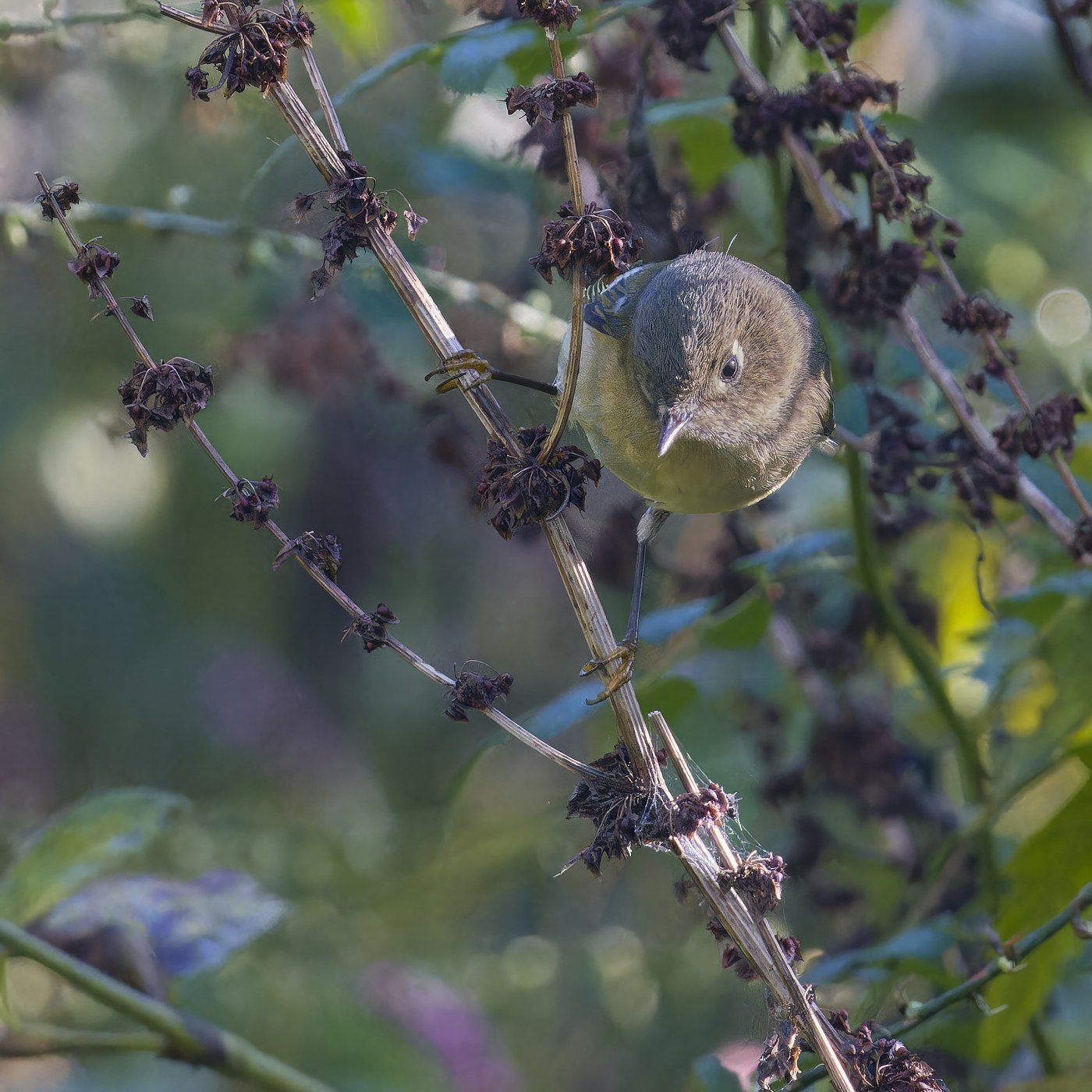
Ruby-crowned Kinglet
Corthylio calendula
A tiny, plain-faced olive-gray songbird with a bold white eye-ring and a surprisingly loud, rollicking song from a normally hidden red crown.
- Size
- 9-11 cm (3.5-4.3 in) long, 14-18 cm wingspan
- Habitat
- coniferous forests for breeding; woodlands, thickets, and gardens during migration and winter
- Type
- songbird
Spotted a bird like this?
Identify any bird from a photo, free.
Overview
The Ruby-crowned Kinglet is a diminutive, plain-faced songbird that packs an outsized voice into a body barely larger than a hummingbird. Its plumage is olive-gray overall, slightly brighter and more yellowish on the wings, with two white wingbars, the lower one bordered by a black bar.
The male's namesake ruby-red crown patch is usually concealed beneath the surrounding olive feathers and flashed only during excitement, aggression, or courtship, making the plain face with its bold white eye-ring the more reliable field mark day to day. Despite its tiny size, this kinglet delivers one of the loudest, most exuberant songs of any small songbird.
How to identify it
Key Field Marks
- Plain olive-gray face with a bold, complete white eye-ring (no dark eyeline)
- Two white wingbars, with a black bar just below the lower one
- Red crown patch in males, usually hidden and flashed only when excited
- Constant wing-flicking while foraging
- Small, stubby dark bill
Similar Species
Golden-crowned Kinglet shows a bold black-and-white striped face pattern and a crown patch (yellow or orange) that is visible far more often, lacking the plain-faced, bold eye-ring look of Ruby-crowned. Hutton's Vireo is superficially similar in plumage but is bulkier, slower-moving, and has a thicker, hook-tipped bill compared to the kinglet's thin bill and hyperactive foraging style.
Habitat & range
Habitat
Ruby-crowned Kinglets breed in coniferous and mixed boreal and montane forests, often near spruce, fir, or pine. During migration and winter, they range much more broadly into deciduous woodlands, thickets, chaparral, and even suburban gardens.
Range
This species breeds across the boreal forest of Canada and Alaska and south through mountainous conifer forests of the western United States. It winters across the southern and coastal United States, Mexico, and Central America.
Migration
Ruby-crowned Kinglets are medium-distance migrants, vacating most of their northern breeding range in winter and moving to a broad wintering range across the southern half of the continent and beyond.
Behavior & voice
Behavior
This kinglet is almost never still, hopping restlessly through foliage and flicking its wings rapidly as it forages, often at eye level or lower during migration, unlike the more canopy-bound Golden-crowned Kinglet.
Voice
The song is remarkably loud and complex for such a small bird, beginning with thin high notes, shifting to lower burry notes, and ending in a rollicking, chanting warble. The call is a scratchy, husky 'ji-dit.'
Feeding
It gleans tiny insects and spiders from leaves and twigs, frequently hovering to pick prey from foliage tips, and will also eat berries and tree sap, especially in winter.
Nesting & Breeding
The female builds a deep, spherical hanging nest of moss, lichen, and spider silk suspended from conifer branches, well concealed high in the canopy. She lays a large clutch, typically 5-12 tiny eggs, one of the largest clutch sizes relative to body size among North American songbirds.
Frequently asked questions
Why is the Ruby-crowned Kinglet's red crown so hard to see?
The red crown patch on males is normally kept flattened and hidden beneath surrounding feathers, and is only raised and flashed during territorial disputes, courtship, or excitement.
How do you identify a Ruby-crowned Kinglet?
Look for a tiny, plain-faced olive-gray bird with a bold white eye-ring, white wingbars, and constant wing-flicking, without the striped face pattern of a Golden-crowned Kinglet.
What does a Ruby-crowned Kinglet eat?
It mainly eats tiny insects and spiders, supplemented by berries and tree sap, especially outside the breeding season.
Where does the Ruby-crowned Kinglet breed?
It breeds in coniferous and boreal forests across Canada, Alaska, and the mountainous western United States.
How many eggs does a Ruby-crowned Kinglet lay?
Females lay unusually large clutches for their size, often 5-12 tiny eggs in a single deep, hanging nest.
Ruby-crowned Kinglet guides
In-depth guides for identifying, finding, and understanding Ruby-crowned Kinglet.
Other birds you may enjoy

Black Redstart
13-14.5 cm (5.1-5.7 in) long, 23-26 cm wingspan

Black-throated Sparrow
12-14 cm (4.7-5.5 in) long, about 19-20 cm (7.5-8 in) wingspan

Greater Bird-of-paradise
Body about 43 cm; males with additional flank plumes up to 50 cm and long tail wires

Blue Tit
11-12 cm (4.3-4.7 in) long, 17-20 cm wingspan

Red-billed Quelea
11.5–13 cm long, wingspan about 20–22 cm
White-plumed Antbird
13-14 cm (5-5.5 in) long

Pyrrhuloxia
19-22 cm (7.5-8.7 in) long, 30 cm wingspan

Blue-gray Tanager
16-18 cm (6-7 in) long

Blackburnian Warbler
11-13 cm (4.3-5.1 in) long, 20-22 cm wingspan

Bluethroat
13-14 cm (5.1-5.5 in) long, 20-22 cm wingspan

Eurasian Nuthatch
12-14.5 cm (4.7-5.7 in) long, 22.5-27 cm wingspan

Wood Thrush
19-21 cm (7.5-8.3 in) long, about 33 cm (13 in) wingspan