
Ruby-crowned Kinglet Identification Guide
One of North America's smallest songbirds, this restless olive-green sprite is best known for its constant wing-flicking and its surprisingly loud, complex song.
Read the full Ruby-crowned Kinglet encyclopedia entry →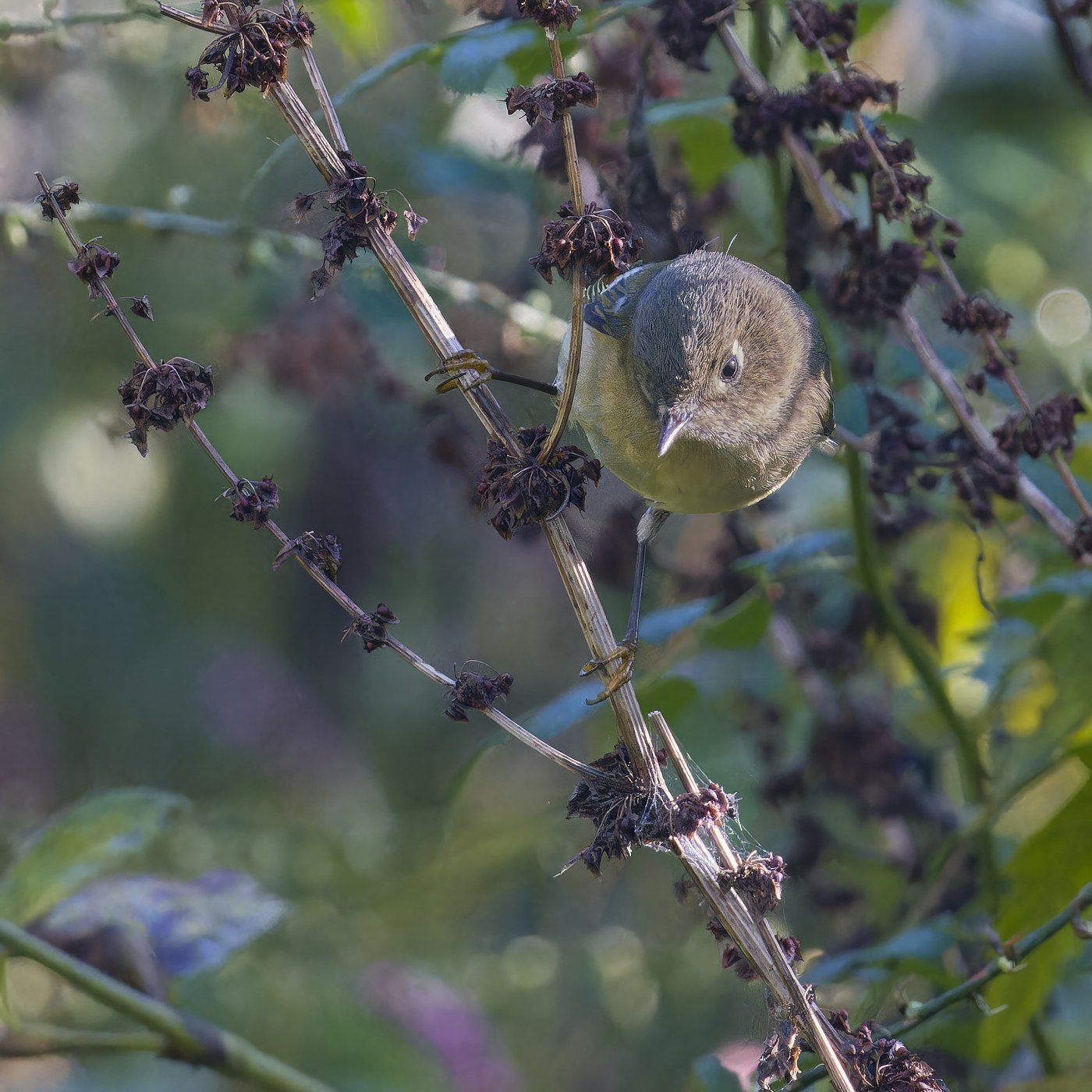
Key Field Marks
- Size & shape: Tiny, about 9–11 cm, plump-bodied with a short tail, short thin bill, and a large head relative to its body — among the smallest songbirds in North America.
- Plumage: Olive-green overall, slightly paler and grayer below; two whitish wingbars on each wing, with a dark bar just behind (below) the lower, more prominent wingbar.
- Face: A bold, broken white eye-ring gives a "spectacled" appearance, rather than a solid eye-line or eyebrow stripe.
- Crown: Adult males have a scarlet-red crown patch that is usually concealed and only flashed into view when the bird is excited, agitated, or displaying — often not visible at all on a calm bird. Females lack the red patch entirely.
- Behavior as a field mark: Constant, nervous flicking of the wings while foraging is highly characteristic and often the first clue to the bird's identity, even before plumage details are seen.
Separating It From Similar Species
- Golden-crowned Kinglet: Has a bold black-and-white/orange-and-yellow striped crown that is always visible (not concealed), and a dark eyeline rather than a broken white eye-ring; Golden-crowned also tends to be found in denser conifer cover and is somewhat less prone to wing-flicking.
- Hutton's Vireo: Superficially very similar in plumage (olive, wingbars, pale eye-ring), but noticeably larger with a thicker, hook-tipped bill, slower and more deliberate movements, and no habitual wing-flicking.
- Female warblers and other small olive songbirds: The kinglet's tiny size, bold white eye-ring, double wingbars, and constant wing-flicking together separate it from confusable warblers.
Where and When to Find One
- Range: Breeds across boreal and montane coniferous forest in Canada, Alaska, and the mountainous western United States; winters across the southern and coastal United States, Mexico, and Central America.
- Habitat: Coniferous and mixed forest on the breeding grounds; a much wider range of habitats in winter and migration, including deciduous woodland, scrub, hedgerows, and gardens.
- Season: Present on breeding grounds in summer; widely encountered as a migrant and winter visitor across much of the U.S. from fall through spring.
Voice
- Song: Surprisingly loud, rich, and complex for such a tiny bird — typically starts with several thin, high, quiet notes, builds into a rolling warble, and ends with a repeated, chanting three-note phrase often rendered as "liberty, liberty, liberty."
- Call: A scratchy, wren-like "ji-dit" or "che-dit," often doubled, given year-round and useful for locating foraging birds in dense cover.
Frequently asked questions
How can you identify a Ruby-crowned Kinglet if you can't see its red crown?
Look for a tiny, plump olive-green bird with a bold broken white eye-ring, two white wingbars with a dark bar behind the lower one, and constant nervous wing-flicking — the red crown patch is often hidden and not needed for identification.
What is the difference between Ruby-crowned and Golden-crowned Kinglet?
Golden-crowned Kinglet shows a bold, always-visible black-and-yellow/orange striped crown and a dark eyeline, while Ruby-crowned has a usually concealed red crown (males only) and a broken white eye-ring instead of an eyeline.
Why does a Ruby-crowned Kinglet flick its wings so much?
Constant wing-flicking while foraging is a characteristic behavior of the species and is thought to help flush small insect prey; it is one of the most useful field clues for identifying the species even at a distance.
What does a Ruby-crowned Kinglet sound like?
Its song is unexpectedly loud and musical for its tiny size, beginning with thin high notes and building to a warbling chant that often ends in a repeated three-note "liberty, liberty, liberty" phrase; its call is a scratchy, doubled "ji-dit."