
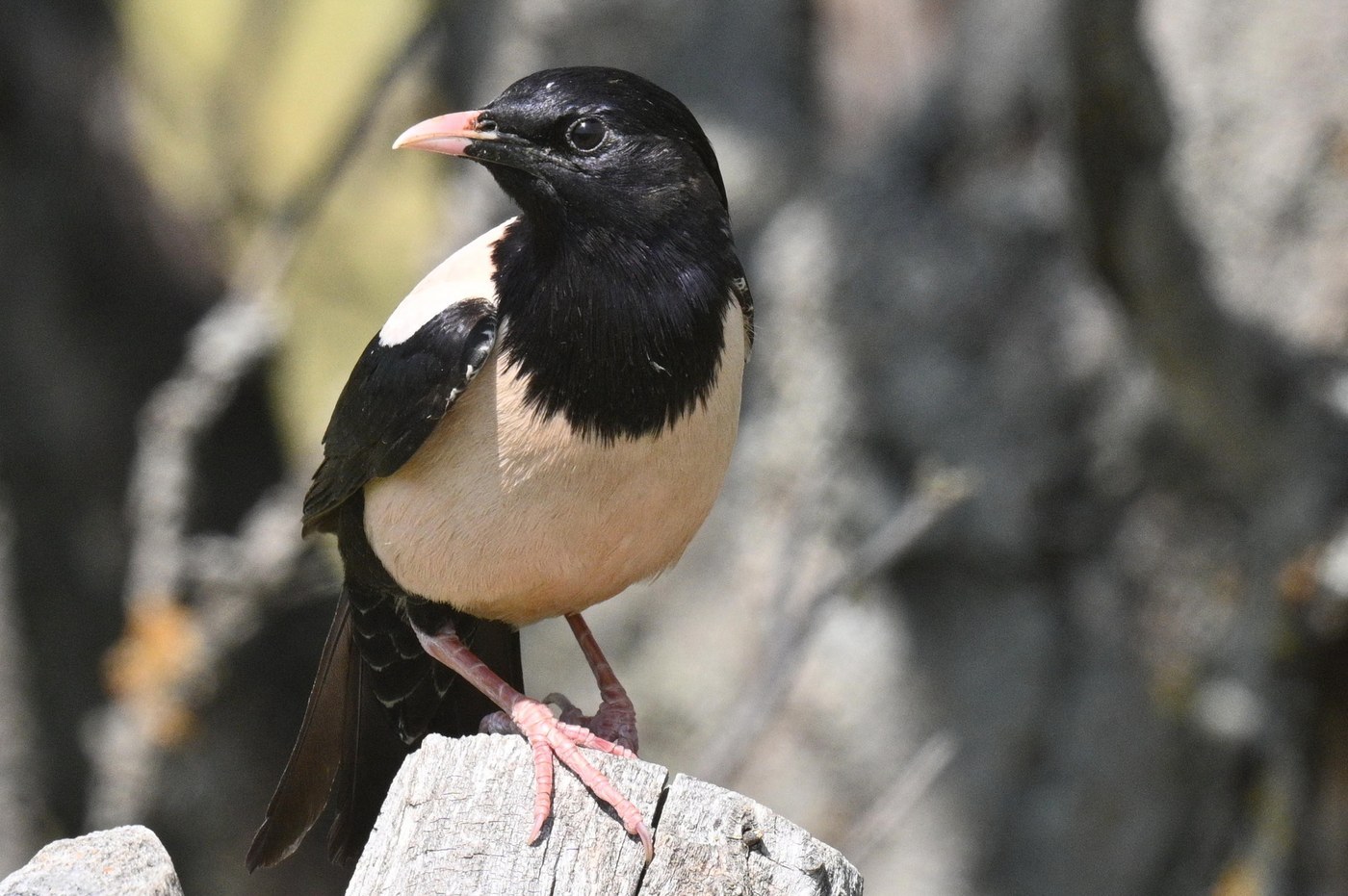
Rose-coloured Starling
Pastor roseus
A striking pink-and-black starling that breeds in huge, irruptive colonies often tied to outbreaks of locusts and grasshoppers.
- Size
- 19-22 cm (7.5-8.5 in) long, 37-40 cm wingspan
- Habitat
- steppe, grassland, and agricultural land, often near locust or insect outbreaks
- Type
- songbird
Spotted a bird like this?
Identify any bird from a photo, free.
Overview
The Rose-coloured Starling is an eye-catching bird combining bubblegum-pink body plumage with a glossy black head, breast, wings, and tail that gleam with purple and green iridescence. Breeding adults also sport a shaggy black crest on the back of the head. Non-breeding and juvenile birds are much duller, sandy-brown overall and easily overlooked among flocks of Common Starlings.
This species is famous for its irruptive, unpredictable breeding movements, appearing in huge numbers wherever locust or grasshopper populations boom, then vanishing from an area for years.
How to identify it
Key field marks
- Adult: bright pink body plumage contrasting sharply with glossy black head, breast, wings, and tail
- Shaggy black crest, most pronounced on breeding males
- Juvenile: plain sandy-brown overall with a pale yellowish bill, told from juvenile Common Starling by paler, sandier tone and stockier shape
- Stocky build with a shorter tail than Common Starling
Similar species
Adults are unmistakable. Juveniles can be confused with juvenile Common Starlings but are paler and sandier, with a less streamlined shape and a paler bill base.
Habitat & range
Range
Breeds erratically across the steppes of south-eastern Europe and Central Asia, with breeding locations shifting year to year depending on food availability. Winters mainly on the Indian subcontinent.
Habitat
Open steppe, dry grassland, and farmland, often congregating wherever there are large insect outbreaks, particularly locusts and grasshoppers.
Migration
An irruptive and nomadic migrant; individuals sometimes wander far outside the normal range, turning up as a rare vagrant across western Europe.
Behavior & voice
Behavior
Highly gregarious, nesting in dense colonies that can number in the thousands, often triggered by an abundance of locusts or grasshoppers. Colonies may form and disperse rapidly as food supplies change.
Voice
Calls include harsh, chattering notes similar to the Common Starling; the song is a scratchy, unmusical warble mixed with clicks and squeaks.
Feeding
A voracious insect predator, especially of locust swarms and grasshoppers, which it also feeds to its young; also eats fruit, berries, and nectar outside the breeding season.
Nesting and breeding
Nests colonially in rock crevices, stone piles, and building cavities. Lays 3-6 pale blue eggs; colonies can form explosively within days of a locust outbreak being located.
Frequently asked questions
Why does the Rose-coloured Starling appear in huge numbers some years and not others?
Its breeding movements are closely tied to outbreaks of locusts and grasshoppers, so it forms enormous colonies wherever such insect booms occur and may be absent from an area for years otherwise.
What color is a juvenile Rose-coloured Starling?
Juveniles are plain sandy-brown, lacking the pink-and-black adult pattern, and can be mistaken for juvenile Common Starlings.
Where does the Rose-coloured Starling spend the winter?
Most of the population winters on the Indian subcontinent.
Is the Rose-coloured Starling related to the Common Starling?
Yes, both belong to the starling family Sturnidae, though the Rose-coloured Starling is placed in its own genus, Pastor.
Rose-coloured Starling guides
In-depth guides for identifying, finding, and understanding Rose-coloured Starling.
Other birds you may enjoy

Black Redstart
13-14.5 cm (5.1-5.7 in) long, 23-26 cm wingspan

Black-throated Sparrow
12-14 cm (4.7-5.5 in) long, about 19-20 cm (7.5-8 in) wingspan

Greater Bird-of-paradise
Body about 43 cm; males with additional flank plumes up to 50 cm and long tail wires

Blue Tit
11-12 cm (4.3-4.7 in) long, 17-20 cm wingspan

Red-billed Quelea
11.5–13 cm long, wingspan about 20–22 cm
White-plumed Antbird
13-14 cm (5-5.5 in) long

Pyrrhuloxia
19-22 cm (7.5-8.7 in) long, 30 cm wingspan

Blue-gray Tanager
16-18 cm (6-7 in) long

Blackburnian Warbler
11-13 cm (4.3-5.1 in) long, 20-22 cm wingspan

Bluethroat
13-14 cm (5.1-5.5 in) long, 20-22 cm wingspan

Eurasian Nuthatch
12-14.5 cm (4.7-5.7 in) long, 22.5-27 cm wingspan

Wood Thrush
19-21 cm (7.5-8.3 in) long, about 33 cm (13 in) wingspan