
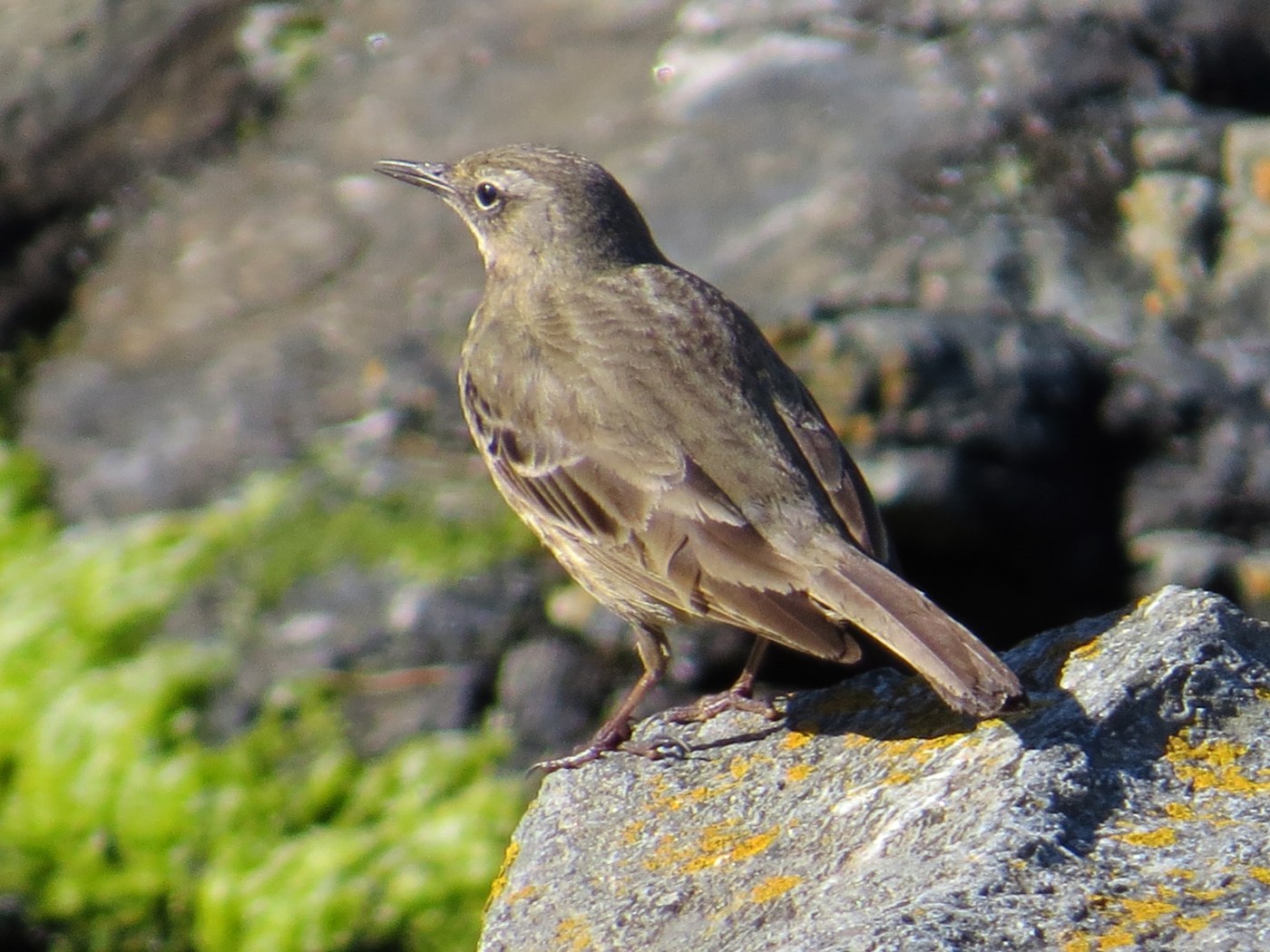
Rock Pipit
Anthus petrosus
A dark, streaky pipit found almost exclusively along rocky Atlantic and North Sea coastlines.
- Size
- 16-17 cm long; wingspan around 23-28 cm
- Habitat
- Rocky coastlines, sea cliffs, and shingle beaches of northwestern Europe
- Type
- songbird
Spotted a bird like this?
Identify any bird from a photo, free.
Overview
The Rock Pipit is a stocky, dark-plumaged pipit that is one of the few songbirds tied almost entirely to a coastal, rocky habitat rather than open farmland or grassland. It is larger and darker overall than its close relative the Meadow Pipit, with a heavier bill and a smoky-olive to grayish-brown back streaked with dusky markings.
Underparts are dull buffy-olive with blurred, diffuse streaking on the breast rather than the crisp, well-defined streaks seen in many other pipits. The legs are dark brownish rather than pink, and the outer tail feathers are dull grayish-white rather than bright white, both useful distinctions from similar species.
Sexes look alike. Juveniles resemble adults but can appear slightly more heavily marked below.
How to identify it
Key field marks
- Dark, sooty-olive upperparts with blurred streaking
- Diffuse, smudgy breast streaking (not crisp lines)
- Dark grayish-brown legs (not pink)
- Dull grayish outer tail feathers, not bright white
- Stout bill relative to other pipits
Similar species
- Meadow Pipit: smaller, paler, more olive-brown with crisper streaking, pink legs, and bright white outer tail feathers; usually found on open grassland/moorland rather than bare rock.
- Water Pipit (winter plumage): grayer overall with a whiter supercilium and cleaner underparts; breeds in mountains, not on sea rocks.
- Behavior is a strong clue: Rock Pipits are almost always seen bobbing and walking on wave-washed rocks, sea walls, or shingle right at the coast.
Habitat & range
Habitat
Rock Pipits are specialists of the immediate coastal zone, favoring rocky shorelines, sea cliffs, jetties, and shingle beaches where they forage in the intertidal zone.
Range
The species breeds along the coasts of the British Isles, Scandinavia, and parts of northwestern continental Europe, including Iceland and the Faroe Islands.
Migration
Most populations are resident or make only short-distance movements, though northern breeders (such as Scandinavian birds) may shift southward along coastlines in winter. Some birds move to sheltered estuaries and harbors outside the breeding season.
Behavior & voice
Behavior
Rock Pipits walk and run along rocks and seaweed-covered ledges, bobbing their tails frequently as they forage, much like other pipits. They are usually seen singly or in loose pairs, staying close to the shoreline.
Voice
The call is a thin, sharp "phist" or "phit," often given in flight and slightly harsher than the call of a Meadow Pipit. The song is a simple, accelerating trill delivered during a short display flight, ending with a slower, descending phrase as the bird parachutes down to a rock.
Feeding
They glean small invertebrates from rocks, seaweed wrack, and tide pools, including tiny crustaceans, insects, and mollusks exposed by the tide.
Nesting and breeding
Nests are built in crevices among rocks, in low vegetation on cliffs, or under overhangs close to the shore. The female lays 4-5 eggs, and both parents help feed the chicks, which fledge after roughly two weeks.
Frequently asked questions
Where do Rock Pipits live?
They live almost exclusively along rocky sea coasts of northwestern Europe, including Britain, Ireland, Scandinavia, and Iceland.
How do you tell a Rock Pipit from a Meadow Pipit?
Rock Pipits are darker, larger-billed, have dusky legs and dull gray outer tail feathers, and stick to rocky shorelines, while Meadow Pipits are paler with pink legs and bright white outer tail feathers and prefer grassland.
What do Rock Pipits eat?
They eat small invertebrates such as insects, tiny crustaceans, and mollusks found among rocks and seaweed in the intertidal zone.
Do Rock Pipits migrate?
Most are resident or move only short distances along the coast, though northern populations may shift south in winter.
What does a Rock Pipit sound like?
It gives a thin, sharp 'phist' call and sings a simple trilling song during a brief display flight over the shore.
Rock Pipit guides
In-depth guides for identifying, finding, and understanding Rock Pipit.
Other birds you may enjoy

Black Redstart
13-14.5 cm (5.1-5.7 in) long, 23-26 cm wingspan

Black-throated Sparrow
12-14 cm (4.7-5.5 in) long, about 19-20 cm (7.5-8 in) wingspan

Greater Bird-of-paradise
Body about 43 cm; males with additional flank plumes up to 50 cm and long tail wires

Blue Tit
11-12 cm (4.3-4.7 in) long, 17-20 cm wingspan

Red-billed Quelea
11.5–13 cm long, wingspan about 20–22 cm
White-plumed Antbird
13-14 cm (5-5.5 in) long

Pyrrhuloxia
19-22 cm (7.5-8.7 in) long, 30 cm wingspan

Blue-gray Tanager
16-18 cm (6-7 in) long

Blackburnian Warbler
11-13 cm (4.3-5.1 in) long, 20-22 cm wingspan

Bluethroat
13-14 cm (5.1-5.5 in) long, 20-22 cm wingspan

Eurasian Nuthatch
12-14.5 cm (4.7-5.7 in) long, 22.5-27 cm wingspan

Wood Thrush
19-21 cm (7.5-8.3 in) long, about 33 cm (13 in) wingspan